
AD/CVD: How Anti-Dumping & Countervailing Duties Work
Learn how importers can check AD/CVD duties, understand AD/CVD scope, find applicable rates and case numbers, and reduce compliance risks.
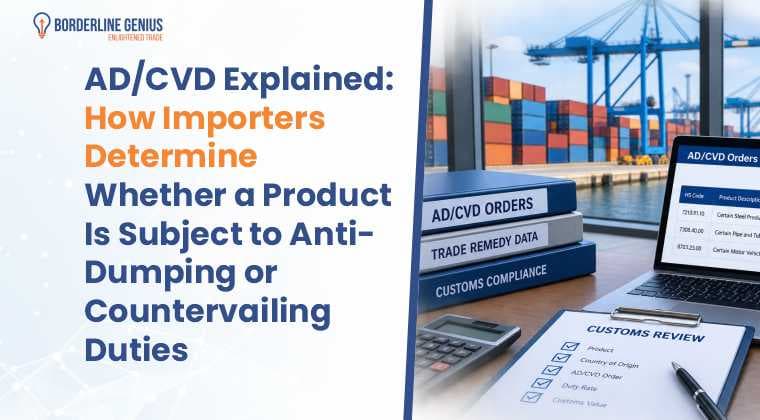
A product can have a standard U.S. tariff rate of 5%, 10%, or even 0% and still be subject to significant additional import duties. One reason is Antidumping and Countervailing Duties (AD/CVD).
AD/CVD measures are designed to address specific unfair trade situations. Antidumping duties can apply when foreign merchandise is sold in the United States at less than fair value, while countervailing duties address certain government subsidies benefiting imported merchandise.
For importers, the practical question is not simply:
"What is the tariff rate for this HS code?"
It is:
"Is my product covered by an AD/CVD order, and if so, what rate and requirements apply to my specific import?"
That question can be considerably harder to answer.
An importer may need to consider the product's characteristics, country of origin, manufacturer or exporter, HTS classification, the scope of the relevant order, case number, applicable cash-deposit rate, and current Commerce and CBP instructions.
This guide explains AD/CVD duties, how to check whether a product is subject to AD/CVD, what AD/CVD scope means, how rates are determined, and what importers should consider when managing AD/CVD compliance.
What Are AD/CVD Duties?
AD/CVD stands for:
-
AD - Antidumping Duty
-
CVD - Countervailing Duty
They are U.S. trade-remedy measures administered primarily by the U.S. Department of Commerce, with the U.S. International Trade Commission (ITC) playing an important role in determining whether the domestic industry has suffered or is threatened with material injury.
Antidumping Duties
Antidumping duties address situations where imported merchandise is sold in the United States at less than its fair value, subject to the requirements of U.S. trade law.
The purpose is to address injurious dumping and provide relief to affected U.S. industries.
Countervailing Duties
Countervailing duties address certain imports that benefit from countervailable subsidies provided by a foreign government.
The resulting duty is intended to offset the amount of the countervailable subsidy determined under the applicable proceeding.
Commerce publishes AD/CVD investigations, determinations, and orders, while the ITC makes the required injury determinations as part of the process.
Why AD/CVD Matters to Importers
The biggest business risk is assuming that the standard tariff rate represents the full duty exposure.
Imagine an importer sees:
HTS duty rate: 5%
The importer calculates its landed cost using that 5% rate.
But suppose the product is also covered by an AD/CVD order.
The actual duty exposure could be substantially higher.
That can affect:
-
Landed cost
-
Product pricing
-
Supplier decisions
-
Sourcing strategy
-
Profit margins
-
Customs compliance
-
Import documentation
-
Cash-flow planning
For businesses importing large volumes, missing an applicable AD/CVD order can therefore become a significant financial and compliance problem.
AD vs CVD: What's the Difference?
|
|
Antidumping Duty (AD) |
Countervailing Duty (CVD) |
|
Addresses |
Dumping |
Countervailable subsidies |
|
Core issue |
Merchandise sold at less than fair value |
Government subsidies benefiting imported merchandise |
|
Administered by |
U.S. Department of Commerce |
U.S. Department of Commerce |
|
ITC role |
Determines injury |
Determines injury |
|
Can apply to |
Specific products and countries |
Specific products and countries |
|
Requires scope analysis? |
Yes |
Yes |
A product can be subject to AD only, CVD only, or both AD and CVD, depending on the applicable proceedings and orders.
What Is an AD/CVD Order?
An AD/CVD order establishes the merchandise, countries, and other conditions to which the relevant trade-remedy duties apply.
For an importer, the most important part is the scope.
Commerce defines the scope as the detailed description of the imported merchandise covered by an AD/CVD order. The scope can include technical and physical characteristics, exclusions, and HTS classification numbers.
This is important because the scope isn't simply:
"Everything under HTS code X."
It can be much more specific.
A scope description may refer to factors such as:
-
Product dimensions
-
Physical characteristics
-
Chemical composition
-
Materials
-
Product configuration
-
Manufacturing characteristics
-
Excluded products
-
Country of origin
-
Other technical characteristics
That is why AD/CVD compliance can require more analysis than a standard tariff lookup.
What Does "AD/CVD Scope" Mean?
AD/CVD scope is the description of the merchandise covered by an AD/CVD order.
It answers:
Which products are actually subject to this order?
Commerce explains that the written scope description is controlling, while the HTS classifications listed in the scope are included primarily as an aid for identifying potentially covered merchandise.
This distinction is critical.
The HTS code can help you find a potential order.
But:
The written scope determines whether the product is covered.
Therefore, an importer shouldn't stop after finding an HTS number that appears in an AD/CVD order.
The next step is to compare the actual product against the scope description.
Why an HTS Code Alone Isn't Enough
Suppose an importer has a product classified under:
HTS XXXXXXXXXX
The importer finds that HTS number listed in an AD/CVD order.
That doesn't automatically prove the product is subject to the order.
Conversely, a product may potentially fall within the written scope even if its HTS classification isn't one of the classifications listed.
Commerce explicitly states that the written scope controls and that inclusion or exclusion of an HTS classification does not determine whether merchandise falls within the scope.
This leads to an important principle:
Use the HTS classification to identify potential AD/CVD exposure, but use the scope language to determine whether the product is actually covered.
How to Check Whether a Product Is Subject to AD/CVD
Importers can use a structured process rather than simply searching for a tariff code.
Step 1: Identify the Product
Start with a detailed understanding of the merchandise.
Collect information such as:
-
Product description
-
Materials
-
Physical characteristics
-
Dimensions
-
Technical specifications
-
Manufacturing process
-
Intended use
-
Product configuration
-
Country of origin
-
Manufacturer
-
Exporter
The more specific the product, the more important the underlying product information becomes.
A generic description such as:
"Steel component"
may not be enough to confidently evaluate AD/CVD scope.
A detailed description of the component's material, dimensions, construction, function, and manufacturing characteristics provides a much stronger basis for comparison.
Step 2: Determine the Correct HTS Classification
Next, determine the appropriate U.S. HTS classification.
This provides an important starting point for identifying potential AD/CVD orders.
The Department of Commerce's AD/CVD search system allows users to search by country, product, case number, HTS number, or commodity.
This makes the HTS classification a useful discovery tool.
But remember:
HTS match ≠ automatic AD/CVD applicability.
You still need to evaluate the scope.
Step 3: Search for Relevant AD/CVD Orders
Once you have the product and HTS classification, search for applicable AD/CVD proceedings and orders.
Useful search inputs can include:
-
HTS number
-
Product
-
Country
-
Case number
-
Commodity
Commerce's AD/CVD Search portal provides public information about active proceedings, including HTS numbers and scope information.
CBP also maintains AD/CVD messages and resources used for administering these duties.
Step 4: Read the Scope of the Order
This is the step that should not be skipped.
Don't just look at:
HTS code → AD/CVD order found → Apply duty
Instead:
HTS code → Potential order → Read scope → Compare product characteristics → Determine applicability
The scope may contain both:
Included merchandise
Products that fall within the order.
Excluded merchandise
Products specifically excluded from the order.
Commerce explains that the scope can include a detailed product description as well as defined exclusions.
Step 5: Compare the Actual Product With the Scope
Now compare the product you are importing with the language of the order.
Consider:
-
Does the product have the required physical characteristics?
-
Does its material or composition match?
-
Do its dimensions fall within the described range?
-
Is the product specifically excluded?
-
Does the manufacturing process matter?
-
Does the country of origin fall within the order?
-
Are there other conditions described in the scope?
This is where AD/CVD research becomes a product-specific compliance exercise, rather than a simple tariff lookup.
Step 6: Identify the AD/CVD Case Number
Once a potentially applicable order has been identified, record the relevant AD/CVD case number.
Commerce assigns case numbers to AD/CVD proceedings, and its public systems allow users to search and access associated information.
A case number is valuable because it gives the importer a more precise way to identify the relevant proceeding, order, documents, and rates.
For example, a proceeding may have separate AD and CVD case numbers.
Maintaining those identifiers in your internal product or compliance records can make future reviews much easier.
Step 7: Determine the Applicable Duty Rate
Finding an AD/CVD order doesn't necessarily mean there is one universal rate for every importer.
Rates can depend on the applicable proceeding and, in some circumstances, the specific exporter or producer.
Commerce explains that final determinations and subsequent administrative reviews can affect duty collection and rates.
The relevant rate may therefore depend on information such as:
-
AD/CVD case
-
Country
-
Producer
-
Exporter
-
Applicable determination
-
Administrative review results
-
Other company-specific treatment
Commerce publishes case-specific information and cash-deposit rates through its AD/CVD resources.
This is why storing only:
Product → AD/CVD = Yes
is not enough.
A useful compliance record should also capture the applicable case and rate information.
Step 8: Check Current CBP Instructions
The Department of Commerce determines the scope and administers the AD/CVD proceedings, while CBP is responsible for enforcing the orders at the border and collecting the applicable duties.
Commerce explains that CBP uses the scope details at ports of entry to identify covered shipments and collect the appropriate financial deposits.
CBP also publishes AD/CVD messages and provides information for reporting and depositing AD/CVD amounts through ACE.
Therefore, checking the current CBP instructions and messages is an important part of an operational compliance process.
Step 9: Consider Whether a Scope Ruling Is Needed
Sometimes the scope isn't clear.
The product may appear similar to merchandise covered by an order, but the importer may not be able to determine confidently whether it falls within the written scope.
In that situation, Commerce provides a scope ruling process.
A scope ruling is an official written determination from Commerce regarding whether specific merchandise falls within the scope of an AD/CVD order.
This is different from a normal HTS classification ruling.
Classification ruling
Determines the appropriate HTS classification.
Scope ruling
Determines whether merchandise falls within an AD/CVD order.
The two questions are related but legally distinct. CBP itself notes that Commerce's AD/CVD scope determinations are separate from CBP tariff-classification rulings.
A Simple AD/CVD Decision Process
You can think about the process like this:
1. What is the product?
↓
2. What is its HTS classification?
↓
3. Does an AD/CVD order potentially cover the product?
↓
4. What does the written scope say?
↓
5. Does the actual product match the scope?
↓
6. What is the applicable AD/CVD case?
↓
7. What rate applies to this importer/product?
↓
8. Are current CBP instructions being followed?
↓
9. If uncertain, is a scope ruling required?
This is fundamentally different from a standard:
HS code → tariff rate
lookup.
Example: Why Scope Matters
Imagine an importer purchases a product that falls under an HTS classification associated with an AD/CVD order.
A basic database search returns:
Potential AD/CVD order: Yes
The importer might assume:
"This product has AD/CVD duties."
But the order's scope could contain technical requirements that the product does not meet.
For example, the scope might define merchandise using particular:
-
Dimensions
-
Materials
-
Chemical composition
-
Physical characteristics
It may also contain explicit exclusions.
If the actual product falls outside the written scope, the HTS match alone does not establish that the merchandise is covered.
This is precisely why Commerce states that the written scope is controlling.
What Happens If a Product Is Subject to AD/CVD?
If merchandise is determined to be covered by an AD/CVD order, the importer may need to account for the applicable duties in addition to normal customs duties.
This can affect:
-
Import cost
-
Cash deposits
-
Landed cost
-
Product pricing
-
Margin calculations
-
Supplier selection
-
Customs entry processes
The importer may also need to provide additional information associated with the applicable AD/CVD entry requirements.
CBP maintains specific AD/CVD reporting instructions and special value fields for ACE entries.
This is why identifying AD/CVD exposure before the shipment arrives is preferable to discovering it during or after entry.
AD/CVD Rates Can Change
Another common mistake is treating an AD/CVD rate as permanent.
AD/CVD orders can undergo subsequent proceedings, including administrative reviews.
Commerce explains that administrative reviews can affect the collection of duties and applicable rates, while sunset reviews occur periodically to determine whether orders should remain in effect.
This means an importer should not assume:
"We checked this product last year, so the same AD/CVD rate applies today."
A reliable compliance process needs current data.
AD/CVD Circumvention Is Another Risk
AD/CVD exposure can also involve circumvention.
Commerce explains that circumvention can include situations such as merchandise completed or assembled in the United States or a third country using parts and components from a country subject to an order, minor alterations, or certain later-developed merchandise.
This matters for businesses with complex global supply chains.
Simply changing the location of final assembly does not necessarily eliminate AD/CVD exposure.
If a business changes:
-
Manufacturing location
-
Supplier
-
Assembly location
-
Product configuration
-
Production process
it may be worth reassessing the relevant AD/CVD exposure.
Common AD/CVD Compliance Mistakes
Mistake 1: Checking Only the Standard Tariff Rate
A product can have a normal HTS duty rate and still be subject to AD/CVD.
Mistake 2: Treating the HTS Code as the Final Answer
An HTS match can identify a potential order, but the written AD/CVD scope controls whether the merchandise is covered.
Mistake 3: Ignoring the Product's Technical Characteristics
AD/CVD scope descriptions can contain detailed physical and technical characteristics.
A generic product description may not be enough.
Mistake 4: Ignoring Country of Origin
AD/CVD orders can apply to specific countries and products.
The same product from another country may have different treatment.
Mistake 5: Assuming One Rate Applies to Everyone
Applicable rates can depend on the specific proceeding and company-specific treatment.
Mistake 6: Using an Old AD/CVD Rate
Administrative reviews and other proceedings can change the applicable duty rate.
Mistake 7: Treating Scope and Classification as the Same Question
Classification: What HTS code applies?
Scope: Is the merchandise covered by an AD/CVD order?
They are different compliance questions.
Mistake 8: Ignoring Changes to the Supply Chain
A change in manufacturing location, supplier, or processing can create a new AD/CVD question.
How to Build a Better AD/CVD Compliance Process
For businesses managing multiple products, a repeatable workflow is more reliable than checking AD/CVD exposure only when a shipment is being prepared.
A useful process can connect:
Product information
Detailed characteristics, materials, dimensions, specifications, and origin.
↓
Classification
Correct HTS classification.
↓
AD/CVD discovery
Identify potentially relevant orders using HTS, product, country, and case information.
↓
Scope analysis
Compare the actual product with the written scope.
↓
Case and rate
Record the applicable case number, rate, and relevant company treatment.
↓
Current status
Check current Commerce and CBP information.
↓
Documentation
Maintain the reasoning and supporting evidence.
This creates a more defensible process than maintaining a spreadsheet with a single column labeled:
"AD/CVD: Yes/No."
How Tariff Genius Helps With AD/CVD Compliance
For businesses managing large product catalogs and multiple import markets, manually checking AD/CVD exposure across government sources can become difficult to maintain.
Tariff Genius provides structured trade-compliance data mapped to HS codes, including Anti-Dumping Duty and Countervailing Duty information, case numbers, rates, and related compliance information.
This helps businesses move beyond a basic tariff-rate lookup.
Instead of asking only:
"What is the standard duty rate for this HS code?"
teams can investigate the broader compliance picture around the classification, including potential AD/CVD exposure.
The platform is designed to provide government-sourced compliance content and can be accessed through APIs, allowing businesses to integrate tariff and trade-compliance information into their own workflows and systems.
AD/CVD Compliance Checklist for Importers
Before importing potentially affected merchandise, ask:
Product
-
Do we have a detailed product description?
-
Do we know the material and physical characteristics?
-
Do we know the country of origin?
-
Do we know the manufacturer and exporter?
Classification
-
Is the HTS classification correct?
-
Have we used the classification to search for potential AD/CVD orders?
Scope
-
Did we read the written scope?
-
Does the actual product match the scope?
-
Did we check listed exclusions?
-
Are there technical characteristics that need to be evaluated?
Case and rate
-
Did we identify the relevant AD/CVD case number?
-
Did we verify the applicable rate?
-
Did we check whether exporter- or producer-specific treatment applies?
-
Did we check current administrative-review information?
Operational compliance
-
Did we check current CBP instructions?
-
Are applicable AD/CVD entry requirements being followed?
-
Is the classification and scope analysis documented?
Uncertainty
-
If the scope is unclear, have we considered a Commerce scope ruling?
The Bottom Line
AD/CVD compliance cannot be reduced to an HS code lookup.
The HS/HTS classification is an important starting point for finding potential orders, but it does not by itself determine whether merchandise is subject to an AD/CVD order.
Importers need to consider:
- Product characteristics
- HTS classification
- Country of origin
- AD/CVD order
- Written scope
- Case number
- Applicable rate
Current Commerce and CBP requirements
The most important principle to remember is:
The HTS code can help identify a potential AD/CVD order, but the written scope of the order controls whether the merchandise is covered. For companies importing significant volumes or managing large product catalogs, maintaining this information manually across multiple sources can become difficult.
Tariff Genius provides structured government-sourced tariff and trade-compliance data mapped to HS codes, including AD/CVD information, case numbers, rates, and other regulatory requirements. That gives businesses a more structured way to identify potential AD/CVD exposure and incorporate it into their broader trade-compliance workflow. The goal isn't simply to find the tariff rate. It's to understand the complete duty exposure before the goods cross the border.
Frequently asked questions
Navigate Global Trade With Greater Confidence
Access expert guidance to help your organization address complex trade, classification, tariff, and compliance challenges.
Talk to a Trade ExpertRelated articles
Keep reading with more guidance on trade compliance and classification.
 Tariff GeniusTariffsImport Duty13 min read
How to Determine Import Duties and Tariffs Using an HS Code?
Learn how to calculate import duty from an HS code. Understand tariff rates, country of origin, customs value, preferential tariffs, and additional duties.
Read article 3 min read
USTR Announced New Section 301 Tariffs on Imports from 60 Countries and Economies
Learn about the USTR Section 301 tariff update affecting 60 countries, new 10% and 12.5% tariff rates, implementation dates, and importer implications.
Read article 7 min read
Parts, Accessories or Complete Articles? How to Classify Components Under the HS
Parts, accessories or complete articles? The decision sequence for classifying components under the HS: Section XVI notes, parts of general use, GRI 2(a).
Read article