
Parts, Accessories or Complete Articles? How to Classify Components Under the HS
Parts, accessories or complete articles? The decision sequence for classifying components under the HS: Section XVI notes, parts of general use, GRI 2(a).

The HS does not treat parts as a coherent category, and that is deliberate. Some chapters carry dedicated parts headings. Some notes send parts to be classified with the machine they belong to. Some notes remove parts from the section entirely. And many goods a manufacturer calls parts are named in headings in their own right, so they are never classified as parts at all. What follows is the sequence that resolves those cases, and what to record so it holds across a catalogue.
A gearbox, a hex bolt, a filter cartridge and a moulded carrying case can arrive on one purchase order, described on one invoice as "parts". Under the Harmonized System they land in four different chapters, on four different bases of reasoning, potentially at four different duty rates. The word "part" on the invoice determines none of it.
What Is the Correct Decision Sequence?
Work through these in order and stop at the first step that resolves the question. This is GRI 1 applied: the terms of the headings and the relative notes govern.
|
# |
Question |
Where the answer lives |
Effect if yes |
|
1 |
Is the article named in a heading in its own right? |
Heading texts; Section XVI Note 2(a) |
Classified there, not as a part |
|
2 |
Does a section or chapter note exclude it? |
Section and chapter notes |
Classified per the note's direction |
|
3 |
Is it a part of general use? |
Section XV Note 2 |
Classified in Section XV, or Chapter 39 for plastics equivalents |
|
4 |
Is it solely or principally used with one kind of machine? |
Section XVI Note 2(b); Section XVII Note 3; Chapter 90 Note 2(b) |
Classified with that machine |
|
5 |
None of the above |
Section XVI Note 2(c) and equivalents |
Residual parts heading |
Steps 1 to 3 dispose of far more components than importers expect. A bolt, a spring, a tube fitting and a padlock never reach step 4.
How Do the Section XVI Notes Work?
Section XVI covers Chapters 84 and 85, so it governs machinery, mechanical appliances and electrical equipment. Its parts framework is the most heavily used in the nomenclature. Chapter 90 and Section XVII are built differently.
Note 2 opens by making itself subordinate: it applies "Subject to Note 1 to this Section, Note 1 to Chapter 84 and to Note 1 to Chapter 85", and does not reach parts of the articles of headings 84.84, 85.44, 85.46 or 85.47. Within that, three limbs run in order:
-
Note 2(a). Parts which are goods included in any heading of Chapter 84 or 85 are "in all cases to be classified in their respective headings". A pump built into a machine tool is still a pump.
-
Note 2(b). Other parts suitable for use solely or principally with a particular kind of machine, or with several machines of the same heading, go with the machines of that kind or to the listed residual parts headings. Special routing applies to parts equally suitable for use principally with goods of headings 85.17 and 85.25 to 85.28.
-
Note 2(c). All other parts fall to headings 84.09, 84.31, 84.48, 84.66, 84.73, 85.03, 85.22, 85.29 or 85.38 as appropriate, and failing those to 84.87 or 85.48.
Note: "solely or principally" is a test about the class of goods, not the individual shipment. The evidence is design, marketing and sales distribution, not the customer's stated intention.
What Are "Parts of General Use"?
This is the concept that removes the largest block of hardware from parts treatment. Section XV Note 2 defines it once, for the whole nomenclature:
-
Articles of headings 73.07, 73.12, 73.15, 73.17 or 73.18, and similar articles of other base metal: tube and pipe fittings; stranded wire, ropes, cables and slings; chain; nails, tacks and staples; screws, bolts, nuts, rivets and washers.
-
Springs and leaves for springs, of base metal, other than clock or watch springs.
-
Articles of headings 83.01, 83.02, 83.08 and 83.10, and frames and mirrors of base metal of heading 83.06: locks and keys, mountings and fittings, clasps, buckles and eyelets, and sign and name plates.
A stainless bolt machined to a drawing and stocked under an equipment maker's own part number is still a bolt of heading 73.18, put outside Section XVI by Note 1(g) and outside the vehicle and aircraft provisions by Section XVII Note 2.
What Is the Difference Between a Part and an Accessory?
A part is integral to the design of the article and necessary to its function. An accessory performs a secondary or subordinate role, improving effectiveness or adapting the article, without being necessary for it to work. The Canada Border Services Agency states the distinction in those terms in Memorandum D10-0-1.
Section XVI speaks only of parts. Chapter 90 and Section XVII speak of parts and accessories, so an article failing the parts test may still qualify there while failing entirely in Chapters 84 and 85. Dust covers, brackets and carrying straps get declared as parts out of habit.
When Do Components Become the Finished Article?
GRI 2(a) is the counterweight to all of the above. A heading referring to an article also covers it incomplete or unfinished, provided it has the essential character of the complete article as presented, and covers it presented unassembled or disassembled.
-
Essential character is assessed as presented. A frame is not a bicycle. Whether a kit missing one major component crosses the line turns on what the assembled goods are, not the proportion of components supplied.
-
"Unassembled" means simple fixing operations. Bolting, screwing, welding or riveting together complete components falls within GRI 2(a). Components requiring further machining or manufacturing do not, and shipping in pieces to reach a parts rate fails at exactly this point.
What Should Be Recorded at SKU Level?
Parts classification is reproducible only if the facts sit on the product record, not in the head of whoever is filing. Five fields carry most of the weight:
-
What the article is, in nomenclature terms. Not the internal part name. A "rotor assembly" is unclassifiable; an electric motor is a heading.
-
What it attaches to. The machine, its heading, and whether the parent sits in Chapter 84, 85, 87 or 90.
-
Whether it is necessary to function. The part-versus-accessory determination, with a one-line reason.
-
Whether use is sole or principal, and the evidence. Fitment data, drawings, catalogue listings.
-
Constituent material. This decides the parts-of-general-use question, and it is the field most often left blank.
Record which step resolved the classification and which note applied. That is what makes it defensible three years later.
Frequently asked questions
Navigate Global Trade With Greater Confidence
Access expert guidance to help your organization address complex trade, classification, tariff, and compliance challenges.
Talk to a Trade ExpertRelated articles
Keep reading with more guidance on trade compliance and classification.
 11 min read
Harmonized System and HS Codes: An In-Depth Guide for Trade Professionals
Learn how the Harmonized System works, understand HS codes, product classification, tariff determination, customs procedures, and international trade compliance.
Read article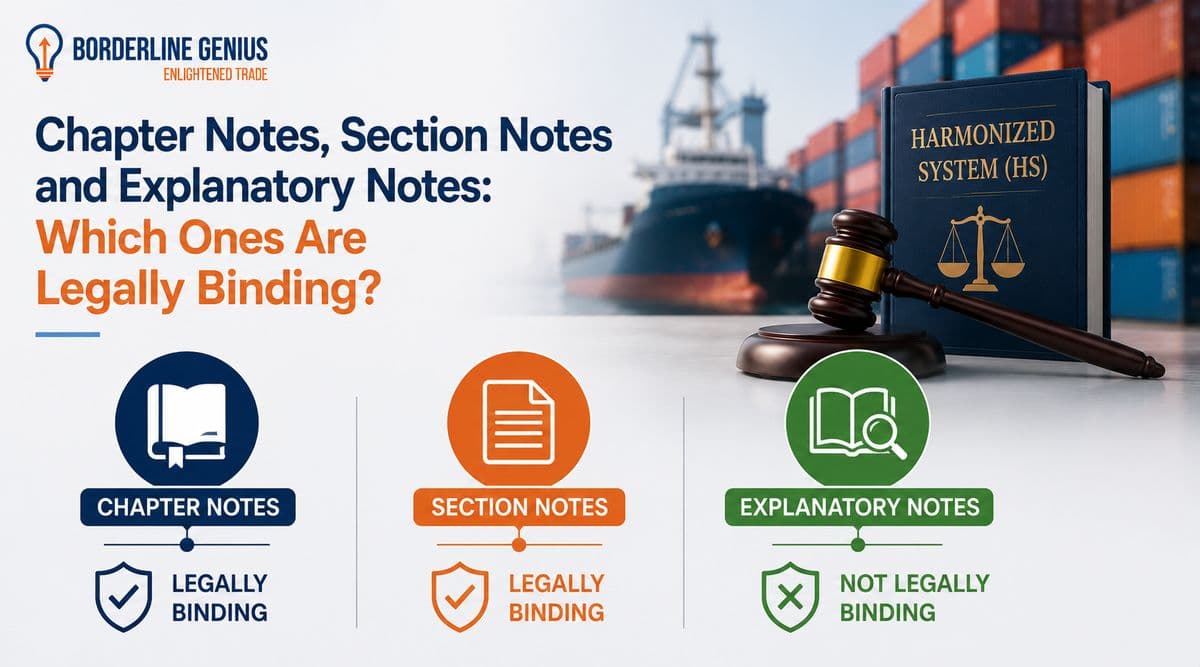 10 min read
Chapter Notes, Section Notes and Explanatory Notes: Which Ones Are Legally Binding?
Section and chapter notes are binding law. WCO Explanatory Notes are not. A clear hierarchy of HS interpretive authority, and what to do when they conflict.
Read article 12 min read
HS Sections and Chapters Explained: Understanding the Tariff Schedule
Learn how the Harmonized System is structured with a complete guide to its 21 Sections, 97 Chapters, and the classification principles that organize the tariff schedule.
Read article