
Chapter Notes, Section Notes and Explanatory Notes: Which Ones Are Legally Binding?
Section and chapter notes are binding law. WCO Explanatory Notes are not. A clear hierarchy of HS interpretive authority, and what to do when they conflict.
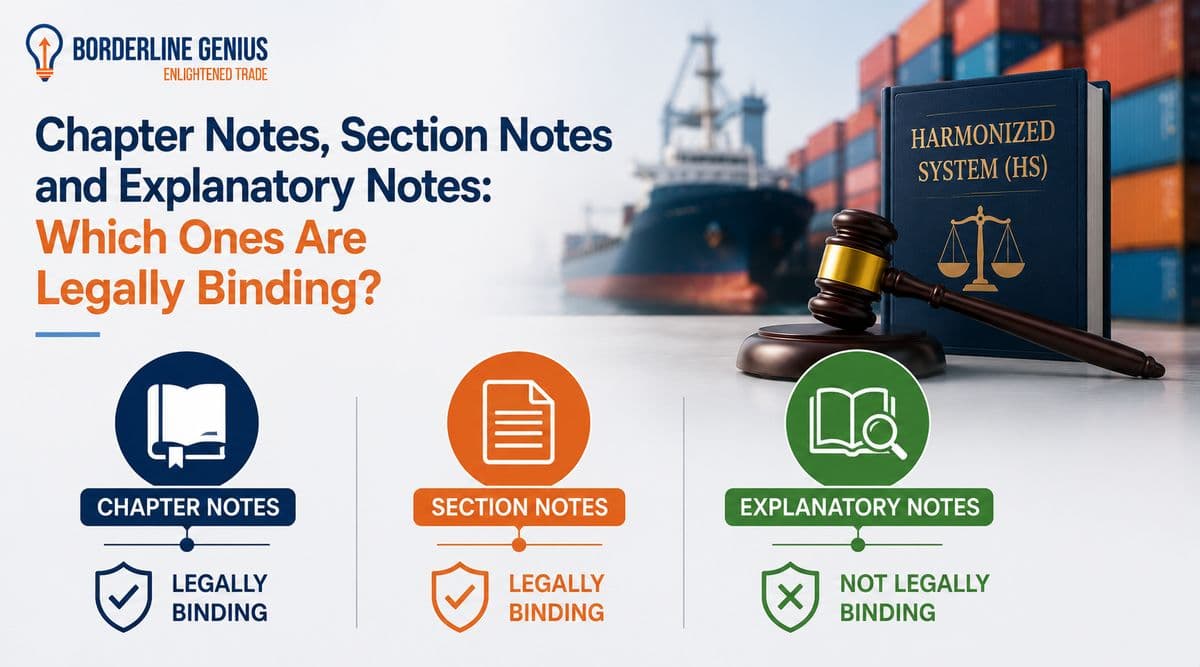
Correct tariff classification involves more than matching a product to a heading. The Harmonized System (HS) includes several interpretive materials: Section Notes, Chapter Notes, Subheading Notes, titles, WCO Explanatory Notes, Classification Opinions, and national customs rulings, but they do not all carry the same legal authority.
Some are part of the legal text of the Harmonized System and must be applied when classifying goods. Others provide guidance that helps interpret the nomenclature but does not have binding legal force. Treating these sources as though they are equal can lead to classification errors, customs disputes, and unnecessary compliance risks.
For example, a classification supported only by the HS Explanatory Notes may appear well researched, yet it can still fail if it conflicts with a legal note. By contrast, a classification based on the wording of a heading or a relevant Section or Chapter Note relies on provisions that customs authorities are required to apply.
Understanding this hierarchy allows importers, exporters, customs brokers, and trade compliance professionals to build classifications that are both technically accurate and legally defensible.
The Legal Text of the Nomenclature
Only certain parts of the Harmonized System have binding legal force at the international level. These provisions form the legal basis of tariff classification and take precedence over all interpretive guidance.
Heading Text
Classification begins with the wording of the four-digit heading under General Rule of Interpretation (GRI) 1. The heading defines the class of goods and serves as the primary determinant of classification. Every word, qualification, and punctuation mark should be considered, as small differences in wording can change the correct tariff classification.
Section and Chapter Notes
Section and Chapter Notes are legally binding because GRI 1 requires goods to be classified according to the terms of the headings and any relevant Section or Chapter Notes.
Rather than explaining the nomenclature, these notes form part of it. They may:
-
define technical terms used in a heading,
-
include products that would not otherwise fall within a heading,
-
exclude products that appear to belong in a heading, or
-
establish conditions that determine whether goods qualify for classification within a chapter or section.
Ignoring a relevant legal note can result in an incorrect classification even when the heading appears to describe the product accurately.
Subheading Notes
Once classification moves beyond the heading level, GRI 6 applies.
Subheading Notes perform the same function as Section and Chapter Notes but at the five- and six-digit level. They are equally binding and must be considered before selecting the final HS subheading.
Together, the heading text, Section Notes, Chapter Notes, and Subheading Notes form the legal text of the Harmonized System and are applied by all contracting parties to the HS Convention.
What Do Section and Chapter Notes Actually Do?
Many classification errors occur because the heading is considered in isolation while the relevant legal notes are ignored. In practice, these notes often determine the correct classification before competing headings are even compared.
They generally perform three functions.
They Define Terms
Many headings contain technical terms that differ from their ordinary meaning.
A legal note may define what qualifies as a "part," establish a purity threshold for chemicals, or clarify whether a material belongs to a particular category. Where a legal definition exists, it replaces the ordinary meaning of the term for classification purposes.
They Include Goods
Some legal notes broaden the scope of a heading by expressly including goods that the heading text alone would not clearly cover.
This ensures that products are classified consistently across all countries applying the Harmonized System.
They Exclude Goods
Legal notes can also remove products from a heading that would otherwise appear to fit.
For example, a heading may accurately describe a product, but a Chapter Note may specifically exclude that product and direct it to another chapter. In such cases, the legal note governs.
This illustrates a fundamental principle of HS classification: the legal notes always take precedence over assumptions based solely on the heading text.
What Is Not Binding: Titles and the Explanatory Notes
Not every document associated with the Harmonized System forms part of the law. While several reference materials play an important role in tariff classification, they cannot override the legal text.
Section, Chapter and Subchapter Titles
Section, Chapter and Subchapter titles exist solely to organise the nomenclature and make it easier to navigate.
GRI 1 states that these titles are "provided for ease of reference only." They help users locate headings but have no legal force.
A product belongs in a chapter because the heading and legal notes classify it there, not because the chapter title appears to describe it.
If a title conflicts with the wording of a heading or a legal note, the legal text always prevails.
The WCO Explanatory Notes
The WCO Explanatory Notes are the official interpretation of the Harmonized System published by the World Customs Organization. They explain how headings should generally be interpreted, describe the types of products covered by each heading, and provide practical guidance for applying the nomenclature.
Despite their importance, the Explanatory Notes do not form an integral part of the Harmonized System Convention. They are therefore not legally binding.
Instead, they are regarded as persuasive authority. Customs administrations frequently rely on them when interpreting the HS, but they are not required to follow them where the legal text leads to a different classification.
For that reason, the strongest classification decisions begin with the legally binding provisions in the heading text and relevant legal notes; and then use the Explanatory Notes to support or confirm the analysis rather than replace it.
What Weight Do Classification Opinions and Rulings Carry?
Between the binding legal text and non-binding interpretive guidance sits another category of authority: WCO Classification Opinions and national customs rulings. While neither changes the legal text of the Harmonized System, both can influence how goods are classified in practice.
Understanding their role helps distinguish evidence that is persuasive from authority that is legally binding.
WCO Classification Opinions
The Compendium of Classification Opinions records classification decisions adopted by the Harmonized System Committee for specific products.
Like the WCO Explanatory Notes, these opinions are not legally binding under the HS Convention. However, they represent internationally accepted classification practice for the products they address and are often treated as strong persuasive authority by customs administrations.
If your product closely matches one covered by a Classification Opinion, it provides valuable support for your classification. Conversely, departing from an Opinion usually requires a clear explanation of why the goods differ in their composition, characteristics, or intended use.
National Customs Rulings
Many customs administrations issue advance or binding tariff rulings to provide certainty before goods are imported.
Examples include:
-
Binding Tariff Information (BTI) issued in the European Union.
-
Binding tariff rulings issued by customs authorities in countries such as the United States, Canada, and Australia.
Unlike WCO guidance, these rulings have legal effect—but only within the jurisdiction that issued them and under that country's customs laws.
A national ruling generally binds:
-
the issuing customs authority,
-
the applicant or holder,
-
the goods described in the ruling, and
-
the period for which the ruling remains valid.
A ruling issued in one country does not automatically bind customs authorities elsewhere. For businesses operating internationally, foreign rulings should be viewed as persuasive evidence rather than universally applicable decisions.
The Hierarchy of Authority at a Glance
|
Instrument |
Binding? |
Purpose |
Authority |
|
Heading text |
Yes |
Primary determinant of classification |
Legal text (GRI 1) |
|
Section and Chapter Notes |
Yes |
Define, include and exclude goods |
Legal text (GRI 1) |
|
Subheading Notes |
Yes |
Govern classification at the five- and six-digit level |
Legal text (GRI 6) |
|
Section, Chapter and Subchapter Titles |
No |
Navigation aid |
"Ease of reference only" (GRI 1) |
|
WCO Explanatory Notes |
No |
Official interpretation of the HS |
Persuasive guidance |
|
WCO Classification Opinions |
No |
Decisions on specific products |
Strong persuasive authority |
|
National customs rulings |
Yes (nationally) |
Bind the issuing authority for the specified goods |
Domestic law |
The key principle is simple:
Start with the legal text. Use Explanatory Notes, Classification Opinions, and national guidance to support your analysis; not replace it.
What Do You Do When Two Sources Conflict?
Conflicts between HS interpretive materials do occur. A heading may suggest one classification, an Explanatory Note another, or a foreign customs ruling may appear inconsistent with the legal text.
When this happens, follow the hierarchy of authority rather than relying on the source that provides the most detailed explanation.
A Legal Note Overrides an Explanatory Note
If an Explanatory Note conflicts with a Section, Chapter, or Subheading Note, the legal note prevails because it forms part of the Harmonized System's legal text.
Heading Text and Legal Notes Override Titles
Section and Chapter titles are only navigation aids. They cannot expand, restrict, or override the wording of a heading or a legal note.
Foreign Customs Rulings Are Persuasive
A ruling issued by another country's customs authority may demonstrate how similar goods have been classified, but it does not bind customs authorities in other jurisdictions.
Classification Opinions Carry Significant Weight
Although not legally binding, Classification Opinions represent internationally accepted practice for specific products. If your goods closely match those considered by the HS Committee, an Opinion provides strong support for your classification.
Seek a Binding Ruling When Certainty Is Needed
Where classification remains uncertain or the commercial risk is significant, applying for a binding tariff ruling is the safest approach. A binding ruling provides legal certainty for the goods described and reduces the likelihood of future disputes or reassessments.
Conclusion
The Harmonized System contains several interpretive resources, but they do not all have the same legal status.
The heading text, Section Notes, Chapter Notes, and Subheading Notes form the legally binding framework for tariff classification. Every classification should begin with these provisions because customs authorities are required to apply them.
The WCO Explanatory Notes, Classification Opinions, and national customs rulings remain valuable tools for understanding and applying the nomenclature. However, they are intended to support the legal analysis; not replace it.
Knowing where each source sits in the hierarchy helps businesses build stronger tariff classifications, reduce compliance risk, and better defend their decisions during customs reviews or audits.
Frequently asked questions
Navigate Global Trade With Greater Confidence
Access expert guidance to help your organization address complex trade, classification, tariff, and compliance challenges.
Talk to a Trade ExpertRelated articles
Keep reading with more guidance on trade compliance and classification.
 7 min read
Parts, Accessories or Complete Articles? How to Classify Components Under the HS
Parts, accessories or complete articles? The decision sequence for classifying components under the HS: Section XVI notes, parts of general use, GRI 2(a).
Read article 17 min read
The General Rules of Interpretation (GRIs): How Goods are Actually Classified
The six General Rules of Interpretation govern every HS classification decision. Get a full walk-through of GRI 1 to 6, with worked examples and the errors that cost importers money.
Read article 12 min read
HS Sections and Chapters Explained: Understanding the Tariff Schedule
Learn how the Harmonized System is structured with a complete guide to its 21 Sections, 97 Chapters, and the classification principles that organize the tariff schedule.
Read article