
HS Sections and Chapters Explained: Understanding the Tariff Schedule
Learn how the Harmonized System is structured with a complete guide to its 21 Sections, 97 Chapters, and the classification principles that organize the tariff schedule.
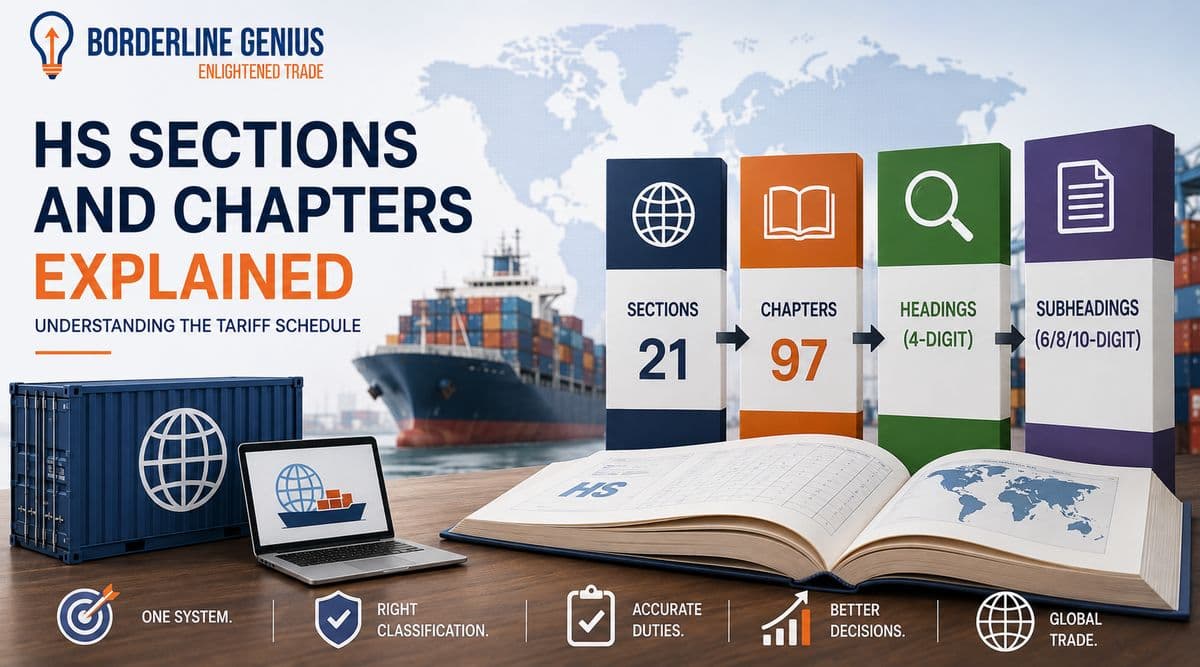
The Harmonized System (HS) is more than a list of product codes. Understanding HS Sections and Chapters begins with its structured classification framework, which organizes goods into Sections, Chapters, Headings, and Subheadings, allowing customs authorities worldwide to classify products consistently.
Beyond a list, the tariff schedule is a map. Products are arranged according to established classification principles. This makes it possible to narrow the search for the correct HS code before evaluating the relevant legal provisions.
Understanding this structure makes HS classification more systematic. It shows where to begin the search and how the different parts of the tariff schedule fit together before the legal rules to classify are applied.
How is the Harmonized System Structured?
HS, or the Harmonized System, follows a hierarchical structure in which each level narrows the classification from broad product groups to more specific categories. This HS code hierarchy begins with Sections before progressing to Chapters, Headings, and Subheadings.
-
Sections are the broadest level. There are 21 Sections, numbered I to XXI in Roman numerals, that group related Chapters. They help organize the tariff schedule but are not part of the HS code itself.
-
Within the Sections are 97 Chapters, numbered 01 to 97, which form the first two digits of every HS code. Chapter 77 is reserved for possible future use and is currently empty, leaving 96 active Chapters.
-
Each Chapter is divided into Headings (four digits), continuing the hierarchy of HS Sections and Chapters. The first two digits identify the Chapter, while the next two identify the Heading within that Chapter. For example, Heading 53.08 is the eighth Heading in Chapter 53.
-
Headings are further divided into Subheadings (six digits). The fifth digit identifies a one-dash subheading, while the sixth represents a two-dash subheading beneath it. A zero indicates that no further subdivision exists at that level.
-
The six-digit level marks the internationally harmonized portion of the HS. Every country applying the Harmonized System uses the same codes up to this point. Beyond six digits, each customs administration may introduce its own national subdivisions.
-
Note that the United States subdivides HS codes into eight-digit rate lines, which are legal, and 10-digit statistical reporting numbers, which the USITC describes as non-legal.
-
The European Union subdivides into eight-digit Combined Nomenclature codes, which are then broken down into 10-digit TARIC codes. They carry measures such as anti-dumping duties and suspensions.
-
Chapters 98 and 99 are not part of the Harmonized System. They are reserved for national purposes, such as special classification provisions or temporary legislative measures. Their content varies between countries.
How is the Tariff Schedule Organized?
The tariff schedule structure is based on the Harmonized System's classification principles. They arrange products by their degree of manufacture, material, economic activity, and function.
This nomenclature is arranged by degree of manufacture. As the World Customs Organization (WCO) explains, goods progress from raw materials to unworked and semi-finished items, and finally to finished products. Live animals appear in Chapter 1, hides and skins in Chapter 41, and leather footwear in Chapter 64. The same animal, at different stages of processing, appears in different Sections.
Note that this organization is supported by 3 additional classification principles:
Economic Activity: The first 24 Chapters (Sections I to IV) broadly cover agriculture and food products, while Sections V and VI cover products from the extractive and chemical industries.
Component Material: Sections VII to XV primarily classify products by the material from which they are made. These include plastics, rubber, leather, wood, paper, textiles, stone, glass, precious metals, and base metals. In case a product consists mainly of a single material, it is generally classified according to that material.
Function and Technological Complexity: From Section XVI onward, the classification shifts from material to function. Machinery, electrical equipment, vehicles, aircraft, precision instruments, and arms are classified by what they do rather than what they are made of. For example, a steel gearbox is not classified in Chapter 73.
The same progression appears throughout the Harmonized System. Within Section XI, textiles move from raw fibers to yarn, fabric, and finished garments. Within Chapter 84, the earlier Headings identify machinery by function, while the remaining Headings are generally organized by the industry the machine serves.
This structure provides a practical starting point for classification. Understanding the Harmonized System structure helps identify where products are likely to appear within the tariff schedule. Unprocessed and natural products are generally toward the beginning of the tariff schedule. Manufactured, assembled, and technologically complex products are toward the end.
What are the 21 HS Sections?
Goods in the Harmonized System are grouped into 21 HS Sections and Chapters, each covering a broad category of products. Together, these Sections form the highest level of the tariff schedule, helping users narrow down the correct Chapter before identifying the appropriate Heading and Subheading.
|
HS Section |
Chapters |
Products Covered |
|
I |
1–5 |
Live Animals and Animal Products: Meat and offal, fish and seafood, dairy, eggs, honey, and inedible animal products, excluding fats and oils, and hides and furskins |
|
II |
6–14 |
Vegetable Products: Live plants and cut flowers, vegetables, fruit and nuts, coffee, tea and spices, cereals, milling products, oil seeds, gums and resins, plaiting materials, excluding wood |
|
III |
15 |
A Single Chapter: Animal, vegetable or microbial fats and oils, their cleavage products, prepared edible fats and waxes |
|
IV |
16–24 |
Prepared Foodstuffs: Processed meat and fish, sugar, cocoa, cereal and bakery preparations, prepared fruit and vegetables, miscellaneous edible preparations, beverages and spirits, food-industry residues and animal feed, tobacco and nicotine products |
|
V |
25–27 |
Mineral Products: Salt, sulphur, stone, lime and cement; ores, slag and ash; mineral fuels and oils, bituminous substances and mineral waxes |
|
VI |
28–38 |
Products of the Chemical and Allied Industries: Inorganic and organic chemicals, pharmaceuticals, fertilisers, dyes and paints, essential oils and cosmetics, soaps and surfactants, enzymes and albuminoidal substances, explosives, photographic goods, miscellaneous chemical products |
|
VII |
39–40 |
Plastics and articles thereof; rubber and articles thereof |
|
VIII |
41–43 |
Raw hides, skins and leather; articles of leather, saddlery, travel goods and handbags; furskins and artificial fur |
|
IX |
44–46 |
Wood and articles of wood, wood charcoal; cork and articles of cork; manufactures of straw and other plaiting materials, basketware and wickerwork (wooden furniture belongs in Chapter 94) |
|
X |
47–49 |
Pulp of wood or other fibrous cellulosic material; paper, paperboard, and articles thereof; printed books, newspapers, and other products of the printing industry |
|
XI |
50–63 |
Textiles and Textile Articles, Sequenced by Material then by Degree of Manufacture: Silk, wool, cotton, other vegetable fibers, man-made filaments and staple fibers (50–55); special textiles, twine, carpets, coated fabrics and knitted fabrics (56–60); knitted apparel (61); non-knitted apparel (62); other made-up articles, sets, worn clothing and rags (63) |
|
XII |
64–67 |
Footwear; headgear; umbrellas, walking-sticks and whips; prepared feathers and down, artificial flowers, and articles of human hair |
|
XIII |
68–70 |
Articles of stone, plaster, cement, asbestos or mica; ceramic products; glass and glassware |
|
XIV |
71 |
A Single Chapter: Natural or cultured pearls, precious and semi-precious stones, precious metals, jewellery, imitation jewellery and coin |
|
XV |
72–83 |
Base Metals and Articles of Base Metal: Iron and steel and articles thereof, copper, nickel, aluminium, lead, zinc, tin, other base metals and cermets, tools and cutlery, miscellaneous articles of base metal; chapter 77 is reserved and empty, does not cover base-metal machinery or vehicles |
|
XVI |
84–85 |
Machinery and mechanical appliances, nuclear reactors and boilers (84); electrical machinery and equipment, sound and image recorders and reproducers (85) |
|
XVII |
86–89 |
Transport Equipment: Railway and tramway rolling-stock (86); motor vehicles and other land vehicles (87); aircraft and spacecraft (88); ships, boats and floating structures (89) |
|
XVIII |
90–92 |
Optical, photographic, cinematographic, measuring, checking, precision, medical and surgical instruments (90); clocks and watches (91); musical instruments (92) |
|
XIX |
93 |
A Single Chapter: Arms and ammunition, and parts and accessories thereof |
|
XX |
94–96 |
Miscellaneous Manufactured Articles: Furniture, bedding, luminaires, illuminated signs and prefabricated buildings (94); toys, games and sports requisites (95); other miscellaneous manufactured articles (96) |
|
XXI |
97 |
A Single Chapter: Works of art, collectors' pieces and antiques |
How Do You Use the Tariff Schedule to Classify Products?
Navigating the tariff schedule involves narrowing a product's classification from broad Sections to specific Headings and Subheadings. Understanding how to move through the HS code hierarchy helps identify the correct classification while ensuring the applicable legal rules and notes are considered at each stage.
-
Decide first whether the product is defined by its material or function. A moulded plastic bracket is a material question. A pump is a function question. That single distinction usually identifies which half of the tariff schedule to search.
-
Use the map to narrow the search to a Section, then to one or two candidate Chapters. Treat this as a starting point rather than the final classification.
-
Read the Heading text in full, including its punctuation and qualifying words.
-
Next, read the Section and Chapter Notes. These are legally binding. They define terms, include goods that the Heading text alone may not clearly cover, and, more often, exclude goods that initially appear to belong there.
-
Then move to the Subheading, comparing only Subheadings at the same dash level.
Why Don't Section and Chapter Titles Determine Classification?
Section and Chapter titles help users navigate the tariff schedule structure, but they do not determine a product's legal classification. As stated in the first sentence of GRI 1, these titles are provided for ease of reference only and have no legal force.
A product does not belong in Chapter 84 simply because the Chapter is titled Machinery. It belongs there because a Heading describes it and no Section or Chapter Note excludes it. The tariff schedule helps identify the correct area, while the legal notes determine the final classification.
The complete method to classify is set out in the General Rules of Interpretation (GRIs) of the Harmonized System.
Why are Exclusions Important in HS Classification?
Exclusions are an essential part of HS classification because they prevent products from being classified solely based on Section or Chapter titles. Instead, legal notes direct certain products to different parts of the tariff schedule.
For example, wooden furniture is not classified in the wood section, a steel machine part is not classified in the base metals section, and animal fats are not classified in the animal products section. In each case, a legal note directs the product elsewhere, showing why classification cannot rely on titles alone.
Note: Every exclusion note exists as a product appears to belong in one part of the tariff schedule but is legally classified elsewhere.
Why Do Many HS Chapters End with "Other"?
Many HS Chapters end with "Other" because the Harmonized System is designed to classify every product that crosses an international border. This ensures that even products not specifically described elsewhere can still be assigned an appropriate classification within the HS code hierarchy.
This is achieved through residual provisions. Chapters, Headings, and Subheadings include "Other" categories to capture products that are not covered by more specific provisions.
Wherever possible, these residual Subheadings are identified by the digit 9, or 8 when the final Subheading is reserved for parts. This allows new Subheadings to be added in future revisions without renumbering the existing classification structure.
This approach has 2 important implications:
-
First, assigning a product to a residual code is a valid classification outcome, provided no more specific provision applies.
-
Second, residual categories often accumulate a wide range of products between HS revisions, making them the most likely candidates for future subdivision. For example, products currently classified under broad "Other" provisions may be assigned dedicated Subheadings in the HS 2028 revision, which enters into force on 1 January 2028.
Conclusion
Understanding HS sections and chapters helps narrow the search for the correct classification. However, legal classification depends on the relevant Heading, Section and Chapter Notes, and the General Rules of Interpretation of the Harmonized System, not the titles alone. Together, they provide the legal and structural principles for classifying products correctly.
Frequently asked questions
Navigate Global Trade With Greater Confidence
Access expert guidance to help your organization address complex trade, classification, tariff, and compliance challenges.
Talk to a Trade ExpertRelated articles
Keep reading with more guidance on trade compliance and classification.
 7 min read
Parts, Accessories or Complete Articles? How to Classify Components Under the HS
Parts, accessories or complete articles? The decision sequence for classifying components under the HS: Section XVI notes, parts of general use, GRI 2(a).
Read article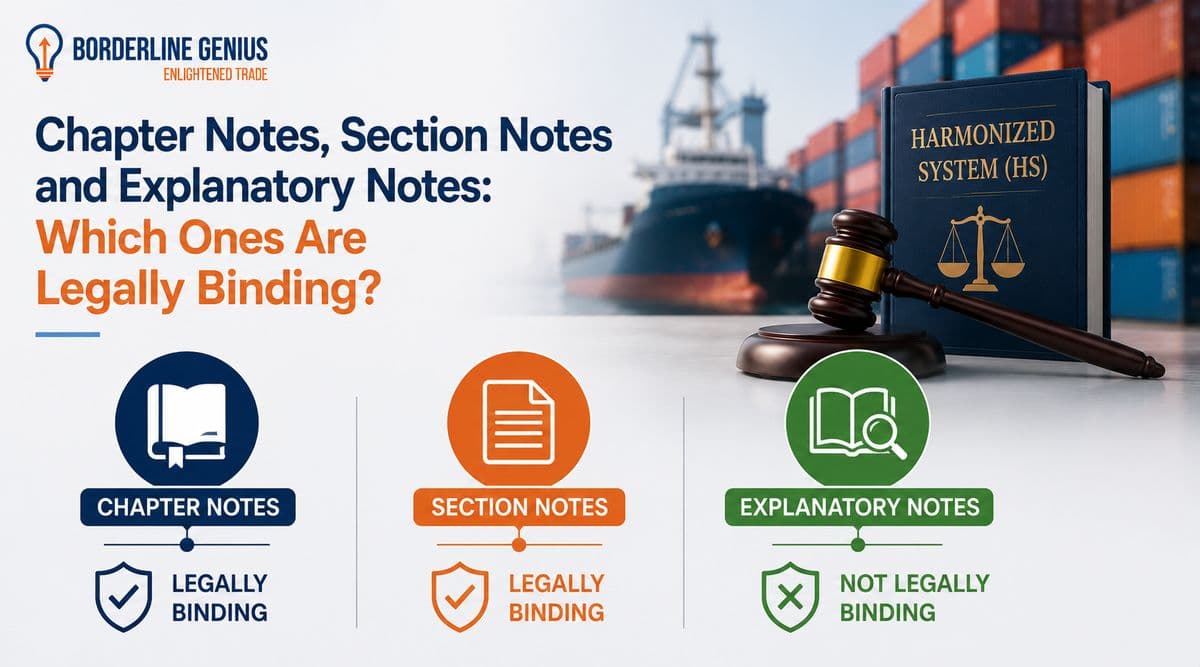 10 min read
Chapter Notes, Section Notes and Explanatory Notes: Which Ones Are Legally Binding?
Section and chapter notes are binding law. WCO Explanatory Notes are not. A clear hierarchy of HS interpretive authority, and what to do when they conflict.
Read article Classification GeniusHS ClassificationTrade Compliance6 min read
Automated HS Code Classification for Large Product Catalogs
Learn how automated HS code classification works for large product catalogs and how AI, bulk processing, APIs, and review workflows can improve classification.
Read article