
Harmonized System and HS Codes: An In-Depth Guide for Trade Professionals
Learn how the Harmonized System works, understand HS codes, product classification, tariff determination, customs procedures, and international trade compliance.
The Harmonized System (HS) is an internationally standardized framework used to classify goods traded globally. It forms the foundation of HS codes and serves an important role in customs procedures, tariff determination, regulatory compliance, and international trade documentation. Yet, despite its widespread use, certain businesses could remain unfamiliar with how this system works, why it matters, or how it influences the trade ecosystem.
As a result, products may not always be classified accurately. Even a small classification error can lead to incorrect duty calculations, customs delays, compliance issues, and unnecessary or costly expenses. Learning about this system is, therefore, essential for ensuring accurate codes that facilitate smooth shipping of goods.
This comprehensive guide covers the Harmonized System, HS codes, their structure, applications, and related concepts to help businesses understand product classification in depth.
What is the Harmonized System?
The Harmonized System (HS), officially known as the Harmonized Commodity Description and Coding System, is an internationally standardized framework for classifying goods traded across borders. Developed and maintained by the World Customs Organization (WCO), it provides a common language for identifying products in global trade.
-
Instead of relying on different product descriptions in every country, this system ensures that goods are consistently classified.
-
As a standardized approach, it creates a uniform method of identifying products for international commerce.
Note: The WCO is a global body helping customs authorities standardize & simplify trade procedures.
Why was the Harmonized System Created?
The Harmonized System (HS) was created to establish a standardized framework for classifying goods that are traded internationally. It was adopted in 1983 and came into force on January 01, 1988. Before it was introduced, countries followed their own methods for classifying them. This often resulted in inconsistent product descriptions. Besides, international trade became more complicated.
To address such challenges, the World Customs Organization developed the Harmonized System. It established a standardized framework for countries to classify products in a consistent manner.
-
The creation of the Harmonized System aimed to:
-
Standardize product classification across international trade
-
Reduce inconsistencies in customs procedures and documentation
-
Simplify the exchange of trade-related information between countries
-
Support the accurate application of tariffs, duties, and trade regulations
-
Facilitate the collection and comparison of global trade statistics
Today, the HS serves as the foundation for product classification in global trade. It enables countries to use a common framework while carrying out customs and regulatory procedures.
Who Uses the Harmonized System?
A wide range of organizations engaging in international trade use the Harmonized System. From classifying products to meeting customs requirements, different stakeholders rely on it to accurately identify goods and facilitate transactions across borders.
Mainly, the users of the HS include the following:
-
Customs authorities utilize this system to classify imported and exported goods, assess applicable duties, and enforce trade regulations.
-
Importers and exporters rely on it for correctly classifying products before shipping.
-
It is useful for customs brokers, responsible for preparing customs declarations and ensuring accurate classification.
-
For managing international shipments and trade documentation, freight forwarders and logistics providers utilize the HS.
-
Through this, government agencies administer trade policies, product restrictions, import controls, and statistical reporting.
-
Trade compliance professionals depend on its use for correct classification, to support regulatory requirements, and to reduce compliance risks.
-
Global sourcing businesses leverage this framework to understand how goods are classified before purchasing or importing them.
Why is the Harmonized System Important?
The Harmonized System is important for providing a common framework to classify goods across international trade. As countries follow the same principles for classification, organizations and customs authorities can identify products with greater consistency.
Beyond this, the HS is significant for the following reasons as well:
-
This system promotes uniform product classification across countries.
-
Businesses can use it to support accurate tariff and duty determination.
-
It simplifies customs procedures as well as trade documentation.
-
Government agencies depend on it to implement trade policies and regulatory measures.
-
The framework facilitates the collection and comparison of global trade-related data.
-
Correct classification helps reduce compliance risks that can otherwise lead to penalties, delayed clearance, affected operations, and poor customer satisfaction.
What is the Structure of the Harmonized System?
The HS, or Harmonized System, has a logical structure to classify products on the basis of their economic activity, component material, level of processing, as well as technological complexity. It is a systematic arrangement that makes classification more consistent across global trade.
This framework has multiple classification levels. It has 21 Sections that one can understand as the broadest categories. They group products as per their nature or industry. Additionally, it has 96 Chapters that further divide these categories into certain groups of goods. Of these, Chapter 77 is currently reserved for future use.
This system consists of Headings to classify products within each chapter in more detail. Subheadings provide the most specific level of classification under the HS.
Order of Goods under HS
Along with a specific structure, the HS follows a logical order while arranging goods. The placement of products reflects a progression from simpler goods to those with greater processing.
For example, natural products, such as live animals and vegetables, appear in the earlier sections. Manufactured items are generally placed in the later sections as their level of processing increases. Machinery, electronics, and precision instruments are classified towards the end. This is due to their technological complexity.
Put in other words, within every section and chapter, products are typically organized from less processed goods to more finished or specialized ones. Hierarchically, it becomes easier to classify them and assign appropriate HS codes.
What is an HS Code?
An HS code is a standardized numerical identifier assigned to products traded internationally. It is derived from the Harmonized System. It enables customs authorities worldwide to identify and classify goods with consistency.
-
Also called the Harmonized System code, it relates to a specific product category.
-
This category is based on its composition, characteristics, and intended use.
-
Such codes are useful for businesses when importing or exporting goods to ensure that they are rightly classified.
Note: While the HS provides the classification framework, an HS code is the practical code assigned to a product.
How Many Digits are in an HS Code?
Under the Harmonized System, an HS code consists of 6 globally standardized digits. They remain the same across all countries. They come into use to identify a product up to the international classification level.
Take into account that many countries extend the six-digit HS code by adding extra digits to address national trade requirements. These extensions are supportive of tariff schedules, customs procedures, statistical analysis, and other country-specific regulations.
-
The length of these codes may vary depending on the country:
-
6 digits: Internationally standardized under the Harmonized System
-
8 digits: Used by many countries for additional tariff classifications
-
10 digits: Commonly adopted for national customs and statistical purposes
-
More than 10 digits: Implemented by some countries to meet specific regulatory or trade requirements
Thus, the total number of digits may differ. However, the first six digits always remain consistent.
Understanding the Six-Digit Structure of an HS Code
An HS code follows a hierarchical structure. Every pair of digits represents a different level of product classification. Together, the 6 digits identify items up to the internationally standardized level.
The six-digit structure is organized as follows:
-
Initially, the first 2 digits represent the Chapter, indicating the broad category of goods.
-
The first 4 digits showcase the Heading, providing a more specific product group within the chapter.
-
All 6 digits reflect the Subheading, identifying the product at the international classification level.
Each level narrows down the product classification further. This structured approach makes it easier to assign HS codes to goods with accuracy.
How are HS Codes Used?
HS codes are used throughout the international trade process. They help in consistently identifying products. This enables businesses and customs authorities to classify items using the same standardized system. As a result, they can reduce classification errors when trading goods.
Let us learn more about the 8 main applications of these codes:
-
Harmonized System codes determine applicable import duties, tariffs, and taxes.
-
Businesses use them to prepare trade-related paperwork and customs declarations.
-
They support meeting compliance requirements for import and export.
-
Through these, one can identify items covered under trade agreements and preferential tariff programs.
-
Authorities use them for customs clearance and border inspections.
-
Through these codes, government agencies collect trade statistics.
-
Such agencies also rely on their usage to monitor import and export activities.
-
Besides, they are essential for applying country-wise trade measures like quotas and anti-dumping duties.
What is an HSN Code?
An HSN code, or Harmonized System of Nomenclature code, is a standardized product classification identifier. It is based on the HS developed by WCO. It categorizes goods using a globally recognized classification framework.
-
Note that although the nomenclature is used internationally, the HSN code is most commonly associated with India.
-
It is mainly used for GST compliance, customs procedures, and product classification.
-
In many other countries, the same classification is generally referred to as an HS code.
-
Both terms are based on the same international system and follow the same principles for classifying goods.
How Often is the Harmonized System Updated?
The Harmonized System is generally updated every 5 or 6 years by the WCO, or World Customs Organization. These revisions ensure that the classification framework remains relevant as international trade continues to evolve.
-
Updates are introduced to accommodate:
-
New products and emerging technologies
-
Changes in global trade practices
-
Environmental and regulatory requirements
-
Evolving industry needs and product classifications
The latest edition of the Harmonized System (HS 2022) came into effect on 1 January 2022. Countries adopt these revisions according to their respective implementation schedules, while continuing to align with the internationally standardized framework.
HS 2028, the next edition, was delayed one year from the original HS 2027 target owing to COVID-19. It was formally adopted in December 2025. It will enter into force on 1 January 2028.
Conclusion
The Harmonized System provides a common foundation for classifying goods in global trade. HS codes derived from this system support essential regulatory processes. Understanding their structure and applications can help businesses and trade professionals classify products accurately, reduce risks, and witness hassle-free operations as they ship goods beyond borders.
Frequently asked questions
Navigate Global Trade With Greater Confidence
Access expert guidance to help your organization address complex trade, classification, tariff, and compliance challenges.
Talk to a Trade ExpertRelated articles
Keep reading with more guidance on trade compliance and classification.
 7 min read
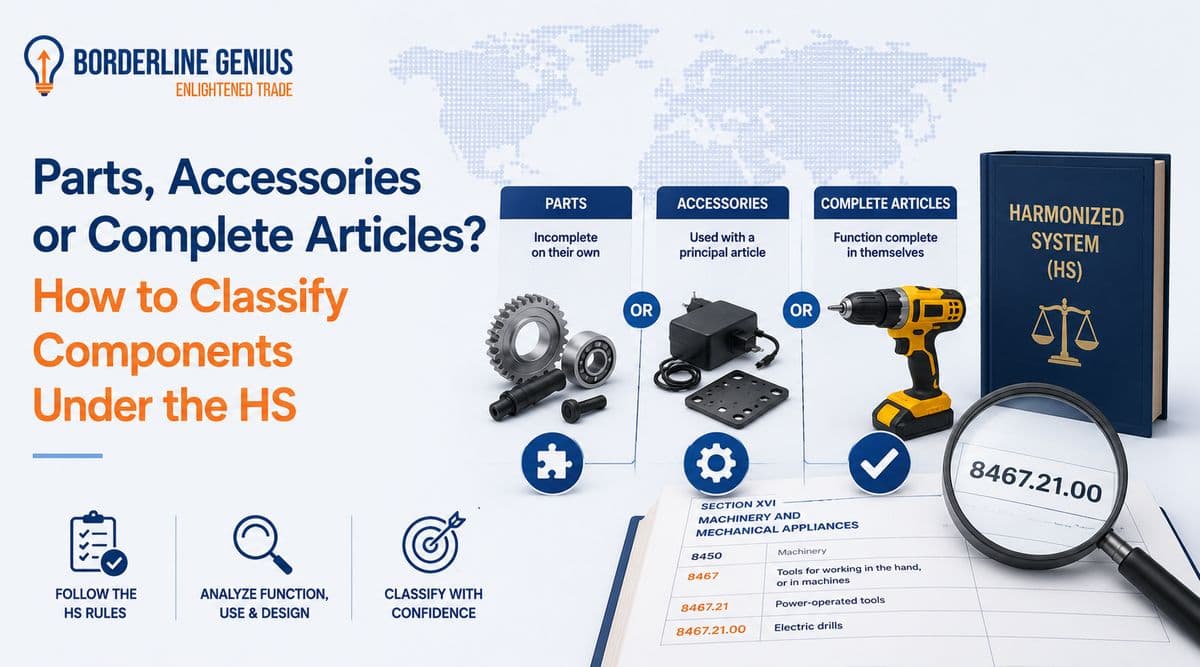
Parts, Accessories or Complete Articles? How to Classify Components Under the HS
Parts, accessories or complete articles? The decision sequence for classifying components under the HS: Section XVI notes, parts of general use, GRI 2(a).
Read article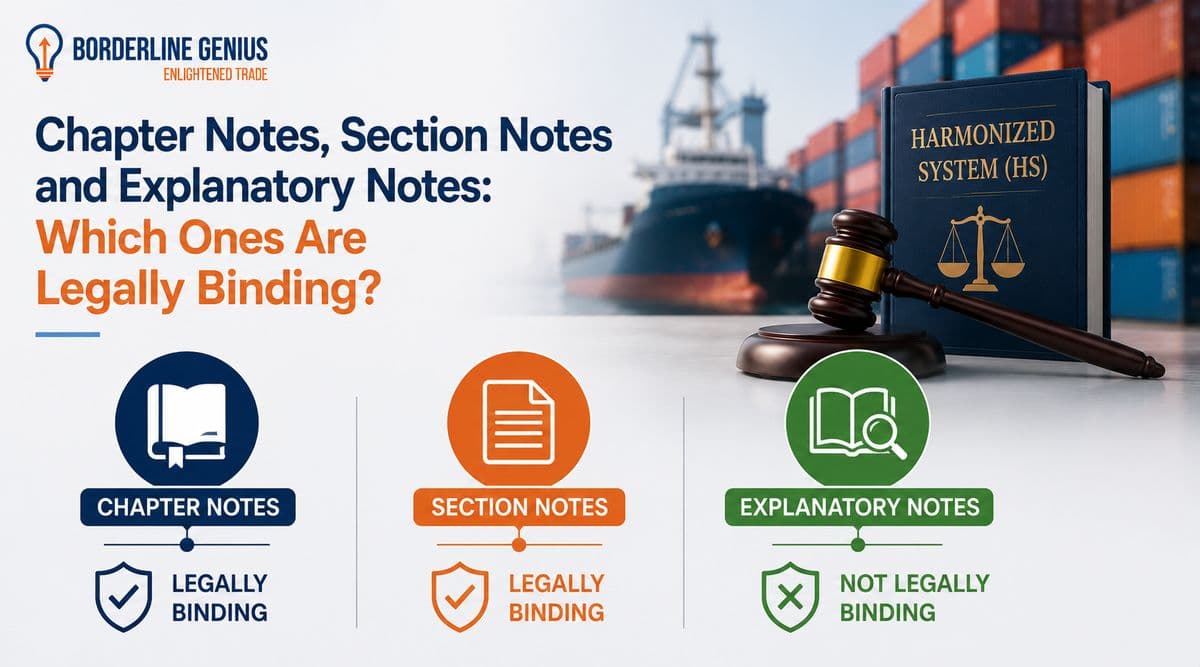 10 min read
Chapter Notes, Section Notes and Explanatory Notes: Which Ones Are Legally Binding?
Section and chapter notes are binding law. WCO Explanatory Notes are not. A clear hierarchy of HS interpretive authority, and what to do when they conflict.
Read article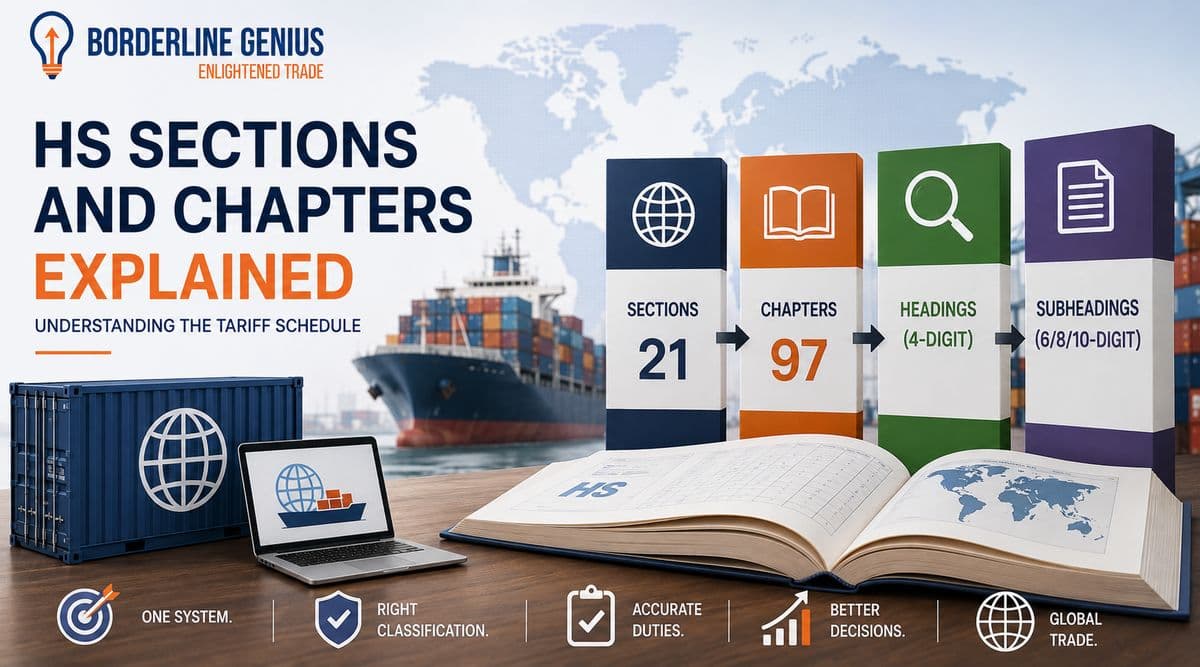 12 min read
HS Sections and Chapters Explained: Understanding the Tariff Schedule
Learn how the Harmonized System is structured with a complete guide to its 21 Sections, 97 Chapters, and the classification principles that organize the tariff schedule.
Read article