
The General Rules of Interpretation (GRIs): How Goods are Actually Classified
The six General Rules of Interpretation govern every HS classification decision. Get a full walk-through of GRI 1 to 6, with worked examples and the errors that cost importers money.
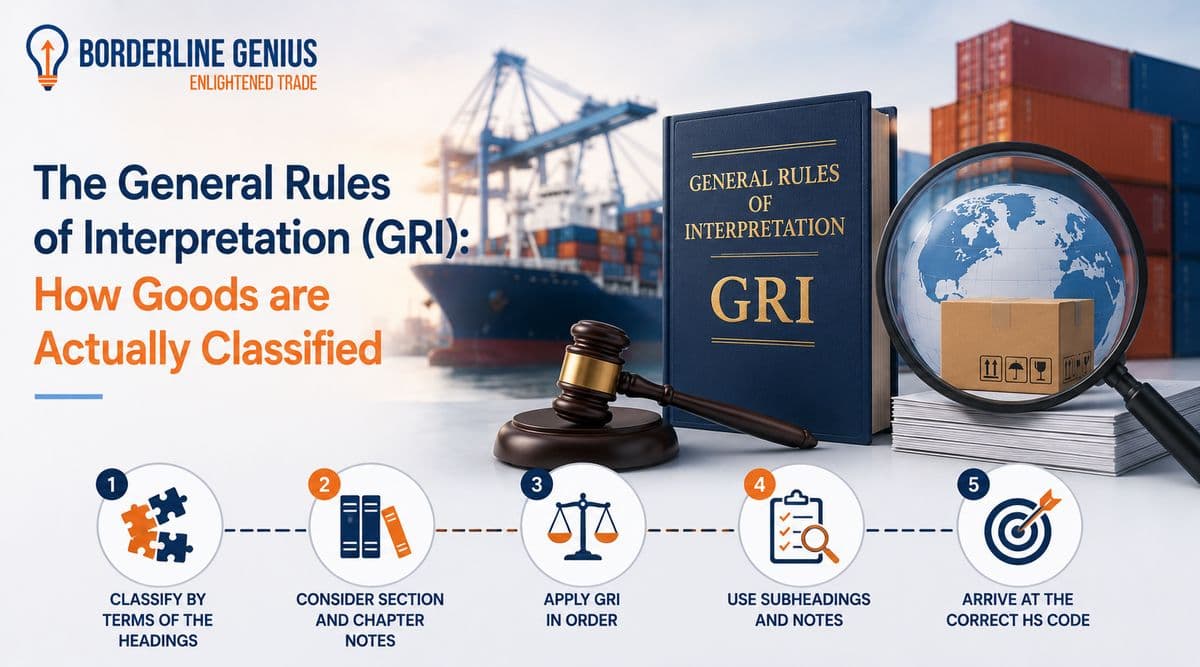
Every HS classification begins with the General Rules of Interpretation (GRIs), whether they are applied consciously or not. Yet many classification decisions still start with a simple tariff database search, selecting the heading that appears to match the product. That approach works frequently to feel reliable but fails often enough to become expensive.
The Harmonized System (HS) does not operate by resemblance. Instead, it relies on six legally binding rules applied in a fixed sequence. These rules form part of the legal text of the Harmonized System and provide the framework for consistent and defensible HS classification.
When a customs authority challenges a classification, or when different classifiers reach different conclusions for the same product, the GRIs provide the legal basis for resolving the issue. This guide explains each of the six rules, how they are applied in sequence, and the common mistakes to avoid during HS classification.
What are the General Rules of Interpretation?
The General Rules of Interpretation (GRIs) are six legally binding rules that govern how goods are classified under the Harmonized System (HS). They appear at the beginning of the HS nomenclature, before Chapter 1, and form part of the Harmonized System itself rather than explanatory guidance.
-
These rules apply to every HS classification decision made by countries that use the Harmonized System. They provide a standardized framework for determining the correct classification of goods for customs purposes. Besides, they form the foundation of HS classification rules used in international trade.
-
The GRIs are applied sequentially. Rather than selecting the rule that appears most suitable, each rule is considered in order until one determines the correct classification.
-
They are also hierarchical in effect. GRI 1 resolves the majority of HS classification decisions, while the remaining rules apply only when the preceding one does not determine the appropriate classification.
Note: The General Rules of Interpretation determine the classification of goods only. Customs duties, origin, customs valuation, and other import or export requirements are governed by separate legal provisions that rely on the final HS classification.
Why Does the Order of the General Rules of Interpretation Matter?
GRIs, or the General Rules of Interpretation, are applied in a fixed sequence. Applying a later rule when an earlier one already determines the classification can result in an incorrect HS classification. Since the GRIs are legally binding, customs authorities expect each classification decision to follow this order.
For example, a gift set containing a razor and shaving cream may initially appear to require GRI 3(b) to determine its essential character. However, if a relevant Section Note, Chapter Note, or heading already provides the classification under GRI 1, the later rules are not considered. In such cases, applying GRI 3(b) would be inconsistent with the legal structure of the Harmonized System.
The correct approach is to begin with GRI 1 for every classification decision and proceed to the next rule only when the current one does not resolve the classification.
Note: GRIs are applied sequentially, not selectively. Each subsequent rule is considered only if the preceding one does not determine the correct HS classification.
GRI 1: The Terms of the Headings and the Legal Notes
The first General Rule of Interpretation establishes the primary principle: classification is determined according to the terms of the headings and any relevant Section or Chapter Notes.
Another important point concerns the legal status of titles. The titles of Sections, Chapters, and Sub-Chapters are provided for ease of reference only and have no legal force. A product does not belong in Chapter 84 simply because the chapter is titled "Machinery." It belongs there because a heading within Chapter 84 describes it and no applicable Section or Chapter Note excludes it.
-
Before applying GRI 1, review the following legal provisions for accurate product or commodity classification:
-
The complete four-digit heading text, including any punctuation and qualifying language.
-
Relevant Section Notes applicable to the entire section.
-
Applicable Chapter Notes governing the chapter.
-
Where relevant, Subheading Notes, although these generally apply at the subheading level under GRI 6.
-
HS Section and Chapter Notes play an important role in classification because they can:
-
Define terms used in the headings, such as what qualifies as "parts," "textile," or a specified purity threshold.
-
Expand the scope of a heading by including goods that the heading text alone might not obviously cover.
-
Exclude goods that the heading text alone would otherwise appear to cover. Exclusion notes are among the most frequently overlooked aspects of HS classification.
Note: If the heading text and the applicable Section and Chapter Notes identify only one appropriate heading for the goods, classification is complete under GRI 1. The remaining GRIs apply only when this rule does not resolve the classification.
GRI 2: Incomplete Articles and Mixtures
GRI 2 consists of two parts, each addressing a different classification scenario.
GRI 2(a) - Incomplete, Unfinished, Unassembled
A reference to an article in a heading also covers that article when it is incomplete or unfinished, provided it has the essential character of the complete article as presented. The same reference also applies to articles presented unassembled or disassembled for product classification purposes.
This rule allows a bicycle shipped flat in a box to be classified as a bicycle rather than as a collection of tubes, wheels, and gears. It also prevents importers from avoiding a higher duty rate by shipping a finished product in separate pieces.
2 conditions must be satisfied:
-
The goods must possess the essential character of the finished article as presented. For example, a bicycle frame alone is not classified as a bicycle.
-
Articles presented unassembled or disassembled must require only simple assembly operations. The rule does not apply where components require further manufacturing or processing.
GRI 2(b) - Mixtures and Combinations
This provision extends the scope of headings that refer to a material or substance. A reference to a material or substance also includes mixtures or combinations of that material with others, while a reference to goods of a given material includes goods made partly of that material.
Unlike GRI 2(a), this rule does not determine the final HS code classification. Instead, by broadening the scope of headings, it increases the likelihood that two or more headings may appear to describe the same product. When this happens, the classification is resolved by applying GRI 3.
GRI 3: When Two or More Headings Apply
The third General Rule of Interpretation, GRI 3, applies only when goods are prima facie classifiable under two or more headings. It is one of the most frequently applied and commonly misapplied rules in HS classification. Its three components must be applied in strict sequence.
GRI 3(a) - The Most Specific Description
Under this rule, the heading representing largely specific description is preferred over one representing a more general description.
Specificity has a well-established meaning in HS classification rules. A heading that specifically identifies the item is considered more specific than one describing a broader class of goods. Likewise, a description that identifies the goods more clearly and completely takes precedence over a less complete description.
An important qualification applies where 2, or headings more than that, refer to only the part of the mixture or composite good’s materials, or to only part of the items in a retail set. In such cases, those headings are considered to be equally specific, even if one appears narrower. As a result, GRI 3(a) cannot resolve the classification, and the analysis proceeds to GRI 3(b). This qualification is one of the most frequently overlooked aspects of GRI 3(a).
GRI 3(b) - Essential Character
For mixtures, composite goods that are made up of different components, and items placed in sets for retail sale, classification is based on the component that gives them their GRI 3(b) Essential Character.
Essential character is determined through a factual assessment rather than a fixed formula. Factors commonly considered include:
-
The nature of the material or component.
-
Its bulk, quantity, weight, or value.
-
The role of the component in relation to the usage of the items.
Among these factors, the role of the component in the use of the goods often carries the greatest weight. For example, in a set containing an inexpensive tool and an expensive carrying case, the tool generally provides the essential character because the set exists primarily to perform its intended function.
What qualifies as a set for retail sale?
All three of the following conditions must be met for HS code classification purposes:
-
It consists of at least two articles classifiable under different headings.
-
The articles are put up together to meet a particular need or carry out a specific activity.
-
They are packaged for sale directly to end users without repacking.
A carton containing unrelated products bundled solely for shipping convenience is not considered a retail set. Instead, each item is classified separately.
GRI 3(c) - Last in Numerical Order
In case GRI 3(a) or GRI 3(b) do not resolve the classification, the items are then classified under the heading that occurs last in numerical order among those equally meriting consideration.
This provision serves as the final tie-breaker. Rather than providing an analytical basis for GRI classification, it ensures a definitive outcome when the preceding rules cannot resolve the issue.
Although applying GRI 3(c) is entirely appropriate where required, it should never be used before fully considering GRI 3(a) and GRI 3(b). When classification relies on GRI 3(c), the rationale for why the earlier rules did not apply should be clearly documented.
GRI 4: The Most Akin Goods
The next rule, GRI 4, applies only when items can’t be classified under any of the preceding GRIs. In such cases, they are classified under the appropriate heading for the products to which they are largely akin.
Although available as an HS classification rule, GRI 4 is used only in limited circumstances. The Harmonized System is designed to be comprehensive, and most chapters include residual "other" provisions to accommodate goods that are not covered by more specific headings.
As a result, genuine classification gaps are uncommon. When GRI 4 is applied, it typically involves novel goods introduced before the HS nomenclature has been updated to accommodate them.
Similarity is assessed by considering the goods' description, character, and intended purpose.
GRI 5: Cases, Containers and Packing
This rule determines how certain cases, containers, and packing materials are classified in relation to the goods they accompany during product classification.
GRI 5(a) - Fitted Cases and Containers
Specially shaped or fitted containers, such as camera cases, instrument cases, gun cases, and musical instrument cases, are classified with the articles they contain when all of the following conditions are met:
-
They are specially shaped or fitted for a specific article.
-
For long-term use, they are suitable.
-
They are presented with the article they are designed to contain.
-
And, they are of a kind normally sold with that article.
An important exception applies where the container gives the goods their essential character. In such cases, the container is classified on its own merits. For example, an ornamental silver box containing a modest item would not be classified together with its contents.
GRI 5(b) - Packing Materials
Packing materials and containers presented with the goods are generally classified with those products when they are of a kind normally used for packing them, supporting consistent trade compliance.
An important qualification concerns reusable packing materials and containers. GRI 5(b) states that this provision "is not binding" where the packing materials or containers are clearly suitable for repetitive use. This wording is significant because it provides flexibility rather than creating an automatic exclusion.
For example, reusable industrial gas cylinders or returnable steel drums may be classified separately where appropriate, particularly when the packing itself has significant value.
GRI 6: Classifying at Subheading Level
While the first 5 GRIs determine the appropriate four-digit heading, GRI 6 governs classification at the subheading level.
Its application is straightforward, but one requirement is fundamental:
-
Classification at the subheading level is determined according to the terms of the subheadings and any related Subheading Notes.
-
GRIs 1 to 5 apply again at the subheading level, subject to the necessary changes.
Only subheadings at the same hierarchical level may be compared. One-dash subheadings are compared only with other one-dash subheadings. Once the appropriate one-dash subheading has been identified, the comparison moves to the two-dash subheadings beneath it, following the GRI 6 Subheadings principle.
This hierarchical approach is among the most frequently overlooked aspects of HS classification. Selecting a two-dash subheading because its wording appears to match the product, without first confirming that the parent one-dash subheading is correct, is a common classification error.
Although the subheading text may accurately describe the product, it will still be incorrect if its parent branch does not apply.
What are the HS Explanatory Notes?
The World Customs Organization (WCO) publishes the HS Explanatory Notes, a multi-volume reference that explains the scope of headings in greater detail and provides examples of included and excluded goods.
Also, the WCO publishes Classification Opinions, compiled in the Compendium of Classification Opinions, which record decisions of the HS Committee on disputed classification issues.
-
Their legal status is important and often misunderstood:
-
The HS Explanatory Notes are the official interpretation of the Harmonized System at the international level.
-
They do not form an integral part of the HS Convention and, therefore, do not have legally binding force. Courts have consistently confirmed this. Most recently, in November 2025, the Court of Justice of the European Union reaffirmed that the Explanatory Notes are "an important aid for interpreting the scope of the various tariff headings" but "do not have legally binding force."
-
Section and Chapter Notes, by contrast, are legally binding because GRI 1 requires classification to be determined according to them.
In practice, the HS Explanatory Notes are highly persuasive and should always be consulted during HS classification. However, they cannot override the wording of a heading or any legally binding Section or Chapter Note. Where a conflict exists, the legal note takes precedence.
How are National Digits Beyond Six Interpreted?
The GRIs govern classification through the first 6 digits of the Harmonized System. Beyond that, countries may add additional tariff or statistical digits, such as the eighth, tenth, or further digits under their own national tariff schedules.
Although many jurisdictions have adopted interpretive rules that closely mirror GRI 6 at the national level, those rules derive their authority from national legislation rather than the Harmonized System itself. As a result, both the legal requirements and the wording of the provisions may differ between jurisdictions.
When classifying goods to a complete national tariff code, always consult the applicable national interpretive rules rather than assuming the GRIs apply beyond the six-digit HS level for HS code classification.
8 Common Mistakes When Applying the GRIs
Even with a structured approach, errors can occur during HS classification. Many of the most common mistakes arise not from misunderstanding the GRIs themselves, but from applying them out of sequence, overlooking legally binding notes, or relying on assumptions instead of the legal text.
Recognizing these 8 pitfalls can help improve classification accuracy and support trade compliance.
-
Relying on keyword searches instead of legal text: Databases are useful finding aids, but they do not determine classification. The Section and Chapter structure helps narrow the search, while the heading text and legal notes determine the correct classification.
-
Overlooking exclusion notes: A heading that appears to describe the product perfectly cannot be used if a Section or Chapter Note specifically excludes the goods. Always review the legal notes before reaching a conclusion.
-
Applying GRI 3 too early: GRI 3 applies only when GRI 1 does not resolve the classification. If the heading text and applicable legal notes identify the correct heading, there is no need to proceed further.
-
Misinterpreting specificity under GRI 3(a): For mixtures, composite goods, and retail sets, headings referring to only part of the goods are treated as equally specific. In these situations, GRI 3(a) cannot determine the classification.
-
Assuming value determines essential character: Value is only one factor considered under GRI 3(b). The role a component plays in the use of the goods often carries greater weight.
-
Comparing subheadings at different hierarchical levels: One-dash subheadings must be compared only with other one-dash subheadings before moving to the two-dash level. Skipping this sequence is one of the most common technical HS classification errors.
-
Treating the HS Explanatory Notes as legally binding: Although they are an important interpretive aid, they cannot override the wording of a heading or any legally binding Section or Chapter Note.
-
Failing to document the classification rationale: A classification decision should clearly record the headings considered, the applicable legal notes, and the reasons for applying a particular GRI. Where the commercial or compliance risk is significant, obtaining a binding tariff ruling provides additional certainty.
Conclusion
The General Rules of Interpretation provide the legal framework for consistent and defensible HS classification. Although the rules themselves are concise, applying them systematically ensures that goods are classified according to the headings and legal notes rather than assumptions or shortcuts.
Whether classifying a single product or managing a large product catalogue, following the GRIs in sequence and documenting the basis for each decision supports greater consistency, compliance, and confidence in customs classification.
Frequently asked questions
Navigate Global Trade With Greater Confidence
Access expert guidance to help your organization address complex trade, classification, tariff, and compliance challenges.
Talk to a Trade ExpertRelated articles
Keep reading with more guidance on trade compliance and classification.
 7 min read
Parts, Accessories or Complete Articles? How to Classify Components Under the HS
Parts, accessories or complete articles? The decision sequence for classifying components under the HS: Section XVI notes, parts of general use, GRI 2(a).
Read article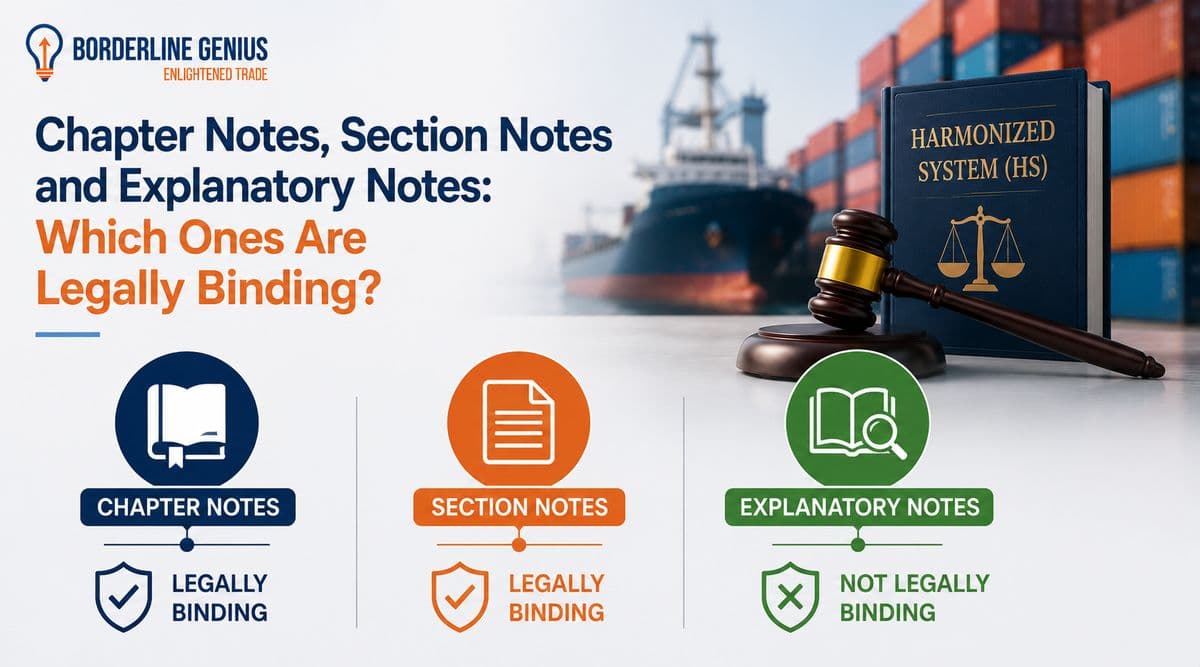 10 min read
Chapter Notes, Section Notes and Explanatory Notes: Which Ones Are Legally Binding?
Section and chapter notes are binding law. WCO Explanatory Notes are not. A clear hierarchy of HS interpretive authority, and what to do when they conflict.
Read article 12 min read
HS Sections and Chapters Explained: Understanding the Tariff Schedule
Learn how the Harmonized System is structured with a complete guide to its 21 Sections, 97 Chapters, and the classification principles that organize the tariff schedule.
Read article