
Antidumping & Countervailing Duties: How Do they Work?
Learn how antidumping and countervailing duties work, why order scope matters, and how businesses can identify and manage AD/CVD compliance risks.
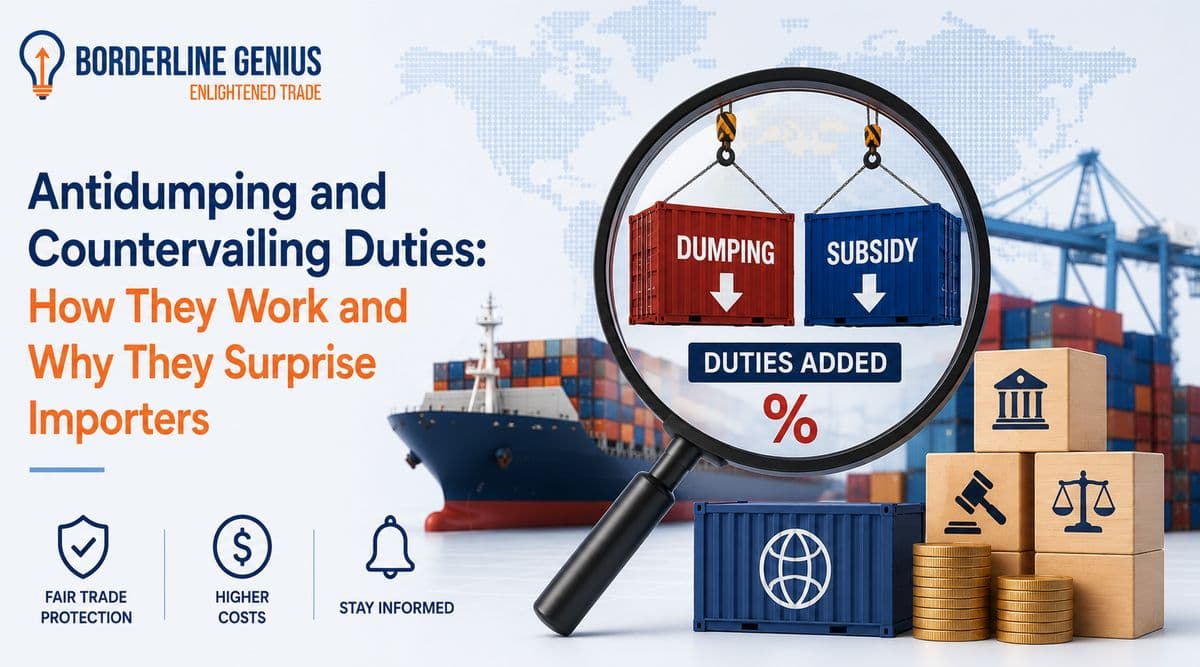
In global trade, an import shipment can be classified correctly, declared accurately, and still become subject to substantial additional duties. Unlike ordinary customs duties, antidumping and countervailing duties are imposed under trade remedy laws and depend on the written scope of an order rather than the tariff classification alone.
This distinction is often overlooked. Importers may identify the correct HS code and calculate the applicable customs duty yet fail to determine whether the product falls within an existing antidumping or countervailing order. The result can be significant additional duties, even when the customs declaration itself is accurate.
This guide explains how these measures are imposed, why the written scope determines coverage, and how importers can identify as well as manage AD/CVD risks before goods are imported.
What are Antidumping and Countervailing Duties?
Antidumping and countervailing duties are trade remedies imposed in addition to the normal customs duty to address unfair practices in the landscape that cause injury to a domestic industry. Although they are often discussed together, they target different forms of unfair trade and are governed by separate WTO agreements.
|
|
Antidumping Duty |
Countervailing Duty |
|
What it Addresses |
Export sales below normal value: below the comparable home-market price, or below constructed cost plus profit |
Actionable subsidies: a government financial contribution conferring a benefit, specific to an enterprise, industry or region |
|
WTO Basis |
Agreement on Implementation of Article VI of GATT 1994 |
Agreement on Subsidies and Countervailing Measures |
|
What Triggers it |
Domestic industry petition, plus material injury or threat of it, plus a causal link |
As for antidumping: petition, injury or threat, causal link |
|
How it is Calculated |
Dumping margin: normal value less export price, ad valorem, per exporter |
Subsidy rate: countervailable benefit per unit, ad valorem, per exporter or programme |
|
What is Examined |
The exporter's pricing |
The exporting government's programmes, as used by the producer |
The same imported item may be subject to both antidumping duties and countervailing duties, meaning the additional duties can apply together on top of the normal tariff.
-
These duties are generally calculated for individual exporters rather than goods.
-
Cooperating exporters may receive company-specific rates, while non-cooperating exporters are often assigned higher country-wide or adverse rates.
-
As a result, changing suppliers within the same country can significantly affect the duty payable.
How does an Antidumping Duty or Countervailing Measure Come into Effect?
The process for imposing antidumping duties and countervailing measures is broadly similar across jurisdictions, although the investigating authority and statutory timelines vary by country.
-
Petition and Investigation: A domestic industry files evidence of unfair trade and injury, and the authority decides whether to open an investigation.
-
Preliminary Determination: When the initial evidence supports the claim, provisional measures or cash deposits may be imposed.
-
Final Determination: The authority decides whether definitive duties should be applied based on its findings.
-
Review and Expiry: Measures generally expire after five years unless a review finds they are still necessary.
Measures are jurisdiction-specific. An article subject to countervailing duty or an antidumping order in one country may not face the same measures elsewhere because each authority conducts its own investigation under domestic law.
Why does the Scope Matter More than the HS Code?
An antidumping or countervailing order defines the covered merchandise through its written scope. Although tariff classifications may be listed, they are included for administrative convenience. In the United States, Customs and Border Protection states that the written scope of the order, not the HTS classification, is legally controlling.
-
A product may be covered even when its HS code is not listed in the order.
-
Goods may fall outside the scope despite their codes being listed.
-
Scope descriptions often rely on technical characteristics such as material composition, dimensions, coatings, or the degree of processing.
-
Determining whether an item falls within the scope is a separate exercise from tariff classification.
Where uncertainty exists, importers may request an AD/CVD scope ruling from the investigating authority to determine whether an article is covered by an existing order.
Note: An AD/CVD scope ruling provides certainty but not an exemption. In case a product falls within the written scope of an order, the applicable duties remain payable whether or not a ruling was requested.
How Do Businesses Screen Goods for AD/CVD Risk?
Identifying AD/CVD risk requires more than checking an HS code. Importers must determine whether an item falls within the written scope of an order before goods are sourced or shipped.
An effective screening process generally includes:
-
Confirming the article’s customs classification and technical specifications.
-
Comparing those specifications against the written scope of active AD/CVD orders.
-
Verifying the exporter, producer, and country of origin covered by the order.
-
Reviewing applicable scope rulings or updates issued by the investigating authority.
-
Recording the assessment to support future compliance reviews and audits.
As product portfolios and sourcing networks expand, many businesses use import compliance software to organize the data, support scope reviews, and identify shipments that may require additional AD/CVD analysis.
Why is the Cash Deposit Rate not the Final Bill?
The cash deposit rate paid when goods enter a country is not always the final duty owed. While some jurisdictions, such as the European Union, assess the final duty at import, the United States treats the amount paid at entry as an estimated deposit. The final liability is determined later through an administrative review, after which customs authorities assess any additional duty or refund any overpayment.
This creates a different financial risk for importers.
-
The cash deposit may increase, decrease, or remain unchanged after the review.
-
Additional duties may become payable years after the goods have been imported and sold.
-
The liability remains with the importer of record, regardless of who cleared the shipment.
-
In the United States, antidumping and countervailing duties are generally not eligible for duty drawback.
How Do AD/CVD Circumvention and Evasion Rules Reach Third Countries?
Importers sometimes shift production or assembly to another country after antidumping and countervailing duties are imposed. Trade authorities monitor these changes and can investigate whether they are intended to avoid existing trade remedy measures.
Common situations include:
-
Assembly in a third country using parts from the country subject to the order.
-
Minor product modifications that do not materially change the merchandise.
-
Later-developed goods designed to fall outside the original scope.
-
False declarations or documentation intended to evade applicable duties.
Authorities may extend existing measures when they determine that production changes or supply chain arrangements are intended to circumvent an order. This assessment is separate from ordinary rules of origin and focuses on whether the merchandise should remain subject to the original trade remedy.
For AD/CVD investigations, the country of final assembly does not always determine origin. Authorities may instead examine where the item's essential component was manufactured, meaning a shipment that satisfies ordinary origin rules can still remain subject to existing duties.
What should an Importer Actually Do?
Importers can reduce AD/CVD risk by building trade remedy checks into their sourcing and compliance processes rather than treating them as a customs clearance issue.
-
Screen articles against active AD/CVD orders before purchase orders are issued, not before shipment.
-
Compare items' specifications with the written scope of the order, not just the HS code.
-
Document the scope analysis to demonstrate reasonable care and support future compliance reviews.
-
Repeat the assessment whenever the supplier, country of origin, product specification, or applicable order changes.
-
Trace the origin of critical components and retain records that support the declared origin.
Why do Businesses Automate AD/CVD Compliance?
Managing AD/CVD compliance becomes increasingly complex as businesses expand their sourcing operations. A single organization may import thousands of items from multiple suppliers across different countries, each subject to changing trade remedy measures, scope rulings, and regulatory requirements.
-
Maintaining compliance also requires continuous reviews of product specifications, supplier information, origin data, and supporting documentation.
-
As new investigations begin, existing orders are amended, or measures expire, importers must ensure their assessments remain accurate and well documented.
-
To improve consistency and reduce manual effort, many organizations use trade compliance software to centralize product information.
-
It can support AD/CVD screening, monitor regulatory changes, and maintain audit-ready compliance records across import and export operations.
How does AI Simplify AD/CVD Compliance?
Managing AD/CVD compliance manually requires reviewing trade remedy orders, interpreting written scope descriptions, verifying supplier and origin information, monitoring regulatory updates, and calculating the total landed cost of imported goods. As product catalogues, sourcing locations, and regulatory obligations expand, these tasks become increasingly time-consuming and difficult to manage consistently.
Many organizations now use AI trade compliance solutions to streamline these activities.
By combining tariff data, product information, regulatory updates, and compliance workflows into a single platform, AI can reduce repetitive research.
It can improve consistency and help identify products that may require additional AD/CVD review before importation.
Borderline Genius Inc. brings these capabilities together through HS code classification software that supports product classification, scope analysis, duty determination, and landed cost calculations within a unified trade compliance workflow. The platform helps businesses reduce manual effort, improve compliance accuracy, and make more informed sourcing and customs decisions across global supply chains.
To Conclude
Antidumping and countervailing duties require more than checking tariff rates or HS codes. Importers must assess the written scope of an order, verify product and origin details, and review potential trade remedy risks before sourcing. Early due diligence is the most effective way to avoid unexpected duty liabilities.
Frequently asked questions
Navigate Global Trade With Greater Confidence
Access expert guidance to help your organization address complex trade, classification, tariff, and compliance challenges.
Talk to a Trade ExpertRelated articles
Keep reading with more guidance on trade compliance and classification.
 12 min read
Binding Tariff Rulings: US, UK, EU, India, Canada, Australia, & China
Learn how binding tariff rulings work across the US, UK, EU, Canada, China, India, and Australia, including procedures, validity, authorities, and databases.
Read article 17 min read
AD/CVD: How Anti-Dumping & Countervailing Duties Work
Learn how importers can check AD/CVD duties, understand AD/CVD scope, find applicable rates and case numbers, and reduce compliance risks.
Read article 7 min read
Classifying Sets, Kits and Composite Goods? How They're Classified Under the HS
Gift sets, starter kits and subscription boxes rarely classify the way people assume. How the retail set test, GRI 3(b) essential character and GRI 5 work.
Read article