
Classifying Sets, Kits and Composite Goods? How They're Classified Under the HS
Gift sets, starter kits and subscription boxes rarely classify the way people assume. How the retail set test, GRI 3(b) essential character and GRI 5 work.
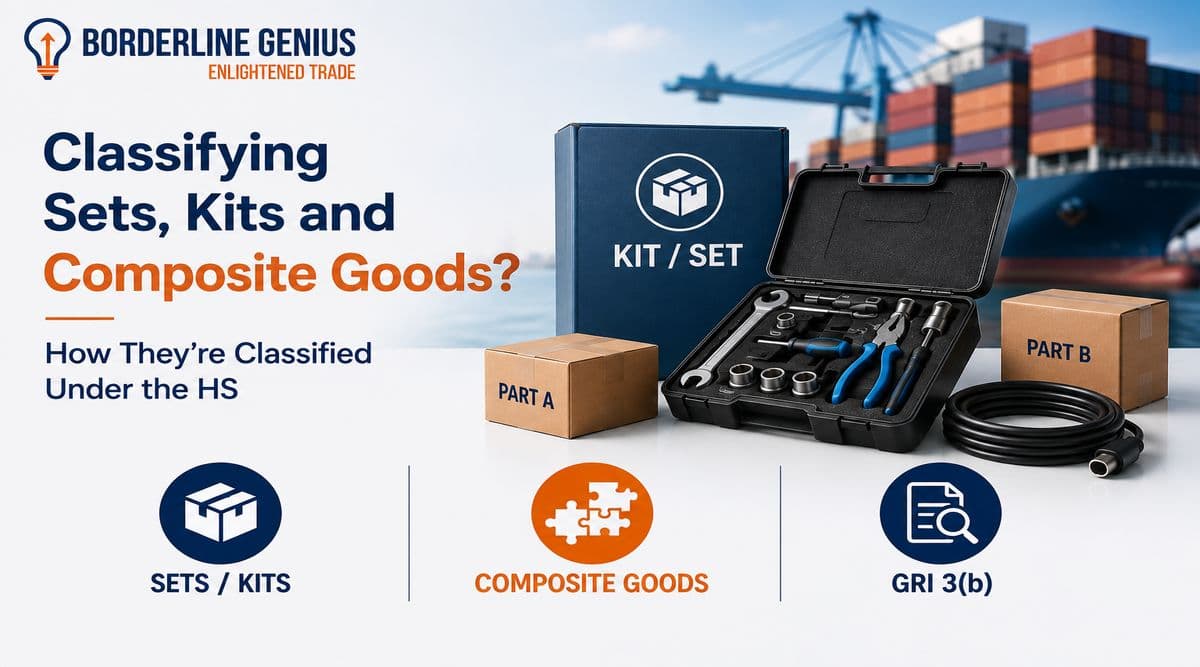
Gift sets, starter kits, subscription boxes and seasonal hampers all raise one question at the border: a single article of commerce for tariff purposes, or several that happen to share a carton? The intuitive answers — the priciest item, or whatever the box is called online — are usually wrong.
A razor classifies cleanly. A tube of shaving cream classifies cleanly. A brush classifies cleanly. Put all three in a printed box with a ribbon on it and you no longer have three classification decisions. You may have one, and it need not be any of the three answers you started with.
What Counts as a Set Put Up for Retail Sale?
A bundle sits between one article and many. Two or more headings each describe part of what is in the box; none describes the whole. That engages GRI 3, which produces one classification for the lot — but only if the bundle meets all three of these conditions.
|
# |
Condition |
What it rules out |
|
1 |
At least two articles prima facie classifiable in different headings |
Six identical mugs — one heading, no conflict |
|
2 |
Put up together to meet a particular need or carry out a specific activity |
A hamper of unrelated food, candles and socks |
|
3 |
Put up for sale directly to end users without repacking |
Bulk cases broken down at a distribution centre |
Failing one is failing the test: each item is then classified separately, on its own line at its own rate. A carton bundled for shipping convenience is not a set, nor is a gift hamper of unrelated goods.
Note: the second condition is the one most bundles fail. A curated box of things a recipient might enjoy is a merchandising concept, not a specific activity.
How Is GRI 3 Applied in Order?
GRI 3 has three limbs, applied in strict sequence.
|
Limb |
Rule |
When it resolves |
|
GRI 3(a) |
The most specific description is preferred |
Rarely, for retail sets — see below |
|
GRI 3(b) |
Classify by the component giving the essential character |
Most retail sets and composite goods |
|
GRI 3(c) |
Classify in the heading occurring last in numerical order |
Only where 3(a) and 3(b) have genuinely failed |
The qualification inside 3(a) defeats the intuitive answer. Where two or more headings each refer to part only of the items in a retail set, they are "to be regarded as equally specific... even if one of them gives a more complete or precise description." A heading naming one component precisely therefore does not win: it ranks equal with the heading covering the rest, and 3(a) is exhausted.
GRI 3(c) is a tie-break of last resort with no analytical content. Using it is legitimate; reaching for it early is indefensible. If a file rests on 3(c), the reasoning showing why 3(a) and 3(b) failed belongs in that file.
What Determines Essential Character Under GRI 3(b)?
Essential character is a factual assessment, not a formula. The factors are the nature of the material or component; its bulk, quantity and weight; its value; and the role of the component in relation to the use of the goods.
The last factor usually carries the most weight. In a set holding an inexpensive tool and an expensive fitted case, the tool generally supplies the essential character: the set exists to deliver the tool. Defaulting to the highest-value item is the standard error. Answer in writing what the buyer is buying the set for.
GRI 3(b) also covers composite goods, routinely confused with sets. A composite good is a single article of different materials or components adapted to one another and not normally sold separately — a tool with an integral plastic handle and steel head. The set test does not apply to it; it goes straight to essential character.
How Are the Case and the Packaging Classified?
GRI 5 handles the container rather than the contents.
Fitted cases (GRI 5(a)). Camera, instrument, tool and similar containers go with the article they contain where they are specially shaped or fitted for it, suitable for long-term use, presented with the article and normally sold with it. The exception is where the container gives the whole its essential character.
Packing materials (GRI 5(b)). Packing presented with the goods is classified with them where it is of a kind normally used for packing them. Read the carve-out precisely: the provision "is not binding" where the packing is clearly suitable for repetitive use. That is discretionary, not an automatic exclusion. A returnable drum may be classified separately, but the rule does not compel it.
Two Bundles Walked Through the Test
A razor, cream and brush in a printed retail box: different headings, a specific activity, sold as presented. It is a set. GRI 3(a) fails, because each candidate heading covers part only of the contents and they rank equally specific. Under 3(b), ask which component the set exists to deliver: typically the razor, on role in use, even if the brush costs more.
A hand tool in a moulded fitted case runs the other way. Ask GRI 5(a) first: a fitted, durable case normally sold with the tool goes with the tool, and no set analysis arises. A generic pouch falls outside 5(a) and returns you to the set test.
What Does This Mean for an E-Commerce Catalogue?
Bundles are the hardest thing in a catalogue to keep correct, because they change while their components do not.
-
Classify per configuration, not per product family. A bundle that swaps two components in October is a different decision from the June version, though every SKU inside it is unchanged.
-
Re-run the set test when contents change. One added item can push a bundle into item-by-item treatment, or move essential character elsewhere. Goods kitted only after import were never a retail set at importation.
-
Record which rule resolved it. "GRI 3(b), essential character supplied by the razor on role in use" is a defensible file note; a bare code is not.
Bundles also concentrate the traps that recur across commonly misclassified product categories: textile pouches, plastic containers and multi-material articles.
Frequently asked questions
Navigate Global Trade With Greater Confidence
Access expert guidance to help your organization address complex trade, classification, tariff, and compliance challenges.
Talk to a Trade ExpertRelated articles
Keep reading with more guidance on trade compliance and classification.
 7 min read
Parts, Accessories or Complete Articles? How to Classify Components Under the HS
Parts, accessories or complete articles? The decision sequence for classifying components under the HS: Section XVI notes, parts of general use, GRI 2(a).
Read article 10 min read
Chapter Notes, Section Notes and Explanatory Notes: Which Ones Are Legally Binding?
Section and chapter notes are binding law. WCO Explanatory Notes are not. A clear hierarchy of HS interpretive authority, and what to do when they conflict.
Read article 12 min read
HS Sections and Chapters Explained: Understanding the Tariff Schedule
Learn how the Harmonized System is structured with a complete guide to its 21 Sections, 97 Chapters, and the classification principles that organize the tariff schedule.
Read article