
How to Manage Product Compliance Data at Scale?
Learn how to manage product compliance data at scale, reduce spreadsheet dependency, centralize classifications and requirements, and improve trade compliance.
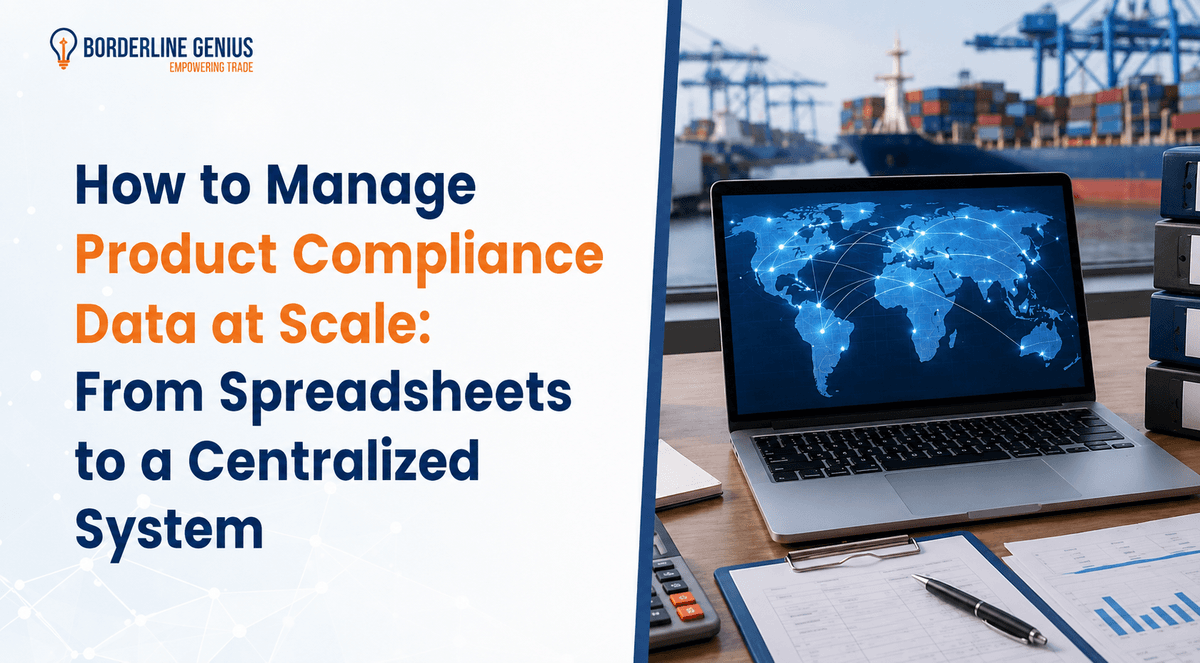
For a company managing a few dozen products, keeping compliance information in spreadsheets may seem perfectly reasonable. A spreadsheet can contain an HS code, country of origin, product description, duty rate, regulatory requirement, supplier, and other relevant information. Someone on the compliance team can update it when something changes.
The problem starts when the product catalog grows.
Suddenly, there are hundreds or thousands of products, multiple suppliers, different countries of origin, changing classifications, regulatory requirements, and teams that need access to the same information. The spreadsheet that once made compliance easier can become one of the biggest sources of friction.
Different teams may maintain different versions. Product information may be stored in emails. Classification decisions may exist in someone's notes. Supporting documents may sit in shared folders. And nobody is completely sure which version represents the current state of the data. This is the underlying challenge of product compliance management. The goal is not simply to store more compliance information. It is to create a reliable system where product, classification, regulatory, and trade compliance data can be maintained, connected, updated, and accessed by the people who need it.
For businesses reaching this level of complexity, moving from trade compliance spreadsheets to a centralized system can significantly improve visibility and reduce manual work.
This is where Genius Workspace fits into the workflow.
Genius Workspace is designed to help businesses centralize product, classification, and compliance information so teams can work from a more consistent source of trade compliance data rather than relying on disconnected spreadsheets, emails, and individual knowledge.
What Is Product Compliance Management?
Product compliance management is the process of collecting, maintaining, organizing, and using the information required to ensure products meet applicable regulatory and trade requirements.
Depending on the business, product compliance data may include:
-
Product descriptions
-
SKU numbers
-
HS codes
-
Tariff classifications
-
Country of origin
-
Product categories
-
Import requirements
-
Export requirements
-
Duties and taxes
-
Certifications
-
Licenses and permits
-
Regulatory restrictions
-
Supporting documentation
-
Supplier information
-
Applicable trade programs
-
Compliance decisions and notes
The exact data requirements vary by product and market.
An electronics manufacturer may need different compliance information from a food importer.
An e-commerce business selling internationally may have different requirements from a customs broker managing declarations for multiple clients.
But the underlying challenge is similar:
As product volume and regulatory complexity increase, compliance data becomes harder to manage consistently.
Why Product Compliance Data Becomes Difficult to Manage at Scale
The problem is rarely the first spreadsheet.
It is the fifth spreadsheet.
Then the sixth.
Then the shared folder.
Then the email chain.
Then the classification file maintained by another team.
Eventually, product compliance data becomes distributed across the organization.
For example:
Product team
Maintains:
-
SKU
-
Product description
-
Product category
-
Product specifications
Trade compliance team
Maintains:
-
HS code
-
Country of origin
-
Import requirements
-
Classification decisions
Procurement
Maintains:
-
Supplier
-
Supplier country
-
Purchase cost
-
Sourcing information
Finance
Maintains:
-
Duty assumptions
-
Tax information
-
Landed-cost inputs
Operations
Maintains:
-
Shipment information
-
Documentation
-
Import processes
All of these datasets are related.
But they may not live in the same system.
That creates the central problem:
The organization has compliance data, but does not necessarily have a single source of truth for that data.
Spreadsheets are not inherently bad.
They are flexible, inexpensive, and easy to create.
The problem is that they are often used as systems when they were really designed to be working documents.
As the business grows, several problems emerge.
Version Control
Which file is current?
You may have:
-
Product_Compliance.xlsx
-
Product_Compliance_Final.xlsx
-
Product_Compliance_Final_v2.xlsx
-
Product_Compliance_Updated.xlsx
The filenames themselves become evidence of the problem.
Conflicting Data
One spreadsheet says a product has one HS code.
Another says something different.
A third file contains a newer country-of-origin value.
Now someone has to determine which information is correct.
Manual Updates
A regulatory change occurs.
Someone has to find the relevant products.
Then find the spreadsheet.
Then update the affected records.
Then tell other teams.
The more products involved, the more manual work this creates.
Limited Traceability
A spreadsheet may tell you:
HS Code: 8504.40
But it may not tell you:
-
Why that classification was selected
-
Who approved it
-
When it was reviewed
-
Which documentation supported the decision
-
Whether the classification is still valid
That missing context can become important during audits or internal reviews.
Key-Person Dependency
Sometimes the real compliance database exists inside someone's head.
One experienced employee knows:
"We classify these products this way because of a decision we made three years ago."
If that person leaves, the organization can lose valuable institutional knowledge.
A centralized system helps convert individual knowledge into organizational knowledge.
What Happens When Compliance Data Is Fragmented?
Fragmented data creates problems far beyond administrative inconvenience.
It can affect actual business decisions.
Classification Errors
Incorrect or outdated classification information can potentially result in:
-
Incorrect duty treatment
-
Customs issues
-
Rework
-
Delays
-
Compliance exposure
Incorrect Country-of-Origin Information
Country of origin can influence duties, trade measures, restrictions, and other requirements.
If different systems contain different origin information, downstream decisions can also become inconsistent.
Outdated Compliance Requirements
A product may have a regulatory requirement that changed months ago.
If the change is not reflected in the central product record, teams may continue operating with outdated information.
Slower Customs Processes
When supporting information is difficult to locate, teams may spend additional time gathering and validating documentation.
Poor Cost Visibility
Trade compliance data can feed into landed-cost calculations.
If classification, origin, duty, or other product-level inputs are inaccurate or outdated, cost calculations can also become unreliable.
Increased Audit Risk
During an audit, it is not enough to know the current answer.
You may also need to demonstrate how the organization arrived at that answer and whether the underlying information was properly maintained.
When Should a Business Move Beyond Spreadsheets?
There is no universal product count at which spreadsheets stop working.
The better question is:
How difficult is it to keep the data accurate and synchronized?
Signs that your organization may have outgrown spreadsheets include:
-
Multiple versions of the same compliance file
-
More than one team maintaining product compliance information
-
Frequent manual data reconciliation
-
Classification information stored in emails
-
Difficulty finding supporting documentation
-
Regular duplicate data entry
-
Unclear ownership of compliance records
-
Product data changing frequently
-
Multiple countries or markets
-
Hundreds or thousands of SKUs
-
Frequent regulatory changes
-
Difficulty producing compliance reports
-
Heavy dependence on specific employees
If several of these are familiar, the problem is no longer the spreadsheet itself.
The problem is the absence of a centralized compliance data management system.
What Should a Centralized Product Compliance System Contain?
Moving away from spreadsheets does not mean simply putting the spreadsheet into a database.
A useful system should connect the different pieces of information that determine product compliance.
Product Information
For example:
-
SKU
-
Product name
-
Product description
-
Product category
-
Product attributes
Classification Information
Such as:
-
HS code
-
Tariff classification
-
Classification rationale
-
Classification status
-
Review date
Trade Information
Including:
-
Country of origin
-
Destination
-
Supplier
-
Importer
-
Exporter
-
Trade program
Regulatory Information
Such as:
-
Import restrictions
-
Product requirements
-
Licensing
-
Certifications
-
Agency requirements
-
Regulatory status
Documentation
Including relevant:
-
Certificates
-
Product specifications
-
Supplier documents
-
Classification support
-
Regulatory documentation
Compliance History
A mature system should ideally preserve information about:
-
Previous classifications
-
Reviews
-
Decisions
-
Changes
-
Approvals
-
Supporting evidence
The objective is to create a connected product compliance record rather than a collection of unrelated files.
The Difference Between a Compliance Database and a Compliance System
A database stores information.
A product compliance system should help teams use that information.
For example, a database may tell you:
Product A → HS Code 1234 → Country X
A more useful system can connect that information to:
-
Regulatory requirements
-
Classification decisions
-
Product documentation
-
Trade activity
-
Regulatory changes
-
Compliance workflows
That creates context.
And context is what makes compliance data useful for decision-making.
How Genius Workspace Helps Centralize Product Compliance Data
This is where Genius Workspace becomes more than a replacement for a spreadsheet.
Genius Workspace is designed to help businesses centralize the product, classification, and compliance information they need to manage trade compliance.
Instead of keeping important information across multiple spreadsheets, emails, and disconnected files, teams can work toward a centralized view of product compliance data.
The workflow can be thought of as:
Centralize → Connect → Maintain → Monitor → Act
1. Centralize
Bring relevant product and compliance information into one environment.
This can include information such as:
-
Product details
-
Classifications
-
Country of origin
-
Compliance requirements
-
Supporting information
The goal is to reduce fragmentation.
2. Connect
Compliance information becomes more useful when the relationships between different data points are visible.
For example:
Product
→ HS Code
→ Country of Origin
→ Destination
→ Applicable Requirements
→ Compliance Status
This connected structure makes it easier to understand the compliance context of a product.
3. Maintain
Product compliance data changes.
Products change.
Suppliers change.
Classifications can be reviewed.
Regulatory requirements change.
A centralized system gives teams a more structured way to maintain these records instead of relying on manual updates across multiple spreadsheets.
4. Monitor
Centralized product information also creates a stronger foundation for regulatory monitoring.
When a regulatory change occurs, the business has structured product information that can help determine:
Which products might be affected?
This connects product compliance management with the broader regulatory monitoring process.
Genius Workspace can help businesses move from:
"A regulation changed."
to:
"This change may affect these products in our compliance data."
5. Act
The final objective is not better data for its own sake.
It is better decisions.
Depending on the change, teams may need to:
-
Review a classification
-
Update product information
-
Collect documentation
-
Review supplier data
-
Assess import requirements
-
Recalculate costs
-
Review upcoming shipments
-
Escalate a compliance issue
A centralized system makes those actions easier to coordinate.
How Product Compliance Data Should Flow Through an Organization
A useful trade compliance data management model looks something like this:
Product created
↓
Product information captured
↓
Classification assigned
↓
Country of origin recorded
↓
Applicable requirements identified
↓
Supporting documentation attached
↓
Compliance record maintained
↓
Regulatory changes monitored
↓
Affected products identified
↓
Compliance action taken
This is very different from a spreadsheet-based process where information is updated only when someone remembers to update it.
Centralized Product Data Can Improve Regulatory Monitoring
One of the biggest advantages of centralizing compliance data is that it creates context for regulatory monitoring.
Consider a new regulation affecting:
HS Code 6109 products imported from Country X.
If your product data is centralized, the organization can more easily determine:
-
Which products use that classification?
-
Which products come from Country X?
-
Which suppliers are involved?
-
Which markets are affected?
-
Which shipments may be exposed?
Without centralized information, someone may need to search across multiple spreadsheets and systems to answer these questions.
This is why compliance data management and regulatory change monitoring should not be treated as completely separate capabilities.
The quality of your product compliance data directly affects how quickly you can understand the impact of regulatory changes.
Product Compliance Software vs. Spreadsheets
The choice is not really:
Spreadsheet vs. software.
The more important question is:
What level of complexity can your current process handle reliably?
|
Area |
Trade Compliance Spreadsheets |
Product Compliance Software |
|
Small product catalogs |
Often sufficient |
Useful |
|
Large product catalogs |
Difficult to maintain |
Better suited |
|
Version control |
Manual |
Centralized |
|
Multiple users |
Can become fragmented |
Shared system |
|
Classification history |
Often limited |
Can be structured |
|
Documentation |
Separate files |
Can be connected |
|
Regulatory monitoring |
Usually manual |
Can be integrated |
|
Product relationships |
Limited |
Structured |
|
Audit traceability |
Often difficult |
Better visibility |
|
Automation |
Limited |
Greater potential |
|
Scalability |
Decreases with complexity |
Designed for scale |
Spreadsheets can still have a role.
They may be useful for analysis, temporary data preparation, or small teams.
But they become increasingly risky when they are the organization's primary system for managing complex compliance data.
How to Structure Product Compliance Data
A centralized system works best when there is a clear data structure.
At a basic level, each product should have a consistent record.
For example:
Product
SKU: 100245
Product: Industrial Power Adapter
Classification
HS Code: XXXX.XX
Classification status: Reviewed
Last review: Date
Trade
Country of origin: Country X
Primary destination: United States
Compliance
Import requirement: Requirement A
Certification: Certification B
Documentation
Supplier specification: Attached
Certificate: Attached
Monitoring
Relevant regulatory alerts: 2
Current status: Review required
The exact fields will vary by organization.
The principle is what matters:
One product should have one reliable compliance record.
Data Quality Is More Important Than Data Volume
Centralizing bad data does not solve the problem.
It can actually make it bigger.
Before moving from spreadsheets to a centralized system, businesses should review:
-
Duplicate products
-
Inconsistent descriptions
-
Missing HS codes
-
Invalid classifications
-
Conflicting country-of-origin values
-
Outdated requirements
-
Missing documentation
-
Duplicate suppliers
-
Inconsistent naming conventions
A centralized compliance system is only as useful as the information inside it.
This means migration should include data cleansing and governance, not simply file import.
Establish Ownership for Compliance Data
Centralization also requires clear ownership.
For example:
|
Data |
Potential Owner |
|
Product information |
Product / Master Data |
|
HS classification |
Trade Compliance |
|
Country of origin |
Trade Compliance / Procurement |
|
Supplier information |
Procurement |
|
Certifications |
Product / Compliance |
|
Regulatory requirements |
Trade Compliance |
|
Documentation |
Compliance / Operations |
Ownership does not mean only one person can edit the information.
It means someone is accountable for maintaining its accuracy.
Create a Compliance Data Governance Process
A centralized system should answer questions such as:
-
Who can create a product record?
-
Who approves classifications?
-
When should classifications be reviewed?
-
Who updates country-of-origin information?
-
How are regulatory changes incorporated?
-
How are outdated records identified?
-
How are changes documented?
-
Who can approve compliance decisions?
Without governance, even a sophisticated compliance platform can eventually become another source of unreliable data.
Product Compliance Data and Landed Cost
Product compliance data also has financial consequences.
Landed cost calculations may depend on information such as:
-
Product value
-
HS classification
-
Country of origin
-
Duty rate
-
Import requirements
-
Taxes
-
Other applicable charges
If those inputs are inaccurate, landed-cost calculations can also become unreliable.
For example, an incorrect classification could result in an incorrect duty assumption.
That means centralized compliance data can support not only compliance teams but also:
-
Finance
-
Procurement
-
Pricing
-
Supply chain
-
E-commerce
-
Operations
The value of accurate compliance data therefore extends beyond regulatory compliance.
It can become part of the company's broader commercial data infrastructure.
Product Compliance for E-Commerce Businesses
E-commerce businesses face a particularly difficult version of this problem.
A DTC brand may start with 20 products.
Then it expands to:
-
100 SKUs
-
Multiple warehouses
-
International customers
-
Multiple shipping destinations
-
New suppliers
-
New product categories
Now the business needs to understand compliance requirements across different markets.
A spreadsheet that worked at 20 SKUs can become difficult to maintain at 1,000.
For international e-commerce, centralized product compliance data can help businesses maintain a clearer view of the information associated with each product and market.
This becomes particularly valuable when compliance information needs to support international fulfillment and cross-border selling.
Product Compliance for Manufacturers
Manufacturers may have even more complex product data.
A finished product may contain:
-
Multiple components
-
Raw materials
-
Suppliers
-
Countries of origin
-
Certifications
-
Regulatory requirements
A change to one component can potentially affect the compliance profile of the finished product.
Centralized data can help organizations understand those relationships more effectively.
Product Compliance for Importers
Importers need accurate product information for customs and trade decisions.
At scale, this can involve thousands of records.
Centralized trade compliance data management can help create a more consistent environment for maintaining:
-
Product classifications
-
Origin information
-
Import requirements
-
Documentation
-
Compliance decisions
This reduces reliance on individual spreadsheets and institutional memory.
Product Compliance for Customs Brokers
Customs brokers manage another layer of complexity because they may need to maintain compliance information across many customers.
Each customer can have:
-
Different products
-
Different suppliers
-
Different classifications
-
Different countries
-
Different regulatory requirements
A centralized system can provide a more structured foundation for managing this information and identifying changes that may require review.
A Practical Roadmap for Moving From Spreadsheets to a Centralized System
Moving away from spreadsheets does not have to happen all at once.
A practical approach can happen in stages.
Phase 1: Inventory the Data
Identify where compliance information currently lives.
For example:
-
Excel files
-
Google Sheets
-
Emails
-
Shared drives
-
ERP systems
-
CRM systems
-
Product databases
-
Individual employee files
The objective is to understand the current data landscape.
Phase 2: Identify the Source of Truth
For each important field, determine which source is most reliable.
For example:
HS classification → Trade Compliance
Supplier → Procurement
Product description → Product Master
This prevents conflicting information from being moved into the new system without resolution.
Phase 3: Clean the Data
Resolve:
-
Duplicates
-
Missing values
-
Conflicting records
-
Outdated classifications
-
Incorrect product descriptions
-
Missing documentation
Phase 4: Standardize the Structure
Create consistent fields and naming conventions.
For example, every product record should use the same structure for:
-
SKU
-
HS code
-
Origin
-
Supplier
-
Product category
-
Compliance status
Phase 5: Centralize
Move the relevant data into a centralized product compliance environment.
This becomes the foundation for ongoing compliance data management.
Phase 6: Automate Where Possible
Once the data is structured, identify repetitive processes that can be automated.
For example:
-
Regulatory monitoring
-
Compliance alerts
-
Data validation
-
Review reminders
-
Change notifications
-
Reporting
This is where a platform such as Genius Workspace can create value beyond simply replacing spreadsheets.
How Genius Workspace Fits Into a Modern Compliance Data Strategy
Genius Workspace can sit at the intersection of product data, classification data, and regulatory intelligence.
Instead of treating these as separate problems:
- Product data
- Classification
- Compliance requirements
- Regulatory changes
Genius Workspace is designed to help bring these elements into a more connected workflow.
That creates a model where:
- Product data provides context.
- Compliance data provides the baseline.
- Regulatory monitoring identifies changes.
- AI helps surface potential relevance.
Alerts bring the issue to the right people.
This is a much more scalable approach than asking employees to continuously reconcile spreadsheets and regulatory updates manually.
The Business Case for Centralizing Compliance Data
The value of centralized compliance data is not simply operational efficiency. It can affect several areas of the business.
Lower manual effort
Teams spend less time searching for information and reconciling spreadsheets.
Better data consistency
Teams can work from a shared source rather than maintaining separate versions.
Faster regulatory response
Relevant changes can be evaluated against structured product information more efficiently.
Better audit readiness
Compliance decisions and supporting information can be easier to locate and review.
Better cost visibility
Accurate product and classification information can support more reliable duty and landed-cost calculations.
Lower key-person dependency
Important compliance knowledge becomes part of the organization's system rather than remaining with individual employees.
Greater scalability
The compliance process can grow with the product catalog instead of requiring proportionally more manual work.
Signs You Have Outgrown Trade Compliance Spreadsheets
Ask yourself:
-
Do multiple people maintain compliance spreadsheets?
-
Do different teams have different versions of product data?
-
Do employees regularly ask each other for the "latest" HS code?
-
Are classification decisions stored in emails?
-
Does finding supporting documentation take significant time?
-
Are regulatory changes manually checked against spreadsheets?
-
Do product updates require changes in several files?
-
Are compliance records difficult to audit?
-
Do you have hundreds or thousands of SKUs?
-
Is one or two employees responsible for most of the institutional knowledge?
If the answer is yes to several of these questions, the issue may no longer be spreadsheet efficiency.
It may be compliance data architecture.
The Bottom Line
Spreadsheets are rarely the problem at the beginning. They become the problem when the business starts using multiple spreadsheets as a substitute for a compliance system. As product catalogs grow, compliance information becomes more interconnected.
A product has a classification. The classification connects to duties and requirements. The product has a country of origin. The origin can affect trade measures. Regulatory changes can affect those requirements. And all of this information may need to be reviewed by different teams. Trying to manage those relationships through disconnected spreadsheets, emails, and individual knowledge becomes increasingly difficult.
The answer is not simply to create a bigger spreadsheet. It is to create a centralized product compliance system.
Genius Workspace is designed to help businesses do exactly that, bringing product, classification, and compliance information into a more connected environment while using AI-powered regulatory monitoring to help identify changes that may affect the products being managed.
The shift is:
Spreadsheets → Centralized data → Connected compliance → Automated monitoring → Actionable intelligence
For importers, manufacturers, e-commerce businesses, and trade compliance teams, that shift can make compliance more scalable, more consistent, and easier to manage as the business grows. Stop managing compliance data in disconnected files. Build a centralized system that helps your team know what your products require, why they require it, and when something changes.
Frequently asked questions
Navigate Global Trade With Greater Confidence
Access expert guidance to help your organization address complex trade, classification, tariff, and compliance challenges.
Talk to a Trade ExpertRelated articles
Keep reading with more guidance on trade compliance and classification.
 Classification GeniusHS ClassificationAI14 min read
How to Classify a Product: A Step-by-Step Guide to Find the Right HS Code
Learn how to classify a product and find the right HS code. Understand product information, GRI rules, HS classification, country-specific codes, and common mistakes.
Read article 18 min read
How to Monitor Regulatory Changes that Affect Your Products?
Learn how to monitor regulatory changes, identify trade regulations that affect your products, and build a proactive compliance monitoring process.
Read article 8 min read
What is Trade Compliance Software & Why Do Modern Businesses Need it in 2026?
Learn what trade compliance software is, how it works, its key features, benefits, and why businesses need AI-powered trade compliance solutions in 2026.
Read article