What is Trade Compliance Software & Why Do Modern Businesses Need it in 2026?
Learn what trade compliance software is, how it works, its key features, benefits, and why businesses need AI-powered trade compliance solutions in 2026.
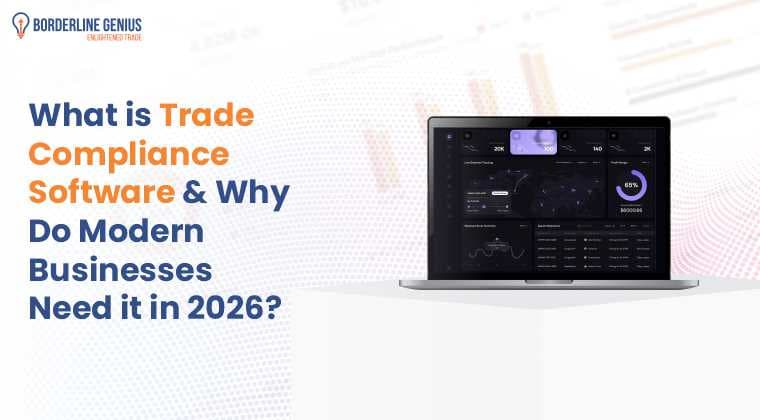
Businesses operating in international markets rely on trade compliance software to manage various regulatory requirements. In 2026, it has become an important digital solution that helps them adhere to global trade regulations, customs procedures, export controls, import regulations, tariff requirements, and complex duty structures.
Globally, as supply chains become more interconnected and regulations rapidly evolve, maintaining compliance is a challenge. As a specialized technology, this software automates different processes to simplify complexities when shipping goods across borders.
Depending on its capabilities, trade compliance software can automate or support processes such as product classification, trade documentation management, and compliance with country-specific requirements.
To better understand how it supports modern trade operations, let us learn more about this technology as well as its functions and features.
What is Trade Compliance Software?
Trade compliance software is a technology solution that enables a business to automate and manage processes across international supply chains. Its capabilities extend across export compliance, import compliance, and customs compliance. The digital system helps organizations comply with trade rules and regulations that meet global standards.
-
Beyond automating individual tasks, such software systems help streamline broader trade compliance workflows by:
-
Centralizing trade data
-
Regularly monitoring any regulatory changes
How Does Trade Compliance Software Work?
At the core, trade compliance software works by automating essential compliance workflows, like product or commodity classification, across customs and import/export operations. In place of conducting manual checks or using disconnected processes, the solution standardizes regular compliance tasks. To do so, it applies existing trade rules along with consistently performing important checks before shipping goods.
The compliance solution also has other functions, including these:
-
By integrating with certain enterprise systems, it screens transactions relating to trade against regulations that apply.
-
It identifies potential compliance risks before processing transactions or shipments.
-
As a platform, it generates the necessary documentation for trade across borders.
-
It is functional for screening business partners, customers, and suppliers against restricted/denied party lists.
-
Before processing shipments, the software verifies:
-
Export controls
-
Trade sanctions
-
Licensing requirements
-
The software uses accurate HS codes, as well as tariff schedules, to classify products.
What are the Main Features of a Global Trade Compliance Platform?
The most important features of a trade compliance platform are centralizing relevant data and accurately classifying goods. Beyond these, it manages licenses and export controls, automates trade documentation, carries out compliance checks, and more. Together, these capabilities help businesses comply better with evolving regulations in the global landscape.
In all, there are 6 key features of the platform that businesses should know.
1. Unifying Trade and Classification Content
For a business to be trade-compliant, the ease of accessing regulatory information matters. A compliance software system combines product classification and trade data, making it accessible in a single space. This content is inclusive of:
-
Export Control Classification Numbers (ECCNs)
-
Harmonized Tariff Schedule (HTS)
-
Free Trade Agreement (FTA) rules
-
Country-wise requirements
-
It automatically maintains these and limits the need to make updates manually.
2. Correct Classification of Goods
One of the top features of international trade compliance software is accurately classifying products for shipping across borders. It determines the correct Harmonized System, or HS codes, along with tariff classifications for import/export items.
3. Automating Trade Documentation
Modern solutions for trade compliance have features like automating the process of creating and managing documents. They make it easier to handle customs declarations, transactions, and other critical paperwork, such as commercial invoices, customs filings, and origin certificates.
-
This functionality is important for reducing manual data entry.
-
It minimizes errors in documents.
-
Inaccuracy in HS codes decreases.
-
Certificates of origin become complete and correct.
4. Management of Licenses, Export Controls, & Embargoes
Trade compliance management software checks if a shipment is in sync with export controls, licenses, and embargoes before it moves. When an export license is required, it helps control the application process, monitor usage, and keep track of approvals.
5. Compliance Checks
Solutions for complying with trade regulations often come with compliance checks. This is an important capability that automates screening to ensure that the shipments are in line with regulatory requirements. Moreover, such systems can:
-
Verify business partners and clients against governmental and international sanction lists
-
Detect potential risks that need to be flagged
-
Identify problems that can impact compliance standards at an early stage
-
Reduce delays in shipping goods for import or export
6. Ensuring Compliance within Business Workflows
Workflow integration is among the main features of global trade compliance software. It combines with enterprise systems like ERP Enterprise Resource Planning, Order Management Systems (OMS), Warehouse Management Systems (WMS), and Transportation Management Systems (TMS).
Note: These are business software systems that organizations use for routine operations like logistics & warehousing.
Why Do Modern Businesses Need Global Trade Compliance Software?
The trading landscape has become complex over time. As regulations evolve, complexities add up for organizations that are part of the supply chain. Since it is essential to comply with these for successful operations within specific countries, the need for simplifying the requirements has been on the rise, especially in 2026.
At the same time, supply chains have expanded across multiple markets. Thus, difficulties have increased in adhering to new shifts while managing manual processes. Depending on disconnected systems, spreadsheets, and internal checks can result in classification errors, incomplete paperwork, and operational delays.
As regulations will continue to change, such traditional approaches may not sync well or efficiently with modern-day compliance needs. It will only become vital to address these challenges through a modern solution. Hence, businesses require global trade compliance software. Considering it as a solution for their emerging needs, it can:
-
Simplify the present-day and futuristic challenges in complying with international or domestic regulations
-
Introduce automation to manage various operations
-
Bring regulatory checks, documentation, trade data, and classification into just one platform
-
Ensure greater compliance and lower operational risks
How Does Borderline Genius Inc. Simplify International Trade Compliance?
As trade regulations will keep evolving, businesses will need something beyond just automation. They will require a solution specifically designed for compliance.
Borderline Genius Inc. is a technology-first global trade compliance company. It's a combination of proprietary AI technology with human intelligence. Thus, complying with country-specific regulations gets easier.
-
Our solutions cut the need for relying on multiple tools and repetitive or manual processes.
-
Using our solutions, businesses can centralize their activities to comply faster.
-
Thus, they can take more informed trade decisions with greater speed.
-
For supporting such requirements, we offer AI-powered solutions backed with human intelligence:
-
These systems enable adapting to recent rules and shifts while aiming for business scalability.
Industries that commonly benefit from trade compliance software include:
-
Automotive: Managing thousands of parts and components requires accurate HS classification and tariff determination across markets.
-
Electronics and Technology: Companies need support with complex product classifications, export controls, and changing regulations.
-
Medical Devices and Healthcare: Accurate classification helps businesses meet import, export, and country-specific compliance requirements.
-
Manufacturing: Large product portfolios make manual classification and compliance management challenging.
-
Aerospace and Defense: Strict export controls require accurate classification and regulatory oversight.
-
Retail and E-commerce: High-volume international shipments require efficient customs and trade compliance processes.
By improving HS code accuracy, tariff management, and import-export compliance workflows, Borderline Genius Inc. helps businesses reduce manual efforts and manage global trade requirements with greater confidence.
Conclusion
Trade compliance software helps businesses manage regulatory requirements across international trade through a centralized and technology-driven approach. As organizations evaluate different solutions, factors such as regulatory coverage, system integration, scalability, and the ability to adapt to changing trade requirements can be just as important as automation itself.
Frequently asked questions
Navigate Global Trade With Greater Confidence
Access expert guidance to help your organization address complex trade, classification, tariff, and compliance challenges.
Talk to a Trade ExpertRelated articles
Keep reading with more guidance on trade compliance and classification.
 7 min read
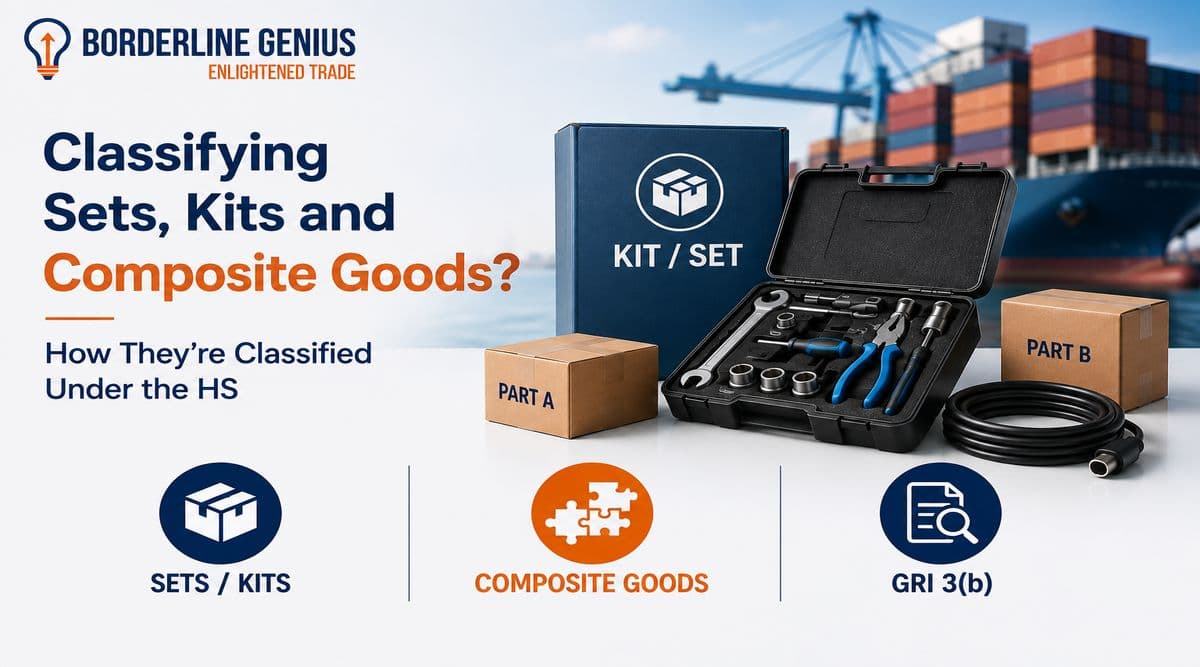
Classifying Sets, Kits and Composite Goods? How They're Classified Under the HS
Gift sets, starter kits and subscription boxes rarely classify the way people assume. How the retail set test, GRI 3(b) essential character and GRI 5 work.
Read article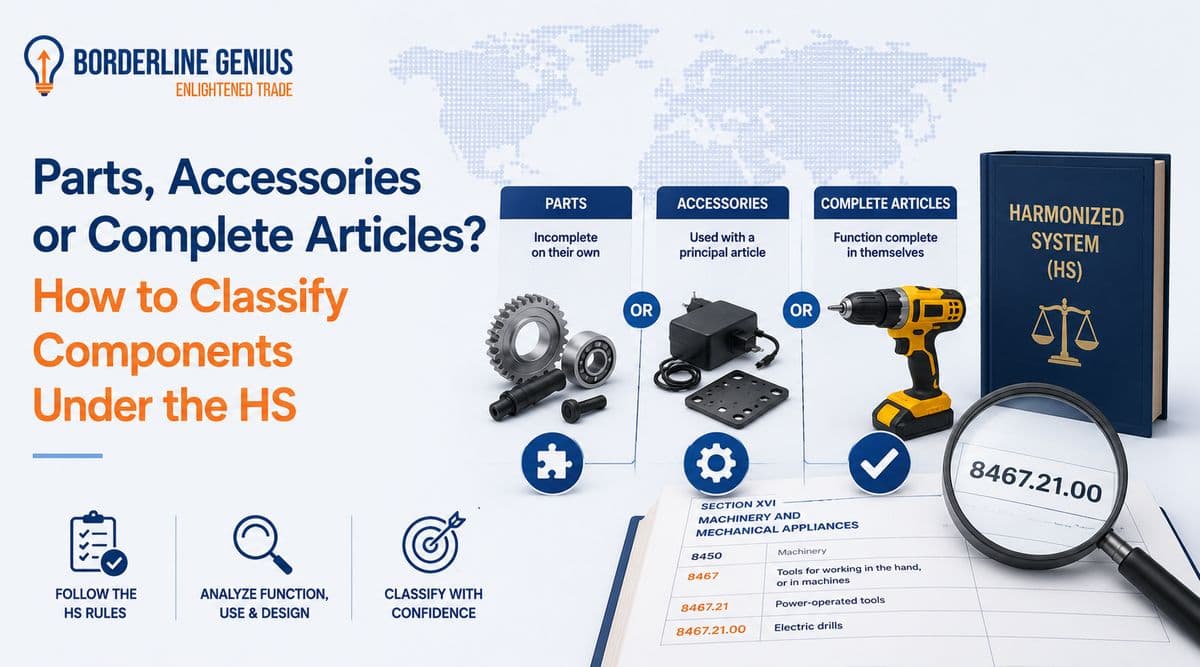 7 min read
Parts, Accessories or Complete Articles? How to Classify Components Under the HS
Parts, accessories or complete articles? The decision sequence for classifying components under the HS: Section XVI notes, parts of general use, GRI 2(a).
Read article 17 min read
The General Rules of Interpretation (GRIs): How Goods are Actually Classified
The six General Rules of Interpretation govern every HS classification decision. Get a full walk-through of GRI 1 to 6, with worked examples and the errors that cost importers money.
Read article