
How to Classify a Product: A Step-by-Step Guide to Find the Right HS Code
Learn how to classify a product and find the right HS code. Understand product information, GRI rules, HS classification, country-specific codes, and common mistakes.
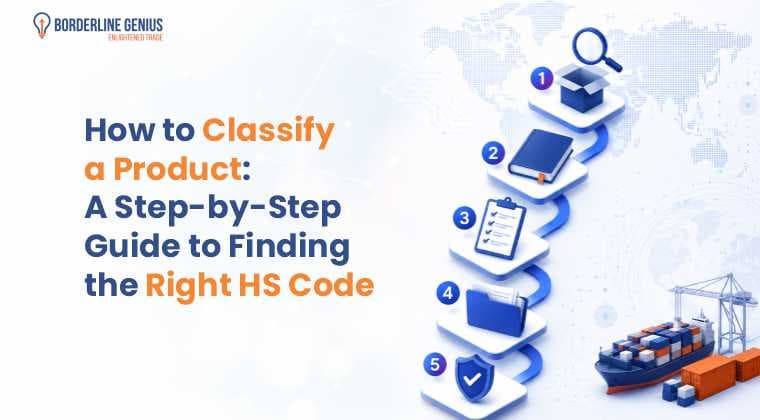
A business involved in international trade needs to classify a product correctly under the Harmonized System (HS). The classification determines how customs authorities treat the finished good, including applicable duties, taxes, trade measures, and other requirements. Finding the right HS code requires more than searching for a product name. Material, function, composition, technical specifications, form, and intended use can affect classification. Knowing how to find an HS code for an article is important because the right classification depends on understanding the item, applying the relevant classification rules, and checking the code carefully before using it for an import or export transaction.
Understanding how to classify a product correctly is important for accurate customs declarations and compliance.
What is an HS Code?
An HS code is a standardized six-digit numerical code used to classify traded products under the Harmonized System. It provides a common basis for identifying goods in international trade and determining their tariff classification across participating countries.
-
WCO, or the World Customs Organization, develops and maintains the Harmonized System.
-
The system organizes traded goods into more than 5,000 commodity groups.
-
Each commodity group is identified using a six-digit HS code.
-
More than 200 countries and economies use the Harmonized System.
-
Countries can add digits to meet their own tariff and statistical requirements.
-
The United States uses the Harmonized Tariff Schedule for imported goods.
-
Schedule B is used for export classification in the United States.
-
The six-digit HS code may not be the final classification required.
Why is Product Classification Important?
Product classification is important because it determines how customs authorities apply tariffs and other trade requirements to a product. Classifying correctly helps businesses establish the applicable duty and tax treatment before completing an import or export transaction.
-
The classification can determine whether additional duties or trade-defense measures apply.
-
An incorrect code can lead to customs questions or shipment delays.
-
Misclassification can result in incorrect duty or tax calculations.
-
Businesses may face additional compliance work when classification errors are identified.
-
Incorrect classification can create unexpected import costs.
-
Customs authorities may challenge a classification and require reclassification.
-
Consistent classification helps businesses apply the same treatment to similar products.
-
Companies managing large product catalogs may need to maintain classification information across multiple sources.
-
Product classification requires ongoing review when products or tariff requirements change.
What Information Do You Need to Classify a Product?
To begin HS code classification, gather as much relevant product information as possible. Starting with an incomplete item description can make classification difficult because names such as “industrial pump,” “smart watch,” “plastic container,” or “electronic device” may not provide enough information to determine the appropriate classification.
1. Product Description
For classifying an article, a clear description should state what it actually is, rather than using only its marketing name or internal SKU. For example, “ProClean 500” could be described as an “electric-powered floor-cleaning machine designed for commercial use.” The description should convey its physical identity and purpose.
2. Material and Composition
To classify a product, the materials and composition of an item can affect its classification. This can happen particularly when it could potentially fall under classifications associated with different materials.
Depending on the item, useful information may include:
-
Primary material
-
Any secondary materials
-
The percentage of each material
-
Chemical composition
-
The product’s construction
-
Any coatings or treatments
-
Whether the item contains multiple materials
3. Function and Intended Use
For product classification, it is important to understand what the item does and what it is designed to be used for. Its function can be a critical factor in determining its classification, particularly when similar-looking products serve different purposes.
-
What does the product do?
-
What is the article designed to be used for?
4. Technical Specifications
One should know technical specifications to distinguish between otherwise similar goods while classifying, especially when their physical appearance or commercial descriptions do not clearly indicate the appropriate classification.
Considering the item, useful information may include:
-
Dimensions
-
Capacity
-
Power rating
-
Voltage
-
Operating characteristics
-
Performance specifications
-
Manufacturing method
-
Components
-
Technical drawings
When classification is difficult, detailed technical information can provide more crucial evidence than a broad commercial description.
5. Condition as Imported or Exported
The condition in which goods cross the border can affect how the classification rules are applied. Relevant details may include whether the shipment contains complete or incomplete products, unassembled items, components, sets, combinations of materials, or mixtures.
6. Supporting Documentation
Businesses can rely on supporting documents to provide additional evidence about a good’s characteristics and help clarify its HS code classification. Useful records may include product specifications, technical datasheets, catalogs, photographs, user manuals, engineering documents, material specifications, and supplier information.
When classifying complex goods, U.S. Customs and Border Protection or CBP’s binding-ruling guidance also emphasizes providing a detailed description of the item and relevant facts when requesting a classification ruling.
How to Classify a Product Step by Step?
Classifying a product involves narrowing the goods from their characteristics to the appropriate HS heading and subheading. The process also requires applying the relevant legal rules, determining any country-specific classification, and validating the final code before using it.
To learn further how to classify a product, go through the steps below:
Step 1: Understand the Product
The first step to classify a product is to establish exactly what you are assigning an HS code to. A complete understanding of the item provides the foundation for evaluating the relevant heading and applying the classification rules correctly.
To define the item accurately, consider these questions:
-
What is the product?
-
What is it made of?
-
What does it do?
-
How is it used?
-
How is it presented?
-
Is it complete or incomplete?
-
Does it contain multiple materials or functions?
Step 2: Identify the Most Relevant HS Section and Chapter
After understanding the product, for classifying it, identify the broad category of goods it belongs to. The Harmonized System follows a hierarchical structure, allowing classification to move from broader categories toward the specific Heading and Subheading that best correspond to the goods.
The HS structure for product classification progresses as follows:
-
Sections provide the broadest grouping of goods.
-
Chapters ascertain the first two digits of the HS Code.
-
Headings determine the first four digits.
-
Subheadings identify the first six digits.
-
The classification should be narrowed progressively rather than selecting a six-digit code at random.
Step 3: Review the Heading Descriptions
With the relevant headings identified for classification, examine their descriptions closely to see how well they correspond to the actual goods. A commercial item name may resemble tariff wording without accurately reflecting the classification. The description itself should be evaluated against the item.
-
Read the actual Heading descriptions in the tariff schedule.
-
Do not choose a code solely because its wording matches the commercial name.
-
Base the classification on the goods and applicable rules.
-
Treat an HS code finder or keyword search as a starting point, not the final answer.
Step 4: Check the Section and Chapter Notes
After reviewing the Heading descriptions, check the relevant Section and Chapter Notes before deciding on the HS code classification. These legal notes can define the scope of a category and may exclude goods that otherwise appear to fit within a particular Heading.
The notes may contain:
-
Definitions
-
Inclusions
-
Exclusions
-
Instructions to classify
-
Scope limitations
Step 5: Apply the General Rules of Interpretation
Once the relevant notes have been reviewed, the General Rules of Interpretation (GRIs) guide how competing classification possibilities are resolved. They are particularly relevant when items are incomplete, combined, or appear to fit more than one Heading.
The GRIs address the classification of:
-
Incomplete or unassembled products
-
Mixtures or combinations of materials
-
Articles that appear to fall under multiple Headings
-
Sets or composite goods
-
Classification at the Subheading level
Step 6: Determine the Correct Six-Digit HS Subheading
The relevant Heading provides the basis for narrowing the classification to the correct six-digit Subheading. This is the internationally harmonized level of the HS, where the selected code should correspond to the specific characteristics of the item.
So, the classification should connect:
-
Product characteristics to the applicable Heading
-
The Heading to the relevant Subheading
-
And the item to the classification rules rather than simply matching a search result
Step 7: Determine the Country-Specific Classification
Next, to classify a product, the six-digit HS code may need to be extended to meet the tariff requirements of the country involved in the transaction. National tariff schedules can add digits beyond the internationally harmonized level to provide additional tariff and statistical detail.
-
Countries can extend the six-digit HS structure with additional digits.
-
The United States uses the HTS for imports.
-
Schedule B is used for exports in the United States.
-
International HS codes form the first six digits of these classifications.
-
Country-specific requirements determine the final classification for the transaction.
Step 8: Validate the Classification
Before using the classification for a transaction, verify that the selected code accurately reflects the item and the reasoning used to reach it. This final review helps identify gaps in product information, interpretation, documentation, or country-specific tariff requirements.
-
Check whether the code accurately describes the product.
-
Ensure that its primary function has been considered.
-
See to it that its material or composition has been accounted for.
-
Determine that the relevant Section and Chapter Notes have been reviewed.
-
Check that the applicable interpretation rules have been applied.
-
The correct country’s tariff schedule should be in use.
-
Make sure that the previous decisions for comparable products support the classification.
-
Lastly, the additional documentation or expert review should be warranted.
For complex or high-value products, businesses may seek formal classification guidance from the relevant customs authority. In the United States, CBP’s Binding Ruling Program provides binding classification decisions before importation.
A Practical HS Code Classification Checklist
Before finalizing an HS code, a practical HS code classification checklist can be used to confirm that the necessary product details, classification research, and validation checks have been completed. It provides a structured review to reduce gaps and support consistent classification decisions.
The product information should cover:
-
Clear product description
-
Material and composition
-
Primary function
-
Intended use
-
Technical specifications
-
Product form and condition
-
Supporting documentation
Ideally, the classification research should cover:
-
Relevant Section identified
-
Essential Chapter detected
-
Potential Headings reviewed
-
Section Notes assessed
-
Chapter Notes reviewed
-
General Rules of Interpretation considered
-
Correct six-digit HS subheading identified
-
Country-specific tariff classification checked
The final validation should cover:
-
Classification reasoning documented
-
Comparable previous classifications reviewed
-
Current tariff schedule checked
-
Complex or uncertain classifications escalated for expert review where appropriate
Why Does HS Code Classification Get Difficult at Scale?
HS code classification becomes difficult at scale when a business must classify a large and changing product catalog. Maintaining consistency becomes harder when classification involves multiple products, teams, and markets.
The challenge increases when a business has:
-
Hundreds or thousands of SKUs
-
Multiple product categories
-
Frequent new product introductions
-
Multiple markets with different tariff requirements
-
Different teams handling classification
-
Historical classifications stored in spreadsheets
-
Incomplete product information from suppliers
Can AI Help with HS Code Classification?
Indeed, AI can assist with HS classification by analyzing product information and identifying potential classification options. It can reduce manual research across large tariff schedules. However, classification rules and expert judgment remain important when products have complex or uncertain characteristics.
How can Artificial Intelligence Support Classification?
AI can help a business handle repetitive product classification tasks and review large volumes of data.
-
Moreover, it can identify potential classification options for review.
-
Automated analysis can reduce manual tariff research.
-
Machine-learning models have been studied for customs goods classification.
Importance of Human Review
Along with the use of artificial intelligence for classifying items, human review remains important when product information is ambiguous or several possibilities appear relevant. Technical characteristics and the interpretation of classification rules can further affect the final decision.
A practical hybrid approach is:
Product information → AI-assisted analysis → Expert review → Documented classification
How Does Classification Genius Help Businesses Classify Products at Scale?
Classification Genius helps businesses manage the classification of goods at scale by combining AI-assisted analysis with expert review. The HS code classification software supports teams handling large product catalogs by organizing their information. It generates recommendations for review across products, teams, and markets.
Product Information Used for Classification
A business can submit product information instead of researching each item entirely from scratch. Classification Genius analyzes the available information. It supports classification research and provides relevant recommendations for review by trade professionals.
-
Product descriptions establish what the item is.
-
Technical specifications offer relevant characteristics of items.
-
Material and composition details add classification context.
-
Supporting documentation gives additional evidence.
5 Common Mistakes to Avoid When Classifying Products
Relying on the product name alone is a common mistake that can lead to incorrect classification, as commercial names may not match the terminology used in the tariff schedule. The item’s characteristics, function, composition, and intended use should also be considered to avoid the wrong HS code.
-
Choosing the first search result can be misleading because an HS code lookup only identifies potential candidates.
-
Ignoring product composition can affect classification when an item contains multiple materials.
-
Skipping Section and Chapter Notes can lead to classification errors.
-
Treating the six-digit HS code as final can cause errors because countries may extend it for national tariff purposes.
-
Using an old classification without rechecking it can cause errors when tariff schedules or classification requirements change.
How to Find an HS Code: A Simple Summary
Finding an HS code requires a structured review of the product and the applicable classification rules. The process moves from understanding the product to identifying the relevant classification, checking national requirements, and validating the final decision.
-
Understand the item by reviewing its material, function, composition, specifications, and intended use.
-
Identify the relevant HS Section and Chapter.
-
Review candidate Headings against the actual tariff descriptions.
-
Check the applicable Section and Chapter Notes.
-
Apply the General Rules of Interpretation to resolve classification questions.
-
Determine the appropriate six-digit HS Subheading.
-
Check the destination country’s national tariff extension.
-
Validate and document the classification reasoning and supporting product information.
Concerning how to find HS codes for larger catalogs and more complex products, classification requirements may require a structured workflow supported by technology and trade expertise.
Final Takeaway
HS code classification is not simply a matter of looking up a product name. The right classification starts with understanding the product in detail, then applying the Harmonized System's structure and classification rules systematically. Whether one classifies products manually or uses an HS code finder/product classification software, the same principle applies. Start with the item, not the code.
Frequently asked questions
Navigate Global Trade With Greater Confidence
Access expert guidance to help your organization address complex trade, classification, tariff, and compliance challenges.
Talk to a Trade ExpertRelated articles
Keep reading with more guidance on trade compliance and classification.
 9 min read
Why the Harmonized System Changes Every Five Years and What Drives Each Revision
Discover how the harmonized system review cycle works, how the WCO revises the HS through Article 16, and what drives each revision.
Read article 11 min read
Harmonized System and HS Codes: An In-Depth Guide for Trade Professionals
Learn how the Harmonized System works, understand HS codes, product classification, tariff determination, customs procedures, and international trade compliance.
Read article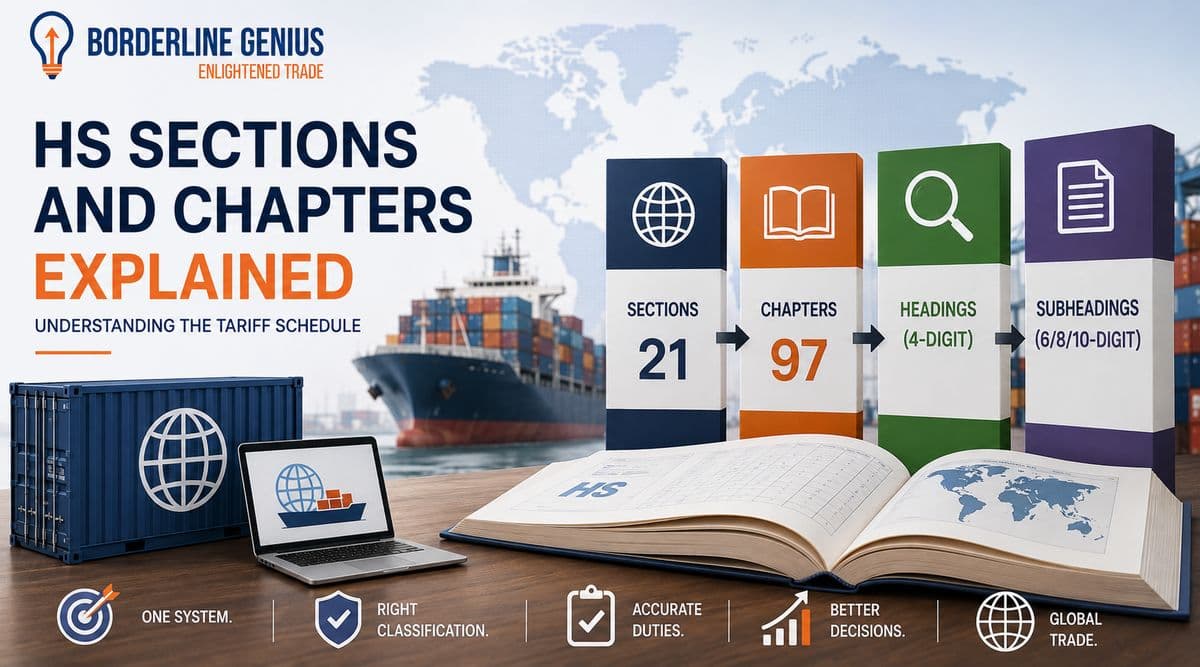 12 min read
HS Sections and Chapters Explained: Understanding the Tariff Schedule
Learn how the Harmonized System is structured with a complete guide to its 21 Sections, 97 Chapters, and the classification principles that organize the tariff schedule.
Read article