
Why the Harmonized System Changes Every Five Years and What Drives Each Revision
Discover how the harmonized system review cycle works, how the WCO revises the HS through Article 16, and what drives each revision.
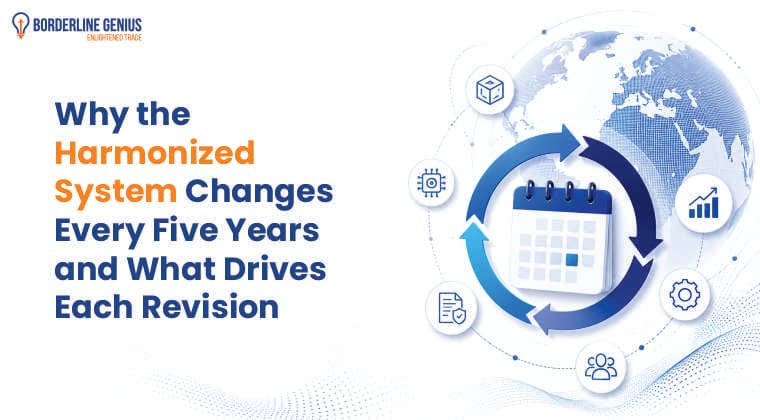
The Harmonized System review cycle means a tariff code is not a permanent address. Roughly every five years, a new edition of the Harmonized System moves some of the world's goods to different codes, and most trade professionals experience the effects directly: a code disappears, a declaration is rejected, or a ruling no longer applies.
Behind these changes is an unusually orderly mechanism. Maintained by the World Customs Organization (WCO) under an international treaty, the Harmonized System follows a defined process that specifies who may propose amendments, who decides them, and how they become binding.
That is why HS revision dates are among the few developments in trade policy that businesses can plan for years in advance. HS 2028 was accepted in January 2026 and takes effect on 1 January 2028.
This article explains how the review cycle works, what makes an amendment proposal succeed, and why countries do not all implement a new HS edition at the same time.
Why Does the Harmonized System Change at All?
The HS is a description of world trade, and world trade does not hold still. Products appear that no heading anticipated. Categories grow from rounding errors to substantial trade flows, at which point governments want them counted separately. Regulators also introduce control measures that require customs data the current structure cannot provide.
Left unchanged, the gap between what the codes describe and what crosses borders would continue to widen until the system no longer served revenue or policy objectives effectively. The Harmonized System review cycle ensures the nomenclature remains aligned with changes in international trade and continues to function as a common classification language for more than 200 countries.
This keeps the original writing style intact, adds only one keyword naturally, and avoids unnecessary rewriting.
How Long is the Review Cycle and Who Runs it?
The European Commission describes the HS as being updated through a 5-year review cycle. The HS review cycle is managed by three bodies, each with a distinct role in developing and approving amendments.
-
First, the HS Review Sub-Committee carries out the technical drafting. It revises proposals, consolidates overlapping submissions, and removes those that cannot be implemented. Straightforward proposals may be accepted during the first review, while more complex issues can remain under discussion for several years.
-
Next, the Harmonized System Committee considers the proposed amendments. It meets twice a year in Brussels, and approval requires a two-thirds majority of the votes cast.
-
Finally, the WCO Council adopts the completed package and recommends it to the contracting parties.
-
The seventh review cycle, which produced HS 2028, ran from July 2019 to June 2025; six years rather than five. This exceptional extension reflected the disruption caused by the COVID-19 pandemic to the committee timetable.
How Does an HS Revision Become Binding?
Amendments to the Harmonized System become legally binding through the procedure established under the Article 16 HS Convention. The WCO Council issues a Recommendation, contracting parties are notified, and the amendments are deemed accepted if no objection is received within six months.
Once the 6-month objection period expires, no further ratification or vote is required. Silence constitutes acceptance, and the new HS edition becomes binding under the Convention, leaving only implementation by the contracting parties.
|
Step |
Who acts |
What happens |
Timing for HS 2028 |
|
Proposal |
Member administration or recognised body |
A change to a heading, subheading or note is submitted with supporting evidence |
Throughout the cycle |
|
Technical review |
HS Review Sub-Committee |
Proposals examined, redrafted, merged or dropped |
Jul 2019 – 2025 |
|
Approval |
Harmonized System Committee |
Package approved by two-thirds majority |
March 2025 |
|
Recommendation |
WCO Council |
Adopted as an Article 16 Recommendation |
June 2025 |
|
Tacit acceptance |
Contracting parties |
Six months to object; absent objection, accepted automatically |
Closed December 2025 |
|
Publication |
WCO |
Amendments published; correlation tables and Explanatory Notes follow |
From January 2026 |
|
National transposition |
Each administration |
National schedules rebuilt on the new structure |
2026 – 2027 |
|
Entry into force |
— |
New edition applies |
1 January 2028 |
Following tacit acceptance, the WCO allows approximately 2 years for publication, correlation tables, Explanatory Notes, translations, and national implementation. This final stage of the Harmonized System review cycle gives customs administrations the time needed to update tariff schedules, revise legislation, adapt systems, and prepare stakeholders before a new HS edition enters into force.
What Makes an HS Amendment Proposal Succeed?
Proposals that progress through the WCO HS amendment process generally do so for one of three reasons.
-
First, trade volume has grown enough to justify separate statistical visibility. A category once buried in a residual "other" subheading may eventually account for sufficient trade that governments require it to be identified separately.
-
Second, a policy regime requires data the current structure cannot provide. Plastic waste is the clearest recent example. HS 2028 restructures these provisions to align with the Basel Convention's categories for hazardous, prior-informed-consent, and other plastic waste. As a result, customs classification and waste-shipment controls now operate within a consistent framework.
-
Third, a persistent classification dispute requires a structural solution. Dietary supplements are a well-known example. For decades, they were classified as food preparations, pharmaceutical products, or beverages depending on their form and marketing claims, often resulting in different duty outcomes. HS 2028 introduces a dedicated Heading 21.07, resolving the issue through the nomenclature rather than repeated case-by-case decisions.
Note: Where a classification dispute recurs across importers and jurisdictions, structural amendment is often the most durable solution. It is also the slowest, with changes typically measured in review cycles rather than months.
Who can Propose an HS Amendment?
Member customs administrations, industry bodies, and international organizations all help shape the amendment agenda. Although the private sector frequently identifies the need for a change, proposals must be submitted through a national customs administration or another recognized body participating in the Harmonized System Committee. Individual companies cannot submit proposals directly to the WCO.
Timing is often the greater constraint. With a five-to-six-year review cycle followed by approximately two years before a new edition enters into force, a proposal submitted today would most likely appear in the edition following HS 2028, based on the established pattern. The WCO has not yet announced the timetable for that edition.
Why Doesn’t a New HS Edition Take Effect Everywhere at the Same Time?
The HS is standardized at 6 digits and no further. Almost every country extends it to 8 or 10 digits to incorporate duty rates, statistical requirements, and regulatory measures, and those national extensions must be rebuilt whenever a new HS edition is introduced. Maintaining those schedules is an essential part of trade compliance across different jurisdictions.
Each country completes this work through its own legislative or administrative process, which varies in timing, consultation, and publication requirements. As a result, national tariff schedules become available at different stages during the two years preceding the entry into force of a new HS edition, and some administrations have historically adopted them later than others.
Note: The international implementation date indicates when the HS structure changes, not when a country's working tariff schedule becomes available. For businesses operating across multiple markets, the practical implementation timeline is often determined by the last national schedule to be published.
How Many HS Editions have there been?
The HS edition history begins with the adoption of the HS Convention in June 1983, followed by the Harmonized System's entry into force in January 1988. Amended editions were introduced in 1996, 2002, 2007, 2012, 2017, and 2022. The WCO recognizes HS 2017 as the sixth edition, HS 2022 as the seventh, and HS 2028 as the eighth.
Take into account that the focus of these revisions has also evolved. While earlier editions primarily supported revenue collection and trade statistics, more recent updates increasingly address environmental protection, public health, and enforcement priorities alongside their original objectives.
In Summary
Understanding the Harmonized System review cycle helps businesses anticipate future classification changes rather than react to them. Treating each HS edition as part of an ongoing compliance process allows organizations to prepare for revisions in advance and adapt more efficiently as the Harmonized System continues to evolve.
Frequently asked questions
Navigate Global Trade With Greater Confidence
Access expert guidance to help your organization address complex trade, classification, tariff, and compliance challenges.
Talk to a Trade ExpertRelated articles
Keep reading with more guidance on trade compliance and classification.
 11 min read
Harmonized System and HS Codes: An In-Depth Guide for Trade Professionals
Learn how the Harmonized System works, understand HS codes, product classification, tariff determination, customs procedures, and international trade compliance.
Read article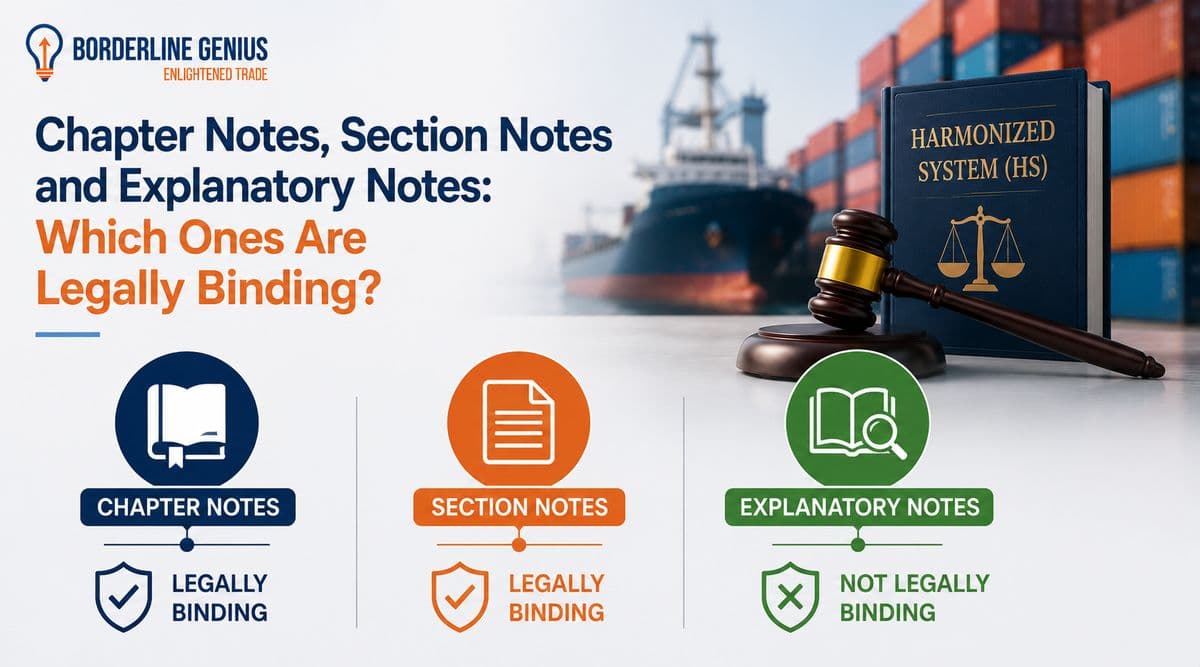 10 min read
Chapter Notes, Section Notes and Explanatory Notes: Which Ones Are Legally Binding?
Section and chapter notes are binding law. WCO Explanatory Notes are not. A clear hierarchy of HS interpretive authority, and what to do when they conflict.
Read article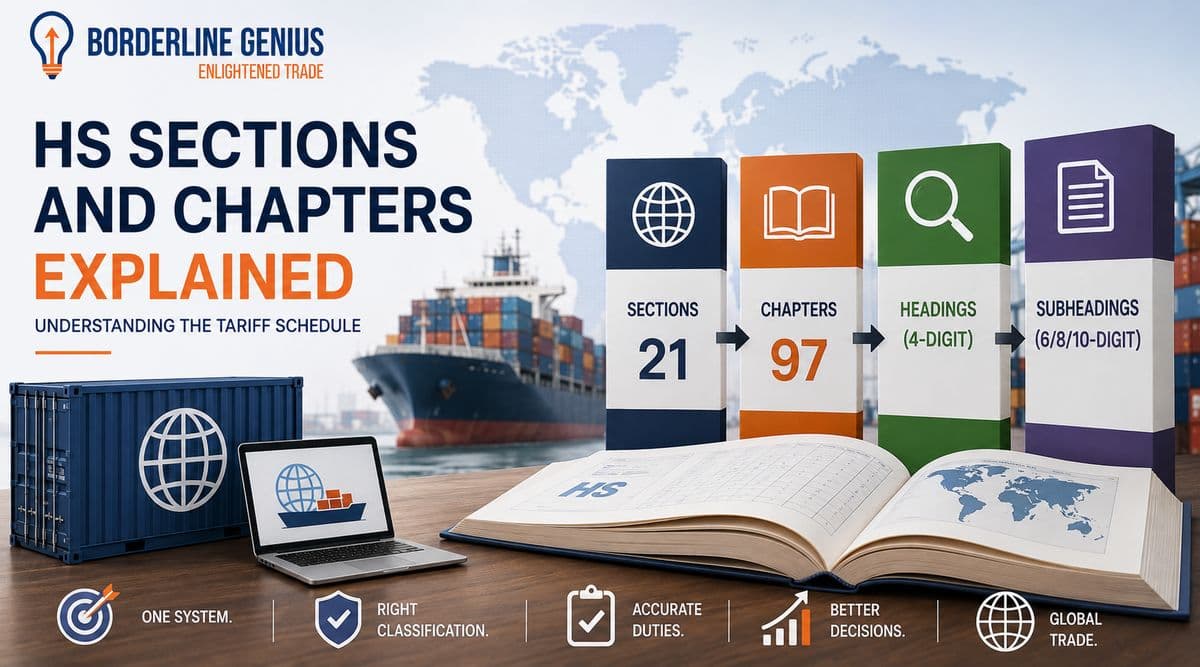 12 min read
HS Sections and Chapters Explained: Understanding the Tariff Schedule
Learn how the Harmonized System is structured with a complete guide to its 21 Sections, 97 Chapters, and the classification principles that organize the tariff schedule.
Read article