
What Happens When You Get an HS Code Wrong: Penalties, Delays, and Retroactive Duties
Learn the risks of incorrect HS codes, from delayed shipments and additional duties to licensing issues, failed origin claims, and customs penalties.
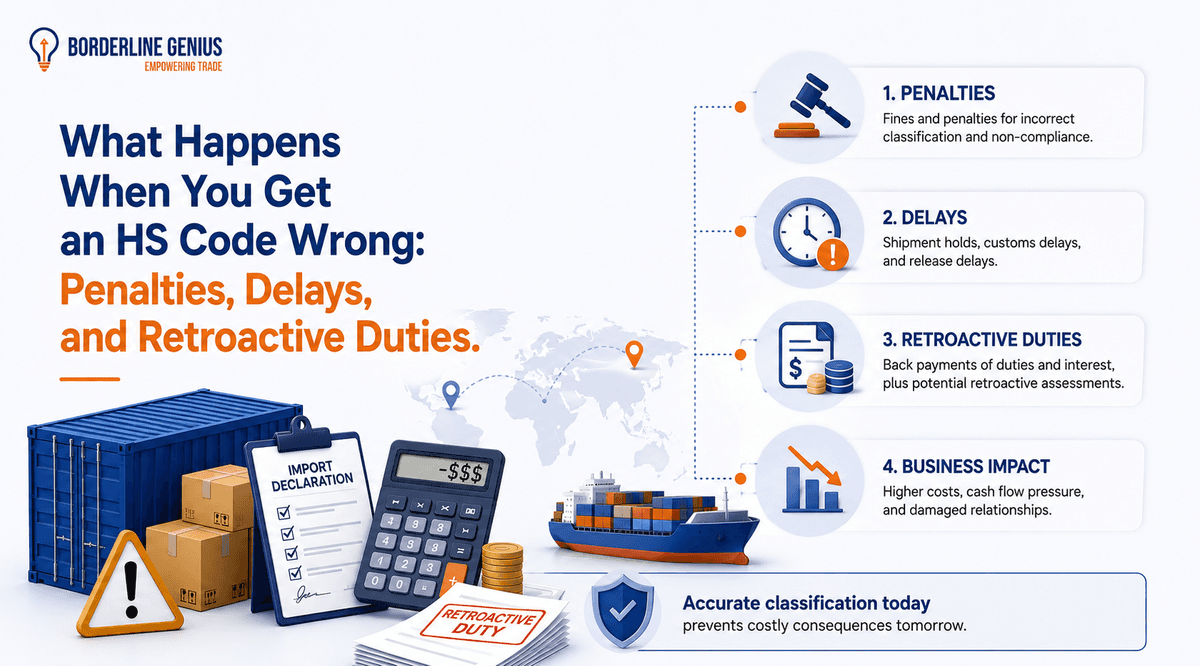
Using the wrong HS code can trigger consequences that extend far beyond a shipment delay. While an incorrect classification may initially appear to be a simple administrative error, it can affect duties, preferential origin claims, licensing requirements, trade remedies, and future enforcement actions.
The financial impact is often delayed rather than immediate. A tariff classification applied today may continue across hundreds of future entries before an issue is identified, exposing businesses to additional duties, penalties, and regulatory scrutiny years after the original declaration.
Explore how an incorrect HS code can affect imports, from the first customs hold to long-term enforcement risks, and what businesses can do to reduce that exposure.
What Happens Immediately When an HS Code is Wrong?
A wrong HS code can result in a declaration being rejected or a shipment being held for customs review before clearance. If the code no longer exists, is structurally invalid, or does not match the goods description, customs systems may stop the declaration for further verification. These are often the earliest HS code misclassification consequences businesses encounter.
-
The correction itself is usually straightforward.
-
Its real cost comes from what accumulates while the shipment remains on hold.
-
This includes demurrage, storage charges, equipment detention, and missed delivery commitments.
-
The more serious risk is a plausible but incorrect code.
-
It may clear repeatedly without challenge, only to be identified years later during a customs audit.
-
This exposes every shipment declared under the same classification.
How Does the Wrong HS Code Change the Duty You Owe?
The duty payable depends on the tariff classification declared. When an inaccurate HS code is used, businesses may either underpay or overpay duties, but the financial consequences are rarely the same. These are among the most significant wrong HS code penalties importers face.
Underpayment of Penalties
Any duty shortfall generally remains payable, together with applicable interest, for the entire period open to reassessment. Liability rests with the importer of record, regardless of who prepared or submitted the declaration. It can also trigger customs penalties for wrong tariff code where the customs authority determines that the incorrect classification led to revenue loss.
Penalty Overpayment
Recovering excess duty depends on each jurisdiction's correction and refund procedures, which are subject to statutory time limits. Once entries have been finally liquidated or the amendment period has expired, overpaid duties are often no longer recoverable.
In practice, classifying goods under a lower-duty code can result in additional duties, interest, and penalties, while using a higher-duty code may permanently increase import costs.
Can an Incorrect HS Code Affect a Preferential Origin Claim?
An incorrect HS code can invalidate a preferential origin claim because origin rules are applied against the declared tariff classification. This is one of the most significant HS code misclassification consequences, yet it is often overlooked.
-
Preferential rules of origin are written by tariff line.
-
Requirements such as a change in tariff heading, regional value content, or a specified manufacturing process are linked to a particular classification.
-
If the declared classification is inaccurate, the origin rule applied is also incorrect, and the resulting origin determination may no longer be valid.
-
The impact can be retroactive.
-
A shipment that originally entered duty-free may become dutiable if the origin claim is denied, and the same reasoning can extend to earlier imports of the product.
-
These issues are frequently identified during a post-clearance audit, when customs authorities reassess previously accepted declarations.
Which Regulatory Controls Depend on the Tariff Code?
Many regulatory requirements are linked to the declared tariff classification because customs systems use that code to determine which controls apply. Classifying inaccurately can trigger HS code misclassification consequences that extend beyond duty liability.
These may include:
-
An import that required a licence but was declared without one.
-
A consignment that should have been referred for veterinary or plant health inspection.
-
Controlled goods entering without the mandatory screening required under applicable control lists.
-
A quota allocated against the wrong tariff line, or not allocated at all.
Unlike a duty shortfall, regulatory non-compliance cannot usually be resolved by paying additional duties later. Such breaches may lead to customs penalties for wrong tariff code, separate regulatory sanctions, or, in some cases, criminal liability.
How can an Incorrect HS Code Affect Trade Remedies?
Trade remedy measures are applied according to tariff classification and product scope. An incorrect declaration does not remove goods from the scope of those measures. This is one of the most expensive HS code misclassification consequences, particularly where trade remedies apply.
Anti-dumping and countervailing duty orders, safeguard measures, and other sector-specific actions are all administered against tariff lines. If goods fall within the applicable scope, using a different tariff classification does not eliminate the underlying liability.
In EAPA Consolidated Case No. 8163, a U.S. Enforce and Protect Act proceeding involving solar cells decided on 23 June 2026, CBP found evasion and held that, for AD/CVD purposes, origin followed the country where the photovoltaic cell was manufactured rather than where the module was assembled. As a result, cash deposit rates of 271.28% for Vietnam and 238.95% for China-wide entries applied as anti-dumping duties.
The case further demonstrates that cooperation has limits. Verified production records and full cooperation helped mitigate the record but did not prevent the evasion finding or the resulting retroactive duties.
What Penalties Apply for HS Code Misclassification?
Penalties for tariff misclassification vary by jurisdiction. This is because each customs authority applies its own enforcement framework. The United States provides one of the clearest examples through 19 USC 1592 penalties, although these rules apply only under U.S. customs law.
|
Culpability |
Maximum Where Duty was Lost |
Maximum Where No Revenue was Lost |
|
Fraud |
Domestic value of the merchandise |
Domestic value of the merchandise |
|
Gross negligence |
Lesser of domestic value or 4× the loss of duties |
40% of dutiable value |
|
Negligence |
Lesser of domestic value or 2× the loss of duties |
20% of dutiable value |
Penalties may apply even when no duty has been lost. Under the U.S. Customs Modernization Act, the importer of record has an affirmative duty to exercise reasonable care when declaring imported goods, while CBP is responsible for determining the final amount due. Failure to meet this standard can result in customs penalties for wrong tariff code, depending on the level of culpability.
The European Union follows a different approach. Article 42 of the Union Customs Code requires Member States to impose penalties that are "effective, proportionate and dissuasive". But the nature and amount of those penalties are determined under each country's national legislation.
How Far Back Can Customs Authorities Review Past Imports?
Customs authorities can review past imports for several years after goods have been cleared, depending on the jurisdiction's recordkeeping and reassessment rules. These review periods are a key reason why wrong HS code penalties often extend well beyond the original shipment.
United States
Under 19 U.S.C. §1508, import records must generally be retained for 5 years from the date of entry. Separate penalties may also apply under §1509 for recordkeeping failures, including fines of up to $100,000 or 75% of the appraised value per release for willful non-compliance.
European Union
Article 51 of the Union Customs Code establishes a three-year baseline for customs review, although individual Member States may apply longer periods under their national laws.
An incorrect classification continues to affect every shipment declared under the same code until it is corrected. As a result, issues identified during a post-clearance review or customs audit can expose years of entries to additional duties, interest, and penalties. Even a small duty difference can become a significant financial liability when applied across high import volumes.
Why is HS Code Misclassification Increasingly a Fraud Enforcement Issue?
HS code misclassification is no longer treated solely as a customs compliance issue. In some jurisdictions, it can trigger fraud investigations, particularly where authorities believe an incorrect classification was used to avoid duties. These are among the most serious HS code misclassification consequences.
-
In the United States, the False Claims Act has become an important enforcement tool alongside customs laws.
-
On 12 May 2026, the Department of Justice announced a record FCA customs settlement of $549.5 million in the Perfectus Aluminum matter.
-
This involved the alleged evasion of AD/CVD on Chinese aluminium extrusions declared as finished merchandise.
-
Enforcement risk is no longer limited to customs inspections.
-
Competitors, former employees, and other whistleblowers can initiate investigations through qui tam actions, expanding the scope of potential enforcement.
-
The DOJ Trade Fraud Task Force, established in August 2024, recovered more than $1 billion in under a year, highlighting the increasing focus on trade-related fraud.
What can Businesses Do to Reduce Misclassification Risk?
Reducing the risk of wrong HS code penalties begins with improving classification decisions before goods are declared. A documented and consistent approach helps businesses demonstrate reasonable care and reduces the likelihood of costly reassessments.
Among all, 3 measures have the greatest impact:
Classify Products Using Documented Reasoning
Apply the General Rules of Interpretation in sequence and record which rule determined the final classification. Maintaining this rationale often distinguishes reasonable care from negligence during customs reviews.
Obtain a Binding Tariff Ruling for High-Risk Products
Where duty exposure, import volumes, or regulatory requirements are significant, a binding ruling provides certainty by confirming the customs authority's position before importation.
Create Customs-Ready Product Descriptions
Accurate classification starts with complete product information. Descriptions that include composition, function, and technical specifications support consistent HS Classification and reduce the risk of downstream errors.
Note: Under 19 U.S.C. §1592(c)(4), a prior disclosure can limit liability to interest on the unpaid duties if submitted before a formal investigation begins. However, because such disclosures may now attract closer scrutiny or trigger a DOJ referral, businesses should seek appropriate advice before proceeding.
In Conclusion,
The consequences of an incorrect HS code rarely end with a delayed shipment. They can continue through reassessments, regulatory action, and enforcement long after goods have cleared customs. Identifying high-risk products early and supporting their classifications with documented reasoning remains one of the most effective ways to reduce long-term exposure.
Frequently asked questions
Navigate Global Trade With Greater Confidence
Access expert guidance to help your organization address complex trade, classification, tariff, and compliance challenges.
Talk to a Trade ExpertRelated articles
Keep reading with more guidance on trade compliance and classification.
 14 min read
Common HS Code Classification Mistakes that Cause Customs Problems
Learn the most common HS code classification mistakes, why they happen, and how businesses can reduce product misclassification, customs delays, and unexpected costs.
Read article 14 min read
HS Code vs HTS Code vs Schedule B: What’s the Difference?
Learn the difference between HS codes, HTS codes, and Schedule B codes. Understand the 6-digit HS system, U.S. import classifications, and export codes.
Read article 11 min read
Harmonized System and HS Codes: An In-Depth Guide for Trade Professionals
Learn how the Harmonized System works, understand HS codes, product classification, tariff determination, customs procedures, and international trade compliance.
Read article