
Common HS Code Classification Mistakes that Cause Customs Problems
Learn the most common HS code classification mistakes, why they happen, and how businesses can reduce product misclassification, customs delays, and unexpected costs.
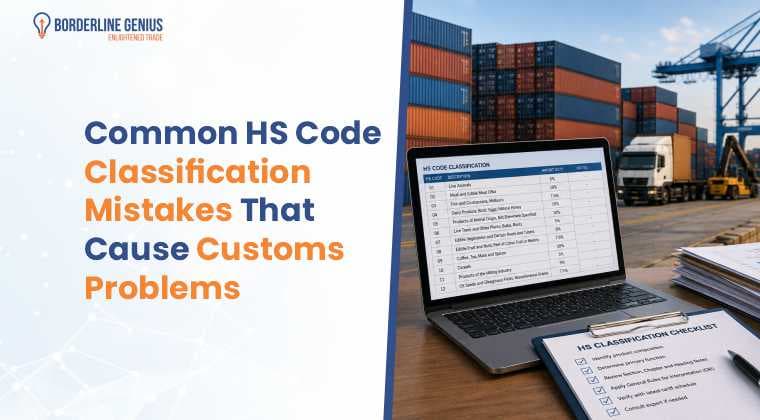
Getting an HS code wrong can look like a small data-entry problem. In reality, product misclassification can affect duties, customs treatment, compliance requirements, and the overall cost and predictability of international trade. The difficulty is that most classification mistakes don't happen because someone cannot find an HS code. They happen because the classification process starts with incomplete product information, relies too heavily on keywords, overlooks classification rules, or fails to account for the country-specific tariff system.
The Harmonized System is used by more than 200 countries and economies, with more than 5,000 commodity groups identified at the six-digit level. Its structure is supported by legal rules designed to achieve consistent classification. For businesses managing hundreds or thousands of products, these mistakes can become difficult to identify and even harder to correct.
Here are some of the most common HS code classification mistakes, why they happen, and how businesses can reduce the risk.
1. Classifying a Product Based Only on Its Name
One of the most common HS classification errors is treating the product name as the classification.
A product may have a commercial name, SKU name, marketing name, or supplier description that does not accurately communicate the characteristics that matter for customs classification.
For example, a product called:
"Industrial Smart Controller"
doesn't necessarily tell you enough to determine its classification.
You may need to know:
-
What the product does
-
What it is made of
-
How it operates
-
Its technical specifications
-
Its intended use
-
Whether it is a complete product or component
-
Whether it incorporates other functions
This is why a simple HS code lookup based on product names can produce misleading results.
The classification needs to be based on the actual characteristics of the merchandise and the applicable tariff provisions.
CBP guidance specifically emphasizes the importance of providing sufficient product information when determining classification, and its published guidance notes that incomplete descriptions can lead to incorrect HTS classifications.
Better approach
Start with the product, not the keyword.
Build a sufficiently detailed product description before searching for a classification.
2. Choosing the First HS Code That Looks Relevant
Another common mistake is finding a tariff description that appears to match the product and immediately selecting it.
This can happen with both manual research and digital HS code finder tools.
The problem is that several headings can sometimes appear relevant.
The correct classification requires you to determine which provision actually applies under the relevant classification rules.
For example, the Harmonized System does not simply ask:
"Which description sounds most like my product?"
It applies a structured set of rules to determine classification.
For U.S. imports, CBP explains that classification under the HTSUS is governed by the General Rules of Interpretation and applicable section and chapter notes.
Better approach
Treat search results as candidate classifications, not automatically as final classifications.
Then validate the candidate against:
-
Heading descriptions
-
Section Notes
-
Chapter Notes
-
Subheading structure
-
General Rules of Interpretation
-
Relevant classification decisions
3. Ignoring the Product's Material or Composition
For many products, what something is made of can be just as important as what it does.
This is particularly relevant for products involving:
-
Multiple materials
-
Composite construction
-
Chemical compositions
-
Blended materials
-
Coated materials
-
Products containing several components
A product described simply as a "container," for example, may require substantially different classification analysis depending on whether it is made from plastic, steel, glass, or another material.
The mistake is assuming that the product's broad commercial category is enough.
Better approach
Capture the product's material and composition as part of the classification record.
For complex products, supporting documentation such as technical specifications, material declarations, drawings, or product datasheets can be important.
4. Ignoring the Product's Function and Intended Use
Two products can look similar but perform different functions.
Conversely, products that look different may perform a similar function relevant to classification.
This makes product function an important part of the classification analysis.
Depending on the tariff provision, intended or principal use can also be relevant. U.S. classification rulings demonstrate that certain provisions are controlled by use and that the applicable rules can determine how that use is evaluated.
Better approach
For every product, ask:
What does it do?
and, where relevant:
What is it principally used for?
Don't rely exclusively on appearance or commercial naming.
5. Stopping at the Six-Digit HS Code
The six-digit HS code is internationally harmonized, but it isn't necessarily the complete classification needed for a specific country's customs process.
Countries can extend the HS structure beyond six digits for national tariff and statistical purposes.
This is particularly important for U.S. businesses, where the HTS provides additional U.S.-specific classification detail for imports.
So:
HS code ≠ necessarily final country-specific tariff code
A business may correctly identify the six-digit HS subheading and still need to determine the appropriate national classification.
Better approach
Always ask:
Which country's classification do I need?
Then continue the classification process using that country's tariff schedule.
6. Using a Supplier's Classification Without Validating It
Suppliers frequently provide HS or tariff codes on:
-
Commercial invoices
-
Packing lists
-
Product catalogs
-
Purchase orders
-
Shipping documents
That information can be useful.
But it should not automatically be treated as the final classification for your import transaction.
The supplier may have classified the product according to the tariff system of the exporting country, while your business needs the classification applicable in the importing country.
Even where the six-digit HS portion aligns, country-specific classifications can differ.
Better approach
Use supplier-provided classifications as input, not unquestioned truth.
Validate them against the relevant destination country's tariff schedule and classification rules.
7. Ignoring Section and Chapter Notes
A heading can look like an obvious match until you read the legal notes associated with it.
The Harmonized System is not just a list of product descriptions. It is a legal and logical classification structure supported by rules and notes.
Relevant Section or Chapter Notes can:
-
Define terms
-
Include particular products
-
Exclude products
-
Direct products to another heading
-
Establish how certain categories should be interpreted
This is one of the biggest differences between a basic keyword search and proper classification research.
Better approach
Never finalize an HS code solely because the product appears to match the heading description.
Check the relevant notes before making the decision.
8. Failing to Consider Previous Classification Decisions
Classification doesn't happen in a vacuum.
There may already be relevant decisions involving similar products.
The WCO maintains classification decisions and a Compendium of Classification Opinions covering significant or difficult classification questions. Its Explanatory Notes provide guidance on the scope of headings and the products included or excluded.
National customs authorities may also publish classification rulings.
In the U.S., for example, CBP's ruling database provides access to classification decisions that can help businesses understand how CBP has treated particular merchandise.
Better approach
For difficult classifications, look beyond the tariff table.
Check:
-
Relevant customs rulings
-
Classification opinions
-
Explanatory Notes
-
Previous internal classification decisions
-
Comparable products
This can provide important context before finalizing a classification.
9. Treating Classification as a One-Time Task
A product may remain physically identical, but the classification environment around it can change.
Tariff schedules are updated. Classification decisions evolve. Trade measures can change. Products themselves can also be modified.
The WCO maintains current classification decisions and updates its classification resources as the HS evolves.
For U.S. imports, the HTS is also periodically amended.
This means a classification decision made years ago should not automatically be treated as permanently valid without appropriate review.
Better approach
Maintain:
-
Classification date
-
Classification rationale
-
Supporting documents
-
Reviewer
-
Relevant ruling or reference
-
Product version
-
Country/market
-
Historical classification changes
This creates a defensible classification history rather than a collection of unexplained codes.
10. Treating Every Product the Same
Another mistake appears when businesses create a single classification process for every type of product.
A simple product with a straightforward material and function may require relatively little research.
A sophisticated product containing multiple components, materials, or functions may require substantially more analysis.
The classification process should therefore reflect the complexity and risk of the product.
Better approach
Create different review levels.
For example:
Low complexity
→ Standard classification workflow
Medium complexity
→ Additional product documentation + review
High complexity
→ Detailed research + expert review + potentially a binding ruling
In the U.S., CBP's Binding Ruling Program allows importers and other interested parties to obtain binding classification decisions before importing merchandise.
11. Relying on an Old Classification Because "We've Always Used It"
This is a particularly dangerous form of classification inertia.
A classification may have been used for years simply because nobody questioned it.
That doesn't necessarily mean it is still the best-supported classification.
The question should be:
Can we still support this classification with the current product information and applicable rules?
This matters even more when:
-
The product has changed
-
The supplier has changed
-
The manufacturing process has changed
-
The destination market has changed
-
The tariff schedule has changed
-
A relevant customs ruling has changed the classification landscape
Better approach
Periodically review high-volume, high-value, or high-risk classifications.
12. Not Documenting Why a Product Was Classified That Way
A spreadsheet containing:
|
SKU |
HS Code |
|
Product A |
1234.56 |
|
Product B |
7890.12 |
doesn't tell the next person why those classifications were selected.
That becomes a problem when:
-
A classification is challenged
-
A team member leaves
-
A product changes
-
A customs question arises
-
Another market needs to classify the same product
-
The classification needs to be reviewed months later
Better approach
Store the reasoning alongside the classification.
A useful classification record should ideally connect:
Product information → Classification analysis → HS/HTS code → Supporting evidence → Reviewer → Decision history
This makes classification much easier to maintain.
What Happens When HS Classification Is Wrong?
The consequences depend on the nature of the error, the country involved, and the circumstances of the transaction.
For U.S. imports, CBP states that incorrect classification can lead to delays and increased duties, including interest, and that failures involving reasonable care can potentially result in detention or seizure and civil or criminal penalties.
The business impact can extend beyond the customs entry itself.
Incorrect classification can contribute to:
-
Unexpected duty costs
-
Shipment delays
-
Additional customs queries
-
Reclassification work
-
Compliance investigations
-
Incorrect landed-cost calculations
-
Incorrect product records
-
Operational disruption
The bigger issue is often uncertainty.
If the business doesn't trust its product classifications, it becomes harder to confidently calculate import costs, evaluate suppliers, price products, or expand into new markets.
How to Reduce HS Code Classification Errors
A strong classification process doesn't depend on one person remembering everything.
It creates a repeatable workflow.
1. Collect better product information
Don't classify from incomplete product names.
2. Use structured classification research
Move systematically from chapter to heading to subheading.
3. Apply the relevant rules
Don't select a code based only on keyword similarity.
4. Validate country-specific classifications
The six-digit HS code may not be the final code required.
5. Use classification references
Review applicable notes, rulings, opinions, and previous decisions.
6. Add appropriate review
Not every product needs the same level of scrutiny.
7. Document the decision
Record the reasoning, supporting information, and reviewer.
8. Maintain classification history
Don't let the classification database become a static list of codes.
How Classification Genius Helps Reduce Classification Errors
For businesses managing a large number of products, following this process manually can become difficult.
Classification Genius helps turn product classification into a structured workflow rather than a series of disconnected HS code searches.
Teams can submit product information—including descriptions, specifications, materials, technical information, and supporting documents. The platform uses AI-assisted analysis to generate classification recommendations, which are then reviewed by experienced trade professionals.
The platform also supports bulk classification, allowing businesses to work with large product catalogs instead of classifying every SKU individually.
Once products are classified, teams can maintain a centralized product master, search classification records, review classification history, collaborate with team members, manage approvals, add comments, and maintain audit trails.
That means the business can move from:
Spreadsheet → Search → Code → Forget
to:
Product data → Classification analysis → Review → Decision → Documented history
For companies dealing with hundreds or thousands of products, that difference can make the classification process significantly easier to manage.
A Practical HS Classification Error Checklist
Before approving a classification, ask:
Product information
-
Do we have a sufficiently detailed product description?
-
Do we know the material and composition?
-
Do we understand the product's function?
-
Do we know the relevant intended or principal use?
-
Do we have supporting technical documentation?
Classification research
-
Did we identify the correct chapter?
-
Did we compare the relevant headings?
-
Did we review Section and Chapter Notes?
-
Did we apply the applicable classification rules?
-
Did we check the relevant subheading?
-
Did we determine the correct country-specific classification?
Validation
-
Did we check relevant customs rulings or classification opinions?
-
Did we compare similar products?
-
Is the classification rationale documented?
-
Has the classification been appropriately reviewed?
Maintenance
-
Is the classification current?
-
Has the product changed?
-
Has the applicable tariff schedule changed?
-
Can another team member understand why this code was selected?
If several of these questions cannot be answered, the classification probably deserves another look.
The Bottom Line
The biggest HS code classification mistakes usually aren't caused by a lack of tariff codes.
They're caused by treating classification as a simple lookup instead of a structured decision-making process.
A reliable process starts with detailed product information, considers the product's characteristics and use, applies the relevant classification rules, validates the country-specific code, checks supporting references, and documents the final decision.
For businesses managing a small number of straightforward products, that process may be manageable manually.
For businesses managing large product catalogs, multiple markets, and frequent classification decisions, the challenge becomes one of scale and consistency.
That's where a structured platform such as Classification Genius can help bring product information, AI-assisted classification, expert review, collaboration, and classification history into one workflow.
The goal isn't just to find an HS code. It's to build a classification process you can trust and manage at scale.
Frequently asked questions
Navigate Global Trade With Greater Confidence
Access expert guidance to help your organization address complex trade, classification, tariff, and compliance challenges.
Talk to a Trade ExpertRelated articles
Keep reading with more guidance on trade compliance and classification.
 14 min read
HS Code vs HTS Code vs Schedule B: What’s the Difference?
Learn the difference between HS codes, HTS codes, and Schedule B codes. Understand the 6-digit HS system, U.S. import classifications, and export codes.
Read article Tariff GeniusTariffsImport Duty13 min read
How to Determine Import Duties and Tariffs Using an HS Code?
Learn how to calculate import duty from an HS code. Understand tariff rates, country of origin, customs value, preferential tariffs, and additional duties.
Read article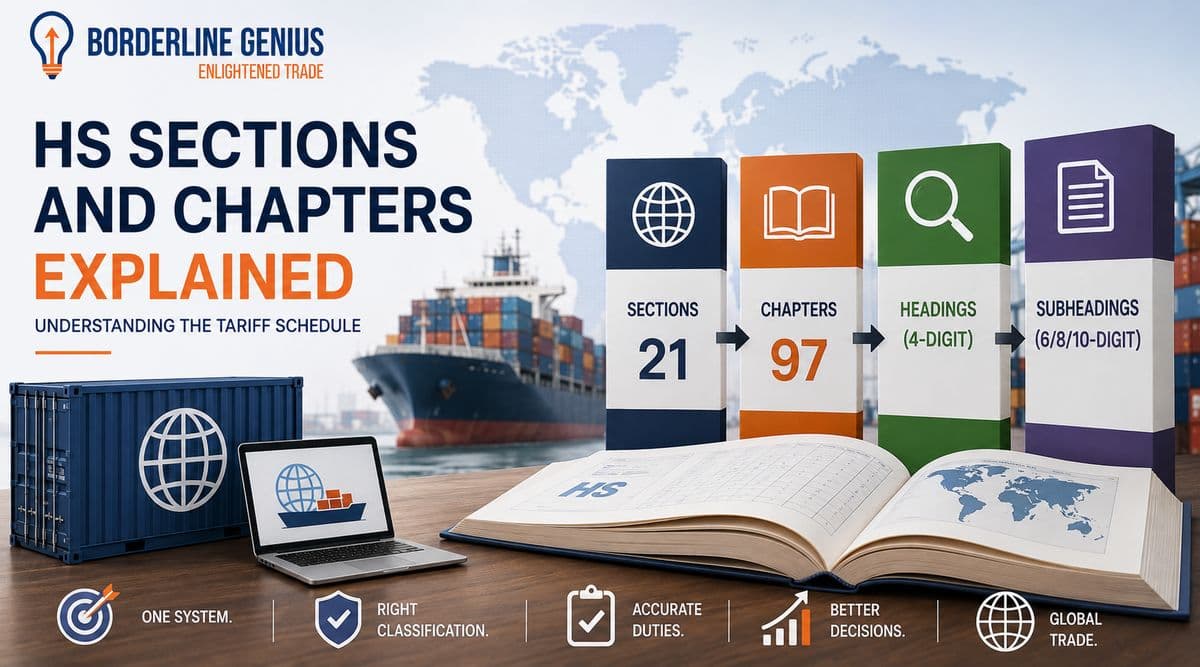 12 min read
HS Sections and Chapters Explained: Understanding the Tariff Schedule
Learn how the Harmonized System is structured with a complete guide to its 21 Sections, 97 Chapters, and the classification principles that organize the tariff schedule.
Read article