
What is Landed Cost? Formula, Components, and How to Calculate it
What is landed cost? Learn the landed cost formula, key components, calculation methods, examples, and how Landed Cost Genius helps simplify import cost analysis.
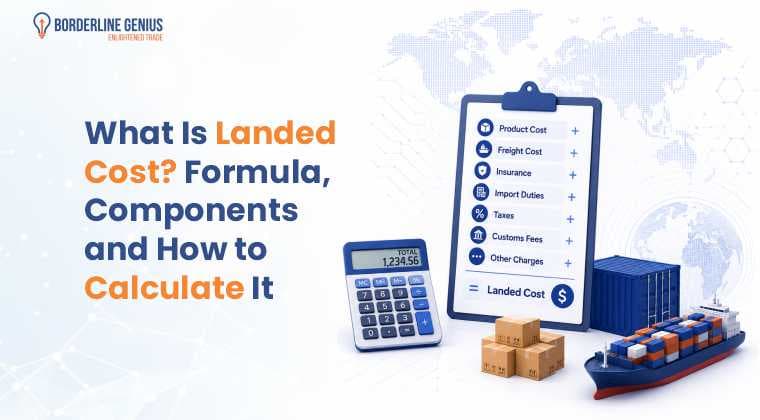
When evaluating an imported product, the supplier's price is usually the first number businesses look at. It is also one of the least complete.
A product quoted at $20 per unit may cost considerably more by the time it reaches your warehouse. Freight, insurance, customs duties, tariffs, taxes, brokerage, handling, and other import-related charges can all add to the cost of acquiring that product.
That difference matters.
If you use the supplier price to calculate your product margin, you may believe a product is more profitable than it really is. If you use it to compare suppliers, you may choose a supplier that is actually more expensive after transportation and import costs are considered. This is where landed cost becomes important.
Landed cost gives businesses a more complete view of what it costs to acquire goods and get them to a defined destination. The U.S. Commercial Service describes landed cost as the total price of a product once it reaches the buyer, including the original product price, insurance, freight, tariffs, taxes, and other fees.
For importers, ecommerce businesses, manufacturers, and finance and procurement teams, understanding landed cost can lead to better sourcing, pricing, margin, and market-expansion decisions. And while the basic landed cost formula is straightforward, calculating it accurately can become surprisingly complex.
What Is Landed Cost?
Landed cost is the total cost of acquiring a product and getting it to a defined destination, including the product cost and applicable transportation, import, and handling costs.
The exact components depend on the transaction.
A typical landed cost calculation may include:
-
Product or purchase cost
-
International freight
-
Insurance
-
Customs duties and tariffs
-
Import taxes
-
Customs brokerage
-
Port and terminal charges
-
Handling fees
-
Inland transportation
-
Other applicable import-related costs
The keyword is applicable.
Not every shipment has the same costs, and not every charge should automatically be included in every landed-cost calculation.
For example, an importer purchasing goods under one Incoterm may be responsible for international freight and insurance, while another transaction may have those costs included in the seller's price.
Similarly, a tax may be included in the initial cash outlay but treated differently for accounting purposes if the business can subsequently recover it.
So, there is no universal list of costs that applies identically to every business.
The objective is to establish a consistent methodology that answers a practical question:
What does this product actually cost us to acquire and bring to the intended destination?
Landed Cost vs. Customs Value: What's the Difference?
This distinction is important because landed cost and customs value are not the same thing.
Customs authorities use legally defined valuation methods to determine the value on which duties and other assessments may be calculated.
For example, U.S. Customs and Border Protection states that transaction value is generally based on the price actually paid or payable for imported merchandise, with certain statutory additions. CBP also notes that the duty may be assessed on the price paid for the goods rather than simply on the broader cost of getting them to the destination.
Landed cost, on the other hand, is a broader business calculation intended to understand the overall cost of acquiring and receiving goods.
This means a business should not assume that every landed-cost component forms part of customs value, or that every customs valuation rule can be used as a landed-cost formula.
That distinction becomes especially important when calculating duties and taxes.
The correct approach is to determine:
-
What the applicable customs valuation basis is.
-
Which duty or tariff applies.
-
What tax or fee applies.
-
What each charge is calculated against.
-
Which costs belong in the business's landed-cost methodology.
What Is the Landed Cost Formula?
A basic landed cost formula is:
Landed Cost = Product Cost + Freight + Insurance + Duties & Tariffs + Taxes + Brokerage + Handling + Other Applicable Costs
For a per-unit calculation:
Landed Cost Per Unit = Total Landed Cost ÷ Number of Units
This looks simple, but the calculation becomes more complicated when individual components are determined using different rules.
For example, a business might have:
-
Product value of $20,000
-
Freight of $3,000
-
Insurance of $500
-
Customs duty
-
Import VAT
-
Brokerage fees
-
Destination handling
The business cannot necessarily calculate duty and VAT by simply applying their respective percentages to the $20,000 product price.
The applicable customs valuation and tax base may be different.
The U.S. Commercial Service provides an example where tariff is calculated on CIF value and VAT is calculated on CIF plus duty.
So the formula is useful as a framework, but accurate landed cost calculation requires the correct inputs and calculation rules behind each component.
What Are the Components of Landed Cost?
1. Product Cost
The starting point is normally the price paid to the supplier for the goods.
If a supplier sells 1,000 units at $20 each:
Product Cost = $20,000
This is the number most businesses see first.
But it is not necessarily the number they should use to understand their true acquisition cost.
2. Freight and Transportation
International transportation can represent a significant portion of landed cost.
Depending on the shipment, this could include:
-
Ocean freight
-
Air freight
-
Rail
-
Road transportation
-
Inland trucking
-
Delivery to the warehouse
Freight costs can vary based on route, shipment size, weight, mode of transportation, fuel costs, carrier, season, and other factors.
For businesses importing regularly, that variability can make a meaningful difference to product-level margins.
3. Insurance
Insurance protects goods against specified risks during transportation.
Whether insurance is separately paid by the buyer, included in the supplier's pricing, or handled through another arrangement depends on the transaction and Incoterm.
Where it represents an applicable acquisition or transportation cost, it may form part of the landed-cost calculation.
4. Customs Duties and Tariffs
Duties and tariffs are often among the most important components of landed cost.
The applicable amount can depend on factors including:
-
Product classification
-
Country of origin
-
Destination country
-
Customs valuation
-
Trade agreements
-
Preferential tariff programs
-
Additional trade measures
This makes HS classification particularly important.
A product cannot be assigned an accurate duty simply because another similar product has a particular tariff rate.
The applicable classification and trade rules need to be established first.
The U.S. Commercial Service specifically recommends identifying the product's HS code and then determining the applicable tariff and tax treatment in the importing country.
5. Import Taxes
Depending on the destination market, imported goods may be subject to VAT, GST, sales tax, or other taxes.
One common mistake is assuming that the tax is always calculated directly on the purchase price.
That is not necessarily the case.
The taxable base can vary by country and by tax.
For example, the U.S. Commercial Service's landed-cost example calculates VAT using the CIF value plus duty.
Businesses should therefore calculate each tax according to the rules applicable to the shipment rather than treating all taxes as a single percentage added to product cost.
There is also an important accounting consideration: a tax paid at import may not necessarily represent a permanent economic cost if the business can recover it through an applicable tax mechanism.
6. Customs Brokerage and Clearance
Importers may incur charges for customs clearance, documentation, brokerage, entry processing, and related services.
These costs can appear small on an individual shipment but become meaningful when spread across thousands of shipments or units.
They should therefore be included when they fall within the organization's landed-cost methodology.
7. Port, Terminal and Handling Charges
Getting goods through the border does not necessarily mean they are ready for sale.
Depending on the supply chain, businesses may encounter:
-
Terminal handling charges
-
Port fees
-
Documentation charges
-
Inspection fees
-
Storage
-
Loading and unloading
-
Destination handling
-
Other logistics charges
Enterprise landed-cost systems commonly account for transportation, handling, insurance, duties, taxes, and other charges associated with bringing inventory into the business.
8. Inland Transportation
The shipment may also need to travel from the port, airport, or border to a warehouse, distribution center, manufacturing facility, or another defined destination.
Whether this transportation belongs in the landed cost depends on how the organization defines its landed-cost boundary.
The important point is to define that boundary clearly and apply it consistently.
How Incoterms Affect Landed Cost
One of the most important variables in landed cost calculation is the Incoterm used in the transaction.
Incoterms® define responsibilities between buyers and sellers, including the allocation of costs, risks, and obligations associated with delivery. The International Chamber of Commerce currently maintains Incoterms® 2020 as the latest edition of its rules.
Consider two supplier quotations:
Supplier A: $20 per unit, EXW
Supplier B: $23 per unit, DDP
At first glance, Supplier A looks cheaper.
But the two prices do not represent the same commercial proposition.
Under EXW, the buyer takes on substantially more responsibility for arranging transportation and other parts of the movement.
Under DDP, the seller assumes much more responsibility, including import clearance and applicable duties and taxes under the rule.
So comparing $20 against $23 does not tell you which supplier is cheaper.
You need to understand what is included in each price and calculate the comparable cost.
This is one of the most important reasons to use landed cost for supplier evaluation.
The cheapest supplier price is not necessarily the cheapest source.
The meaningful comparison is the landed cost under comparable assumptions.
Landed Cost Calculation Example
Consider an importer purchasing 1,000 units.
The shipment has the following estimated costs:
|
Cost component |
Amount |
|
Product cost |
$20,000 |
|
International freight |
$3,000 |
|
Insurance |
$500 |
|
Customs duty |
$1,175 |
|
Import tax |
$2,467.50 |
|
Brokerage and handling |
$600 |
|
Estimated landed cost |
$27,742.50 |
The calculation is:
$20,000 + $3,000 + $500 + $1,175 + $2,467.50 + $600 = $27,742.50
With 1,000 units:
Landed Cost Per Unit = $27.74
The supplier price was:
$20.00 per unit
But the estimated acquisition cost is:
$27.74 per unit
That $7.74 difference is significant.
Suppose the business sells each unit for $35.
Using only supplier cost:
$35 − $20 = $15
Using estimated landed cost:
$35 − $27.74 = $7.26
The product has not become less profitable because the landed cost calculation changed.
The calculation simply revealed the economics that were already there.
Why Landed Cost Matters for Product Profitability
The supplier invoice can make a product look attractive.
Landed cost tells you whether that attractiveness survives contact with the actual supply chain. This is particularly important for businesses with relatively low product margins.
A $2 increase in freight, a change in tariff treatment, or an unexpected import charge can materially affect the margin on a product when the original margin is already narrow.
For ecommerce businesses, this can influence:
-
Product pricing
-
Market selection
-
SKU profitability
-
Promotional pricing
-
Supplier selection
-
International expansion
For manufacturers, it can influence:
-
Component sourcing
-
Production costs
-
Supplier comparison
-
Make-versus-buy decisions
-
Product margins
For finance and procurement teams, it can influence:
-
Supplier negotiations
-
Cost analysis
-
Budgeting
-
Inventory costing
-
Margin analysis
-
Sourcing strategy
Landed cost therefore isn't just a logistics metric.
It is a commercial decision-making metric.
Why Manual Landed Cost Calculation Becomes Difficult
The basic formula is not difficult.
The problem is everything that sits behind it.
A business with a handful of SKUs and shipments may be able to manage landed cost in a spreadsheet.
But consider what happens when the business has:
-
Hundreds or thousands of SKUs
-
Multiple suppliers
-
Multiple countries of origin
-
Multiple destination markets
-
Different Incoterms
-
Different HS classifications
-
Changing tariff rates
-
Different freight modes
-
Multiple currencies
-
Different tax treatments
-
Shipment-level charges that need allocation
Now the challenge isn't knowing that:
Landed Cost = Product Cost + Other Costs
The challenge is determining which costs apply, which rates apply, what those rates are calculated against, and how the resulting costs should be allocated.
That is where manual processes begin to create problems.
Common Landed Cost Calculation Mistakes
Using purchase price as landed cost
The supplier invoice is not the complete cost of importing the product.
Applying duty directly to product price
Duty may be calculated using a specific customs valuation basis. The calculation should follow the applicable customs rules rather than a generic formula.
Ignoring Incoterms
A supplier quote without understanding its Incoterm can make two apparently comparable prices fundamentally different.
Using outdated tariff information
Tariffs and trade measures can change. The U.S. Commercial Service recommends periodically reviewing HS codes and tariff information, noting that tariff and tax information can change over time.
Treating every tax as a permanent cost
Some taxes may be recoverable depending on the business and jurisdiction. Landed cost methodology should account for the organization's actual economic treatment of those taxes.
Allocating shipment costs incorrectly
A shipment can contain multiple SKUs with different values, weights, volumes, classifications, and duty treatments. A blanket allocation may distort individual product costs.
Calculating landed cost after the purchase
This is perhaps the most strategically important mistake.
If landed cost is only calculated after an order has already been placed, it provides visibility into a decision that has already happened.
The greater value comes from using estimated landed cost before the purchasing or sourcing decision.
Estimated vs. Actual Landed Cost
Landed cost can be calculated at different points in the import process.
Before a purchase, businesses may calculate an estimated landed cost using expected freight, duties, taxes, and other charges.
After the shipment arrives, actual charges can replace those estimates.
This distinction matters because freight quotations, tariff rates, exchange rates, customs charges, and other costs can change.
The U.S. Commercial Service explicitly recommends treating landed-cost figures as estimates because tariffs, taxes, and additional charges can change.
Modern landed-cost systems can support this estimated-to-actual workflow. Oracle's Landed Cost Management documentation, for example, describes estimating charges initially and later updating them with actual amounts as they become available.
For businesses, this creates an important opportunity:
Use estimated landed cost to make the decision, and actual landed cost to improve future decisions.
How to Calculate Landed Cost More Effectively
A practical landed cost calculation process should follow a consistent sequence.
1. Start with the product
Identify the SKU, quantity, supplier price, currency, and country of origin.
2. Identify the Incoterm
Determine what transportation and delivery costs are already included in the supplier's price and which costs remain with the buyer.
3. Determine the classification
Identify the appropriate HS code and applicable tariff treatment.
4. Establish transportation costs
Calculate the expected freight, insurance, and relevant transportation charges.
5. Calculate duties and tariffs
Determine the applicable customs valuation basis and tariff treatment.
6. Calculate applicable taxes
Identify the relevant import taxes and their respective tax bases.
7. Add other applicable charges
Include brokerage, handling, port, documentation, inland transportation, and other costs within your defined landed-cost methodology.
8. Allocate costs
Where a shipment contains multiple products, allocate shared costs using an appropriate methodology.
9. Calculate the unit cost
Divide the total landed cost by the relevant quantity to determine landed cost per unit.
10. Compare estimated and actual costs
Once the shipment is complete, compare estimates with actual charges to identify recurring variances and improve future calculations.
The process sounds manageable.
The difficulty is maintaining all of these inputs accurately and consistently as the number of products, shipments, suppliers, and markets increases.
How Landed Cost Genius Helps Businesses Calculate Import Costs
Most experienced importers already understand that freight, duties, taxes, and other charges affect their true cost. The problem is that getting all of those variables together and turning them into a reliable product-level cost can be difficult to manage manually.
Landed Cost Genius is designed to help businesses move from a simple supplier-price view to a more complete view of import costs.
Instead of evaluating a product based primarily on:
Supplier Price = $20
businesses can work toward understanding:
What will this product actually cost us when it reaches our target market?
That distinction can change sourcing and profitability decisions.
Evaluate landed cost before committing to a purchase
The most valuable time to understand landed cost is often before the purchase order is placed.
Imagine two suppliers:
|
|
Supplier A |
Supplier B |
|
Product price |
$20 |
$22 |
|
Freight |
Higher |
Lower |
|
Duty exposure |
Higher |
Lower |
|
Other import costs |
Higher |
Lower |
|
Estimated landed cost |
$27.50 |
$25.75 |
Supplier A wins on purchase price.
Supplier B wins on actual cost.
Without landed cost visibility, the business could make the wrong sourcing decision before it ever receives the goods.
Landed Cost Genius is built around helping businesses bring this type of cost visibility closer to the point where sourcing and purchasing decisions happen.
From Product Price to True Import Cost
For importers, the question should not stop at:
"How much does the supplier charge?"
It should continue to:
"How much will this product cost us when it reaches the destination?"
That requires visibility into the factors that sit between the supplier invoice and the final destination.
Landed Cost Genius helps businesses approach landed cost as a structured calculation rather than a disconnected collection of spreadsheets, invoices, freight quotes, tariff lookups, and manual calculations.
That can be particularly valuable for businesses managing multiple products, suppliers, and international markets.
Who Can Benefit From Landed Cost Genius?
Importers
Importers can use landed-cost visibility to evaluate the true cost of sourcing products internationally and compare suppliers using a more meaningful cost basis.
Ecommerce Businesses
For ecommerce businesses, understanding landed cost can help determine whether products can maintain target margins after international shipping, duties, taxes, and other import costs.
Manufacturers
Manufacturers sourcing components, materials, or finished goods internationally can use landed cost to understand the actual acquisition cost of imported inputs.
Finance and Procurement Teams
Finance and procurement teams can use landed-cost information to support supplier comparisons, sourcing decisions, margin analysis, budgeting, and cost management.
Why Landed Cost Should Be Part of the Sourcing Decision
Landed cost is often treated as an accounting exercise.
It can be much more valuable than that.
Imagine you're considering a new supplier.
The supplier offers a 12% lower unit price than your existing supplier.
That sounds attractive.
But after accounting for freight, duties, taxes, handling, and other costs, the total landed cost is only 2% lower.
Now consider another supplier whose product price is 5% higher but whose total landed cost is 10% lower.
The supplier with the highest quoted price may actually offer the best economics.
This is why landed cost can change the way businesses evaluate international suppliers.
The objective is not to find the lowest purchase price.
The objective is to find the lowest viable total acquisition cost while meeting quality, compliance, service, and business requirements.
The Bottom Line
Product price is not the same as product cost.
When goods cross international borders, the cost of acquiring them can include much more than the supplier's invoice.
Freight, insurance, duties, tariffs, taxes, brokerage, handling, and other costs can materially change the economics of an imported product.
The basic landed cost formula is simple:
Landed Cost = Product Cost + Freight + Insurance + Duties + Taxes + Other Applicable Costs
But calculating that number accurately requires the right product data, classification, tariff treatment, customs valuation, Incoterm, tax rules, logistics costs, and allocation methodology.
That is why landed cost becomes increasingly difficult to manage as businesses expand across products, suppliers, and international markets.
Landed Cost Genius is designed to help businesses bring greater visibility and structure to this calculation—so they can understand the cost of importing a product before that cost becomes a surprise.
Whether you're an importer comparing suppliers, an ecommerce business evaluating product margins, a manufacturer sourcing international inputs, or a finance and procurement team trying to improve cost visibility, the goal is the same:
Know what your product really costs before you make the decision.
Frequently asked questions
Navigate Global Trade With Greater Confidence
Access expert guidance to help your organization address complex trade, classification, tariff, and compliance challenges.
Talk to a Trade ExpertRelated articles
Keep reading with more guidance on trade compliance and classification.
 18 min read
How to Monitor Regulatory Changes that Affect Your Products?
Learn how to monitor regulatory changes, identify trade regulations that affect your products, and build a proactive compliance monitoring process.
Read article 11 min read
Harmonized System and HS Codes: An In-Depth Guide for Trade Professionals
Learn how the Harmonized System works, understand HS codes, product classification, tariff determination, customs procedures, and international trade compliance.
Read article 8 min read
What is Trade Compliance Software & Why Do Modern Businesses Need it in 2026?
Learn what trade compliance software is, how it works, its key features, benefits, and why businesses need AI-powered trade compliance solutions in 2026.
Read article