
The 10 Most Commonly Misclassified Product Categories in Customs
Find out commonly misclassified product categories in customs, the competing HS headings behind each dispute, and the legal rules for correct classification.
Commonly misclassified products in customs often share characteristics with more than one HS heading or require specific legal rules to determine the correct classification. For example, a component may appear to belong with the machine it fits, while a dietary supplement may seem to qualify as a medicament even though the Harmonized System (HS) classifies it differently.
An incorrect classification can affect duty rates, trade remedies, licensing requirements, and eligibility for preferential origin. Once an HS code is assigned, it is often reused for subsequent shipments. This means a single mistake can be repeated across multiple imports until it is identified during a customs review or audit.
These errors are not evenly distributed. They typically arise where the intuitive answer differs from the legal one. While commercial understanding often focuses on what a product is used for, the HS frequently classifies goods according to their material, objective characteristics, and the applicable legal rules.
This guide examines 10 of the most commonly misclassified goods' categories and the General Rules of Interpretation (GRIs) or legal notes that help in determining accurate classification.
Why are Some Products Commonly Misclassified in Customs?
Certain goods are commonly misclassified in customs because they may satisfy more than one HS heading. Or, they may need particular legal classification rules to determine the correct heading.
-
Many commonly misclassified products in customs share similar characteristics with goods covered by multiple headings.
-
Others require customs authorities to apply Section and Chapter Notes, principal use provisions, or the GRIs before the correct classification can be determined.
Which Products are Commonly Misclassified in Customs?
The items commonly misclassified in customs are those whose classification depends on specific legal rules rather than its commercial description or intended use.
Many goods appear capable of fitting more than one HS heading. Others require customs authorities to apply provisions such as the General Rules for the Interpretation (GRIs), Section and Chapter Notes, or principal use tests before the correct classification can be determined.
The following categories illustrate some of the most frequent challenges encountered during HS code classification and explain why they are among the most commonly misclassified products in customs.
1. Parts, Accessories, and Complete Articles
Distinguishing between parts and accessories is one of the most common customs classification challenges. In parts vs. accessories customs disputes, an item may fall under its own heading, the parts heading for the machine it is used with, or the heading covering the finished article.
-
For machinery and electrical goods, Section XVI Note 2 resolves this issue in sequence.
-
If a component is itself described by a heading in Chapter 84 or 85, it is classified there regardless of the equipment to which it is fitted.
-
Only when no such heading applies does sole or principal use with a particular machine become relevant.
An accessory is distinct from a part. A part is necessary for an article to perform its intended function, whereas an accessory enhances, adapts, or adds to a function that already exists. Many HS headings distinguish between the two, making the difference critical for accurate classification.
2. Textile Articles Sold for a Technical Function
Although a textile article may be designed to perform a technical function, the nomenclature often classifies it according to its material rather than its intended application. Applying this principle consistently is an important aspect of trade compliance, particularly where a product's commercial purpose differs from its legal classification.
The Court of Justice of the European Union confirmed this approach in Servoprax GmbH v Hauptzollamt Duisburg, Case C-631/23, decided on 20 November 2025. Medical tourniquets were classified as made-up textile articles under subheading 6307 90 98, subject to a 6.3% duty, rather than as instruments used in medical sciences under subheading 9018 90 84, which is duty-free. Their textile character determined the outcome.
This principle also affects medical, filtration, safety, and industrial textiles, where the material of an article may take precedence over its technical function.
3. Goods "Of a Kind Used For" a Purpose
Wherever a heading uses the phrase "of a kind used for," it establishes a principal use classification provision. It applies to the class or kind of goods rather than the destination or actual use of a particular consignment.
The US Court of International Trade confirmed this principle in Cyber Power Systems (USA) Inc. v. United States, decided on 23 April 2026. Electric power cables were held not to be "of a kind used for telecommunications" under subheading 8544.42.20 and were instead classified under the residual subheading 8544.42.90.
Rather than conveying messages, the principal use of that class of goods is transmitting power, even though the cables could be, and were, used in telecommunications installations.
4. Retail Sets and Kits
Although bundling is a commercial decision, whether a collection of items qualifies as a set is determined by the legal rules of the Harmonized System. The test is cumulative: the goods must be classifiable under at least two different headings, put up together to meet a particular need or carry out a specific activity, and presented for sale directly to users without repacking.
Retail sets are among the most commonly misclassified products in customs because businesses often assume that packaging multiple items together automatically creates a single classified product. In practice, only collections meeting all of the legal requirements for a retail set can be classified under one HS heading.
If any requirement is not satisfied, each item is classified separately, which can change the applicable duty. When all three conditions are met, essential character GRI 3(b) determines the classification of the entire set based on the component that gives it its essential character.
Correctly identifying whether goods qualify as a retail set helps reduce classification disputes involving misclassified goods in customs. Applying the legal test before importation allows businesses to determine whether a single heading or separate classifications are required.
5. Multi-Function Machines
Machines that perform more than one function are classified according to specific legal rules rather than every capability they possess. Applying these provisions consistently supports effective trade compliance management, particularly where a single item performs several related operations.
Section XVI Note 3 provides the classification rule for composite machines and those designed to perform two or more complementary or alternative functions. They are classified as the machine performing the principal function. Note 4 applies to functional units, where separate components contributing to a clearly defined function are classified under the heading covering that function.
Determining the principal function is a factual exercise. Neither the number of capabilities nor the costliest component, by itself, establishes the correct classification.
6. Dietary Supplements and Functional Foods
Dietary supplements HS code classification has historically been one of the most debated issues in Chapters 21 and 30. The same active ingredient may be classified as a food preparation, a medicament, or, in liquid form, under beverage headings, depending on its dosage form, concentration, and marketing claims.
Chapter 30 Notes exclude foods and beverages, including most dietary supplements, keeping them outside the pharmaceutical chapters unless they have a genuine therapeutic profile.
This area of classification will change under HS 2028. From 1 January 2028, a dedicated heading (21.07) will apply to dietary supplements. Businesses should review their product lines against the new heading as part of a broader HS 2028 readiness assessment.
7. Composite Goods and Mixtures
Goods made from different materials or components may fall under more than one heading. GRI 3(b) resolves this by classifying them according to the component that gives the article its essential character. Applying this principle correctly supports accurate trade compliance and helps avoid incorrect classification outcomes.
-
Value, weight, bulk, and quantity are useful indicators.
-
But none of these determines the outcome on its own.
-
Greater importance is usually given to the role of a component in relation to the use of the article.
-
For example, an expensive housing surrounding an inexpensive working component rarely provides the essential character.
-
This is because the product is purchased for its function rather than its casing.
8. Goods Presented Unassembled
Items presented unassembled are among the commonly misclassified products in customs. GRI 2(a) permits an unassembled or disassembled article to be classified as the finished article, but only when specific legal conditions are satisfied.
The components must be capable of being assembled through fixing operations such as riveting, bolting, or welding, without further working or machining. An incomplete article also qualifies only if, in its presented condition, it already possesses the essential character of the finished article.
Items arriving under separate entries, at different times, or from varied suppliers are classified in the condition in which they are imported rather than according to the completed product they are intended to become.
9. Plastics Versus Articles of Other Materials
Chapter 39 appears broad but is limited by numerous exclusion notes, making plastics one of the most frequent sources of HS code classification errors. Many goods that seem to belong there are instead classified under chapters covering textiles, rubber, furniture, or toys.
Plastic-coated and plastic-impregnated textile fabrics are a common example, where Chapter 59 Notes, rather than the material that appears to dominate, determine whether the product falls within Section XI or Chapter 39.
HS 2028 also introduces significant changes to plastic waste classification. The revised provisions align with the Basel Convention by distinguishing hazardous waste, waste subject to the Prior Informed Consent (PIC) procedure, and other plastic waste, while also introducing separate identification for single-use plastic articles.
10. Chemical Products Defined by Purity, Form or Use
Classification of chemical products often depends on thresholds specified in the legal notes rather than the product's commercial description. Applying these criteria correctly is essential for trade compliance, as a single requirement may move a substance from one chapter to another.
-
Chapter 29 covers separate chemically defined organic compounds and specifies the impurities that may be tolerated.
-
Whereas Chapter 28 contains equivalent provisions for inorganic compounds.
-
Elsewhere, alcoholic strength, sugar content, concentration by weight, and whether an item is presented in measured doses or retail packings may also determine classification.
Note: When a specification sheet reports a value close to a legal threshold, normal batch variation can itself become a classification and compliance risk.
Summary Table
The following table summarizes the commonly misclassified products in customs discussed in this guide. It highlights the competing classification outcomes and the legal test used to determine the correct HS heading.
|
Category |
Competing classification |
Deciding test |
|
Parts and accessories |
Own heading/parts heading/finished article |
Section XVI Notes 1–2; part vs. accessory |
|
Technical textiles |
Material heading vs. function heading |
Objective character as presented (Servoprax) |
|
"Of a kind used for" goods |
Specific-use vs. residual subheading |
Principal use of the class (Cyber Power) |
|
Retail sets and kits |
One code vs. items classified separately |
Three-part set test, then GRI 3(b) |
|
Multi-function machines |
Each function's heading |
Principal function, Section XVI Notes 3–4 |
|
Dietary supplements |
Food preparation/medicament/beverage |
Chapter 30 exclusions; heading 21.07 from 2028 |
|
Composite goods |
Heading of each component |
Essential character, role in use |
|
Unassembled goods |
Finished article vs. components |
GRI 2(a); assembly only, as presented |
|
Plastics |
Chapter 39 vs. textiles, rubber, other |
Chapter 39 and Chapter 59 notes |
|
Chemicals |
Chapter 28/29 vs. 21, 30, 38 |
Stated purity, form, or dosage threshold |
Some classification issues require a more detailed legal analysis than can be covered in a single guide. Parts and components, and sets, kits, and composite goods, are examined separately as they involve multiple legal rules and frequent classification disputes.
Conclusion
Understanding the legal principles behind the 10 most commonly misclassified products in customs helps support accurate classification decisions and reduce compliance risks. Applying the correct legal rules, rather than relying on a product's description alone, leads to more consistent customs outcomes.
Frequently asked questions
Navigate Global Trade With Greater Confidence
Access expert guidance to help your organization address complex trade, classification, tariff, and compliance challenges.
Talk to a Trade ExpertRelated articles
Keep reading with more guidance on trade compliance and classification.
 11 min read
Harmonized System and HS Codes: An In-Depth Guide for Trade Professionals
Learn how the Harmonized System works, understand HS codes, product classification, tariff determination, customs procedures, and international trade compliance.
Read article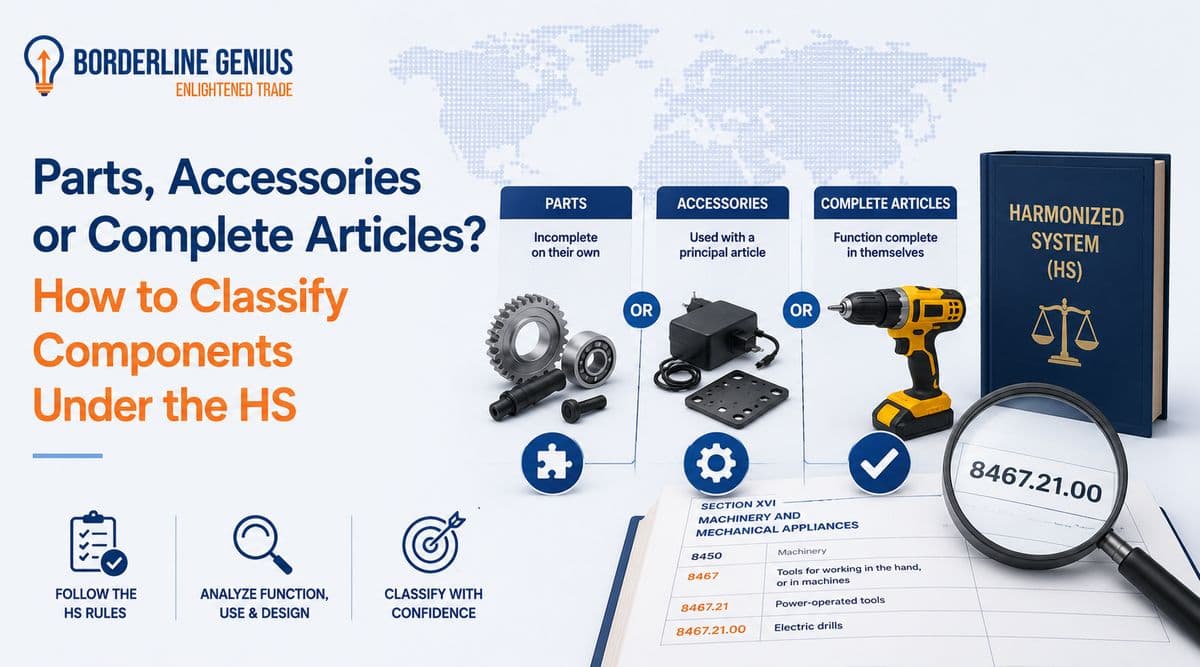 7 min read
Parts, Accessories or Complete Articles? How to Classify Components Under the HS
Parts, accessories or complete articles? The decision sequence for classifying components under the HS: Section XVI notes, parts of general use, GRI 2(a).
Read article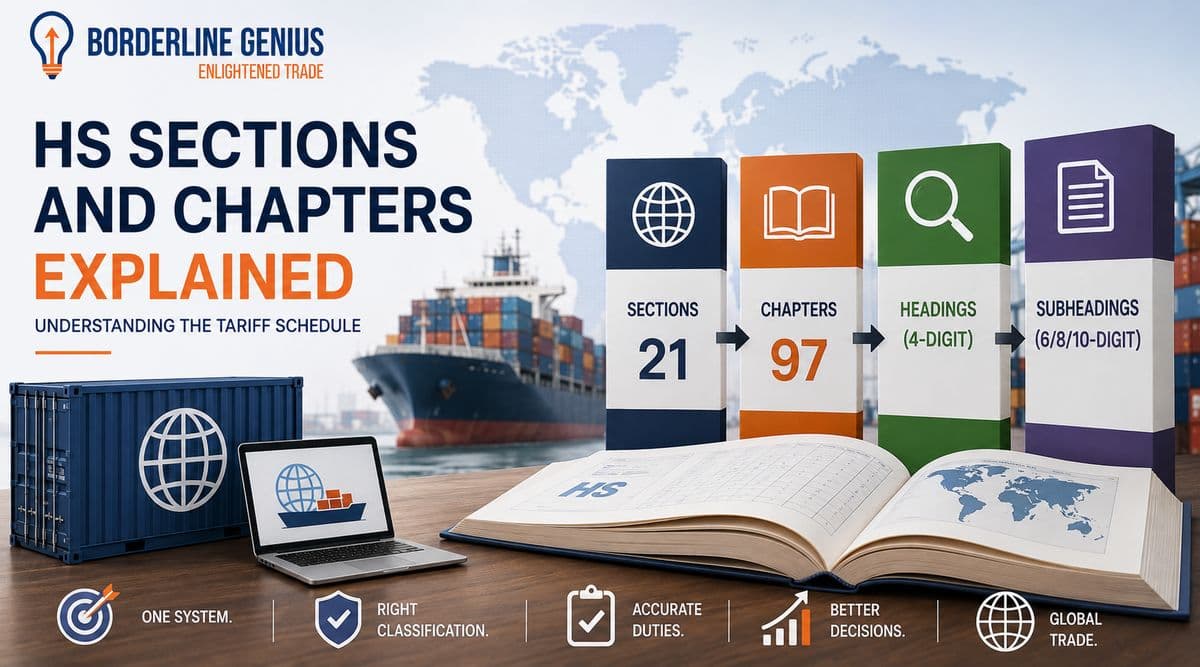 12 min read
HS Sections and Chapters Explained: Understanding the Tariff Schedule
Learn how the Harmonized System is structured with a complete guide to its 21 Sections, 97 Chapters, and the classification principles that organize the tariff schedule.
Read article