
How are Import Duties Calculated?
Learn how import duties are calculated using product classification, origin, customs value, and quantity. Understand import duty calculations, duty rates, customs valuation, and additional trade measures with practical examples.
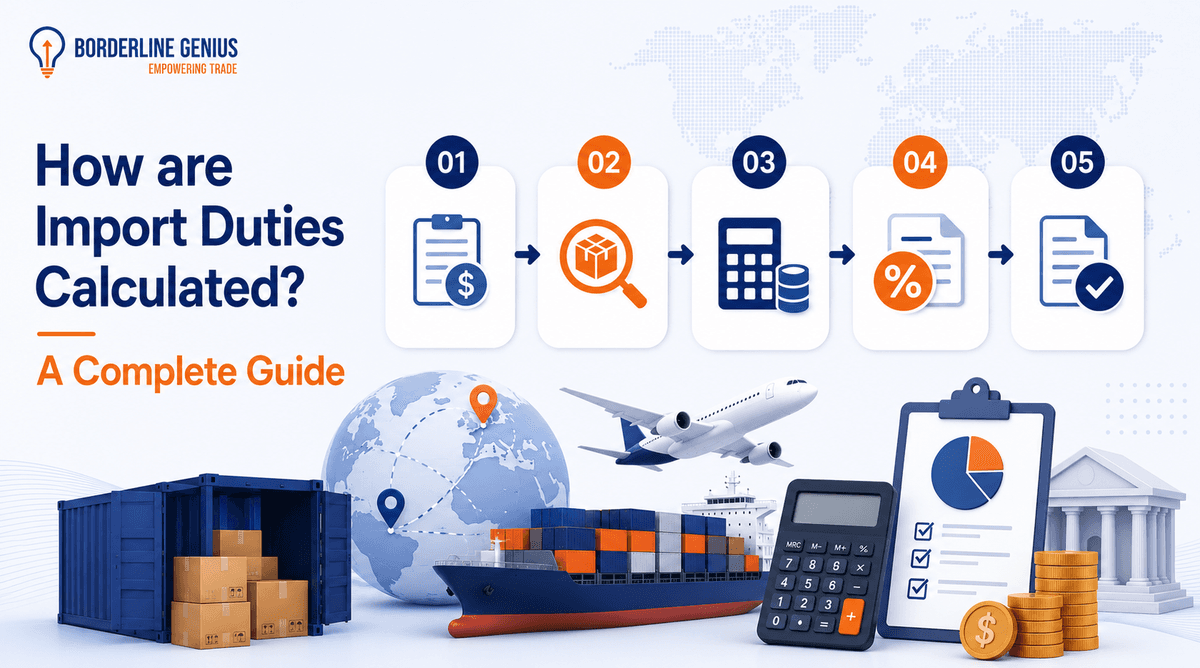
Import duty is calculated using four key inputs: product classification, origin, customs value, and quantity. A change in any one of these can produce a different result, even when the shipment itself remains the same.
Many businesses assume import duty is simply a rate looked up in a tariff schedule. In practice, it is the outcome of an import duty calculation based on legal and commercial information established before goods reach the border. Understanding how these inputs interact is essential for estimating import costs more accurately and avoiding costly errors.
It is important to understand how import duties are calculated before determining the duty payable on any shipment. Additionally, this article explains the four inputs, duty rate types, customs value calculation, additional measures, and the arithmetic behind import duty using a jurisdiction-neutral worked example.
What are the Four Inputs to a Duty Calculation?
An import duty calculation is based on 4 inputs: classification, origin, customs value, and quantity. Each influences the final duty amount, and changing any one of them can produce a different result.
Classification: This is about what the goods are, expressed as a code in the national tariff derived from the Harmonized System. Classification determines the applicable duty rate. It also establishes whether trade remedy measures, quotas, licensing requirements, and product regulations apply.
Origin: This input includes where the goods originate, determined under legal origin rules rather than by where they were shipped from or invoiced from. Origin determines which tariff rate applies and whether additional measures or preferential treatment apply.
Customs Value: The monetary base used for the duty calculation, determined under prescribed valuation rules rather than taken directly from the commercial invoice. Customs value calculation follows specific legal valuation methods rather than relying solely on the commercial invoice value.
Quantity: It is irrelevant where duty is purely ad valorem but becomes essential where specific or compound duties apply.
These four inputs do not carry equal weight. Classification underpins the other three because it determines which tariff rate applies, the unit of quantity required, and whether an antidumping order or other sectoral measure affects the goods. An error in origin or valuation changes the duty amount. Errors in classification change both the duty amount and, often, the legal obligations that apply.
Classification is a legal determination made by applying the General Rules of Interpretation (GRIs) in sequence. It is not simply a product database search, and a classification that has not been tested against the GRIs may not be legally correct.
What Types of Import Duty Rates are There?
Import duty rates are generally classified into four types: ad valorem duty, specific duty, compound duty, and mixed or alternative duty. Each is calculated differently, which means the same product can attract different duty amounts depending on the applicable rate structure.
|
Rate type |
Applied to |
Illustrative form |
Behavior |
|
Ad valorem |
Customs value |
5% of customs value |
Scales with price, incidence is constant as a share of value |
|
Specific |
Quantity — units, weight, volume, alcohol content |
$0.30 per kilogram |
Fixed in cash terms, incidence rises sharply as unit prices fall |
|
Compound |
Both |
4% of value plus $0.15 per litre |
Two components, calculated separately and added |
|
Mixed or alternative |
Whichever of two calculations is greater or lesser |
6% of value, or $2 per unit, whichever is greater |
Creates an effective floor or ceiling on duty per unit |
Specific duties often create the greatest confusion because they are charged as a fixed amount per unit rather than as a percentage of value. For example, a duty of $0.30 per kilogram equals 3% of a product valued at $10 per kilogram but 15% of one valued at $2 per kilogram. As prices fall, the effective duty rate increases. As prices rise, its impact decreases until the tariff schedule is revised.
This distinction affects import duty calculation. Cost estimates based on percentage-based duties can become inaccurate where specific or compound rates apply. Likewise, when duty depends on quantity, correctly declaring net weight, volume, or units becomes just as important as declaring customs value.
Note: Where a rate is specific or compound, the tariff schedule specifies the unit of quantity used for the calculation, which may differ from the commercial invoice. Net weight, gross weight, litres of pure alcohol, and units of finished goods are different measurement bases. Using the wrong unit can result in an incorrect duty declaration.
Which Import Duty Rate Applies?
The applicable import duty rate depends primarily on the product's origin. A tariff schedule often lists multiple rates for the same product, and the correct column is selected according to the applicable origin rules.
MFN Tariff Rate: The MFN tariff rate (Most-Favoured-Nation) is the default rate applied to goods imported from most trading partners. Under the WTO's most-favoured-nation principle, tariff advantages granted to one member are generally extended to all other members unless a recognized exception applies.
Preferential Rate: Preferential rates apply under free trade agreements, customs unions, or unilateral preference programmes when the goods satisfy the applicable origin rules. Preference is not automatic. Businesses must demonstrate eligibility using the required certificate, declaration, or statement of origin and retain supporting documentation for the prescribed period.
Non-MFN Rate: Non-MFN or general column rates apply to goods imported from countries that do not have normal trade relations with the importing country. These rates are typically much higher than the default tariff.
Another important distinction is between bound rates and applied rates. A bound rate is the maximum tariff a WTO member has committed not to exceed, while an applied rate is the tariff currently charged. Since many countries apply rates below their WTO commitments, they may increase tariffs up to the bound rate without breaching their obligations. Therefore, a low applied rate should not be assumed to remain unchanged.
How is Customs Value Determined?
Customs value calculation determines the monetary base on which import duty is applied. Most countries follow the WTO Customs Valuation Agreement, which establishes six valuation methods that must be applied in sequence. A later method may only be used if the preceding one cannot be applied.
|
Order |
Method |
Basis |
|
1 |
Transaction value |
The price actually paid or payable for the goods when sold for export, adjusted by the statutory additions |
|
2 |
Transaction value of identical goods |
The already-accepted customs value of identical goods exported at or about the same time |
|
3 |
Transaction value of similar goods |
The same, for goods that are commercially interchangeable rather than identical |
|
4 |
Deductive value |
The resale price in the importing country, less commissions, transport, duties and other post-importation costs |
|
5 |
Computed value |
Cost of materials and production, plus profit and general expenses, plus delivery costs |
|
6 |
Fallback |
Reasonable means consistent with the Agreement's principles, using data available in the importing country |
Methods 4 and 5 may be applied in reverse order at the importer's request. Otherwise, the prescribed sequence remains unchanged.
Most imports are valued using the transaction value method. However, transaction value is not simply the commercial invoice total. Customs value calculation requires certain statutory additions where they are not already included, such as:
-
Packing and container costs
-
Selling commissions and brokerage paid by the buyer
-
Assists, including materials, components, tools, dies, moulds, engineering, or design work supplied free of charge or at a reduced cost
-
Royalties and licence fees paid as a condition of sale
-
The value of any resale proceeds that accrue to the seller
Assists and condition-of-sale royalties are among the most frequently overlooked additions because they often do not appear on the commercial invoice. They are also common findings during post-clearance customs audits.
Another important consideration is whether international freight and insurance form part of the dutiable value. Some countries calculate duty on a CIF basis, including cost, insurance, and freight to the port of importation. Others use an FOB basis, excluding these costs. This jurisdictional difference can significantly affect the final duty amount and is a common source of errors when calculating import duties across multiple markets.
What is Duty Stacking in Import Duties?
Duty stacking occurs when more than one duty or trade measure applies to the same shipment. The total duty is generally the sum of all applicable measures rather than the highest individual rate.
Antidumping Duties: It is imposed when imported goods are sold below their normal value and cause injury to a domestic industry. In many countries, these duties are assigned to individual exporters or producers, meaning identical goods from the same country may attract different rates.
Countervailing Duties: This is applied to offset actionable subsidies provided by the exporting country's government.
Safeguard Measures: Introduced to protect domestic industries from sudden increases in imports, these measures often operate through tariff-rate quotas, with higher duties applying once quota limits are exceeded.
Sectoral and Unilateral Measures: Imposed under national security, retaliation, or other trade policy measures, these measures vary by country and are generally the least stable part of the tariff framework.
Before applying any additional measure, three questions should be answered:
-
Does the measure apply to the product based on its classification and origin?
-
Is it calculated on customs value, quantity, or another prescribed base?
-
Does the measure exclude any other duties that would otherwise apply?
Recovery mechanisms also vary by measure. Programmes such as duty drawback, bonded warehousing, and free trade zones do not apply uniformly to every category of duty, so eligibility should be assessed separately for each measure.
What Does an Import Duty Calculation Look Like?
A customs duty formula applies the relevant duty rate to the customs value or quantity, depending on the applicable tariff structure. The worked example below illustrates how the different inputs combine to produce the final amount payable.
|
Line |
Basis |
Amount |
|
Goods value (2,000 × $12.50) |
Invoice |
$25,000.00 |
|
International freight |
— |
$1,800.00 |
|
Insurance |
— |
$200.00 |
|
Customs value (CIF) |
Transaction value plus freight and insurance |
$27,000.00 |
|
Base duty at an illustrative 4.2% |
4.2% of customs value |
$1,134.00 |
|
Illustrative antidumping duty at 11.5% |
11.5% of customs value |
$3,105.00 |
|
Total duty |
|
$4,239.00 |
|
Import VAT at 20% |
20% of (customs value + duty) |
$6,247.80 |
|
Total charges at the border |
|
$10,486.80 |
The figures are hypothetical and used only to demonstrate how an import duty calculation works. They do not represent the tariff rates of any country.
|
Scenario |
What Changes |
Total Duty |
Total Charges |
Duty per Unit |
|
Baseline |
As above |
$4,239.00 |
$10,486.80 |
$2.12 |
|
Reclassified |
A different subheading at an illustrative 9.8%, outside the antidumping order's product scope |
$2,646.00 |
$8,575.20 |
$1.32 |
|
Origin changes, preference claimed |
Same code, origin qualifies under an FTA at 0% and falls outside the antidumping order |
$0.00 |
$5,400.00 |
$0.00 |
|
Origin changes, no normal trade relations |
Same code, non-MFN column at an illustrative 35% |
$9,450.00 |
$16,740.00 |
$4.73 |
This comparison highlights how changing a single input can produce a different outcome. A higher tariff rate does not always result in a higher duty if the product is no longer subject to additional measures such as antidumping duties. Likewise, changing the product's origin may significantly alter the applicable tariff treatment even when the goods, quantity, and customs value remain unchanged. This demonstrates why an import duty calculation depends on evaluating all applicable factors rather than the tariff rate alone.
Note: If the same shipment were assessed on an FOB basis instead of a CIF basis, the customs value would exclude international freight and insurance. As a result, the total duty payable would also be lower, even though the product, origin, and tariff rate remained unchanged.
Why are Import Taxes Different from Import Duty?
Import taxes and import duty are separate charges, even though both are collected at the border. They are calculated differently and have different financial implications for businesses.
Import VAT or GST: Import VAT or GST is generally calculated on the customs value, duty, and certain post-importation costs. As duty forms part of the tax base, additional duties can also increase the amount of VAT or GST payable.
Recoverability: Import VAT is usually recoverable by VAT-registered businesses as input tax, making it a working capital cost rather than a cost of goods. Import duty is generally not recoverable in the ordinary course and remains a direct import cost.
Excise Duty: Excise duty applies only to specific categories of goods, such as alcohol, tobacco, and energy products. It is separate from import duty and, in many jurisdictions, also forms part of the VAT calculation.
Treating recoverable taxes as import costs understates margins, while treating non-recoverable duties as recoverable overstates them. Distinguishing between these charges is essential for accurate import cost calculations and effective trade compliance.
Who Pays the Duty, and Where?
Duty is owed to the customs authority of the country of importation by the importer of record: the party that declares the goods and takes legal responsibility for the declaration's accuracy. Appointing a customs broker does not transfer that responsibility. A broker files on the importer's instructions; liability for a wrong classification, a wrong value, or an unsupported preference claim stays with the importer of record.
Incoterms allocate who bears the cost commercially. Under delivered-duty-paid terms, a seller may take on importer-of-record obligations in a market where it has no establishment, which is a compliance position and not only a pricing one.
Why Does the Duty Calculation Change over Time?
An import duty calculation is accurate only at a specific point in time. As regulations, tariff schedules, and HS classification requirements change, the same shipment may attract a different duty in the future.
Trade Measures Change: Antidumping duties, countervailing duties, safeguard measures, and other trade remedies may be introduced, reviewed, extended, or revoked. Sectoral measures can also change with little notice.
Tariff Schedules Change: The HS is revised periodically, and national tariff schedules are updated between revisions. The HS 2028 amendments move many products into different codes, meaning changes to a Harmonized System code can also change the applicable duty rate, even where the intention is to remain revenue-neutral.
Preference Claims Expire: Free trade agreement claims remain valid only while the required origin documentation is maintained. Expired supplier declarations or missing supporting evidence can invalidate a previously available preferential duty rate.
Binding Rulings can Change: Binding tariff rulings provide certainty but generally have a limited validity period. They may also be revoked or superseded following changes to tariff schedules or court decisions.
Any duty rate should always be verified against the current national tariff schedule before making an import decision. Rates published in secondary sources, spreadsheets, or internal systems reflect a point in time and may no longer be current.
How can Businesses Simplify Import Duty Calculations?
Businesses can simplify import duty calculations by replacing manual processes with structured digital workflows. As tariff schedules, trade measures, origin rules, and customs valuation requirements continue to change, maintaining accurate calculations through spreadsheets alone becomes increasingly difficult.
Modern trade compliance software centralizes the information required for duty calculations, helping businesses manage product classification, tariff data, customs valuation, origin documentation, and regulatory updates within a single system. This reduces manual effort while improving consistency across import operations.
For organizations handling large product catalogues or importing into multiple markets, import compliance software also helps standardize duty calculations, maintain supporting records, and reduce the risk of errors caused by outdated data or disconnected processes.
This approach enables businesses to manage import duties more efficiently while adapting to changing trade requirements.
How can Trade Compliance Software Improve Import Duty Calculations?
Trade compliance software improves import duty calculations by bringing together the information required to determine duties accurately. Instead of relying on multiple spreadsheets and disconnected systems, businesses can manage classification, valuation, tariff data, origin requirements, and trade documentation within a centralized platform.
Maintain Current Regulatory Data: A reliable customs compliance software solution helps maintain current tariff schedules, supports free trade agreement qualification, and tracks regulatory updates that may affect duty calculations.
Improve Operational Consistency: Built-in workflows, approval processes, and audit trails help standardize import activities while reducing manual errors and improving consistency across compliance operations.
Estimate Total Import Costs: Many organizations also use tariff management software with a landed cost calculator to estimate duties, taxes, freight, insurance, and other import-related expenses before shipments are finalized.
These capabilities help businesses calculate import duties more consistently while adapting to changing global trade requirements.
Which Trade Compliance Software can Help Manage Import Duties?
The best trade compliance software is one that supports accurate import duty calculations while adapting to changing regulations, tariff schedules, and business requirements. Rather than relying on multiple disconnected tools, businesses should look for a platform that combines product classification, tariff intelligence, landed cost estimation, documentation, and compliance workflows within a single system.
Borderline Genius Inc. offers a global trade compliance software platform that helps businesses simplify import duty management through AI-powered solutions and trade expertise. Its products support product classification, tariff research, landed cost estimation, trade documentation, and compliance collaboration across global trade operations.
Its product suite includes:
-
Classification Genius: Supports accurate HS and export classifications while providing duty, VAT, and tariff information to assist classification decisions.
-
Tariff Genius: Enables businesses to monitor tariff changes, evaluate applicable duties, and stay informed about evolving trade measures across different markets.
-
Landed Cost Genius: Estimates the total landed cost of imported goods by combining duties, taxes, tariffs, freight, and other shipment-related expenses into a single calculation.
When evaluating software, businesses should prioritize solutions that improve the accuracy of import duty calculations, integrate with existing business systems, and scale alongside changing global trade requirements.
Conclusion
Understanding how import duties are calculated is less about the arithmetic than about identifying the correct inputs. Classification, origin, customs value, and quantity each influence the final result. When these are determined accurately and kept current, duty calculations become more reliable despite changing tariff schedules and trade measures.
Frequently asked questions
Navigate Global Trade With Greater Confidence
Access expert guidance to help your organization address complex trade, classification, tariff, and compliance challenges.
Talk to a Trade ExpertRelated articles
Keep reading with more guidance on trade compliance and classification.
 10 min read
What Happens When You Get an HS Code Wrong: Penalties, Delays, and Retroactive Duties
Learn the risks of incorrect HS codes, from delayed shipments and additional duties to licensing issues, failed origin claims, and customs penalties.
Read article 13 min read
Import Compliance: Duties, Taxes & OGA/PGA Rules
Understand import compliance requirements beyond tariffs, including duties, taxes, restrictions, licenses and OGA/PGA requirements.
Read article 17 min read
AD/CVD: How Anti-Dumping & Countervailing Duties Work
Learn how importers can check AD/CVD duties, understand AD/CVD scope, find applicable rates and case numbers, and reduce compliance risks.
Read article