
Import Compliance: Duties, Taxes & OGA/PGA Rules
Understand import compliance requirements beyond tariffs, including duties, taxes, restrictions, licenses and OGA/PGA requirements.
When businesses evaluate the cost of importing a product, the tariff rate is usually one of the first numbers they look for. It is also one of the easiest numbers to mistake for the complete picture.
A product may have a relatively low standard duty rate and still create significant import obligations because of additional duties, taxes, restrictions, licensing requirements, certifications, or requirements imposed by government agencies other than customs.
This matters because import compliance is ultimately about more than how much duty a product carries. It is about understanding what is required for that product to enter a market legally, what information must be provided, which agencies may be involved, and what costs or restrictions could affect the transaction.
In the United States, for example, CBP operates the Automated Commercial Environment (ACE) as the country's electronic trade-processing platform. ACE supports not only customs processing but also data exchange with Partner Government Agencies (PGAs).
For importers managing hundreds or thousands of products, this creates a broader question:
What does this product actually require for compliant importation—not simply what tariff rate applies to it?
Why the Tariff Rate Is Only One Part of Import Compliance
Consider an importer sourcing a product from overseas for the U.S. market. The first step may be to identify the appropriate HTS classification and determine the applicable duty rate.
That classification is important. The Harmonized Tariff Schedule provides the classification framework used to determine U.S. tariff treatment and statistical reporting.
But the classification does not necessarily answer every question the importer needs to resolve.
The same product may also need to be evaluated for additional duties, trade remedies, taxes, restrictions, quotas, or requirements from another government agency. Depending on the product, an importer may need to provide additional information, obtain a license or certification, or satisfy an agency-specific requirement before the goods can be admitted.
This is particularly important for products regulated for reasons beyond customs revenue. Food, pharmaceuticals, medical devices, agricultural products, chemicals, consumer products, wildlife and other categories can involve government agencies with their own regulatory requirements.
So there are really two different questions:
What will it cost to import this product?
and
What do I need to do to import this product compliantly?
The tariff rate answers only part of the first question. It does not answer the second.
What Does Import Compliance Include?
Import compliance is best understood as a combination of several interconnected areas rather than a single calculation.
The first is classification. A business needs to determine the appropriate HS or HTS code for its merchandise. This classification then becomes an important reference point for researching tariff treatment and other trade requirements.
The second is duties and taxes. The standard customs duty may be only one component. Depending on the transaction, preferential tariff treatment, additional duties, trade-remedy measures, VAT or GST, excise taxes, and other charges may need to be considered.
The third is admissibility and restrictions. Certain products may be prohibited, restricted, subject to quotas, or allowed only when specific conditions are met.
The fourth is government-agency regulation. A product may fall under the jurisdiction of an agency responsible for food safety, agriculture, environmental protection, consumer safety, pharmaceuticals, medical devices, or another regulated area.
Finally, there are the data and documentation requirements needed to demonstrate compliance and support the import entry.
These areas overlap, but they should not be treated as interchangeable. A correct classification does not automatically establish that every regulatory requirement has been satisfied.
How HS Codes Help Identify Import Compliance Requirements
The HS code is still the natural starting point for much of this analysis.
The international Harmonized System provides a common framework for classifying traded goods, while individual countries extend that system into their own tariff schedules. In the United States, the HTS provides the detailed classification and tariff structure used for imports.
That makes the classification extremely useful for organizing trade-compliance information.
A business can use the classification as a starting point to investigate:
-
Applicable tariff treatment
-
Preferential rates
-
Additional duties
-
Trade remedies
-
Potential restrictions
-
Government-agency requirements
-
Quotas and other measures
But there is an important limitation.
An HS code is not a complete compliance determination.
The product itself still matters. Its material, characteristics, intended use, country of origin, manufacturer, and other attributes can affect the requirements that apply.
The FDA provides a good illustration. Its system uses FD flags associated with HTS codes to help indicate whether FDA information may be required, but FDA explicitly notes that not all regulated products have an FD flag. Whether an FDA requirement applies can also depend on the intended use of the product.
That distinction is important when building any system around import compliance by HS code. The classification can help surface relevant requirements, but it should not be presented as the sole determinant of regulatory applicability.
Duties and Taxes Can Extend Beyond the Standard Tariff
Once a product has been classified, the next question is usually the duty rate.
But even here, the standard rate shown against an HTS classification may not represent the entire duty exposure.
The U.S. HTS contains provisions for additional duties and other import measures, including temporary provisions and additional import restrictions in Chapter 99.
Trade remedies such as Anti-Dumping and Countervailing Duties can create another layer of duty exposure. Preferential trade programs can also change the rate when specific eligibility conditions are satisfied.
The result is that two products with the same basic classification may not necessarily have the same effective import treatment. Country of origin, trade program eligibility, applicable trade measures, and other transaction-specific factors can influence the outcome.
Taxes introduce another layer.
Depending on the destination market, importers may need to account for VAT, GST, excise taxes, or other taxes associated with imported goods. These are distinct from the customs duty and can affect the actual economics of an international transaction.
For a business evaluating sourcing options, therefore, the useful number is not always the headline tariff rate. It is the broader import cost and compliance exposure associated with the product.
Import Restrictions Can Matter as Much as Duties
There is another side to import compliance that has nothing to do with the amount of duty paid.
Some goods cannot simply be imported because they carry regulatory restrictions.
A product may be permitted only if the importer meets specific requirements. Another product may require a license, certification, permit, or other documentation. Some goods can be subject to quotas, while others may be prohibited altogether under applicable laws or regulations.
This distinction matters commercially.
A higher duty may make a product less profitable. A missing permit or regulatory requirement can prevent the shipment from being admitted in the first place.
For example, CBP notes that biological materials imported into the United States can be regulated by CBP and partner government agencies because of potential risks to agriculture, public health, and natural resources. Importers are responsible for complying with the relevant requirements, and noncompliance can result in delays, penalties, or seizure.
This illustrates why an import compliance assessment needs to consider both financial exposure and admissibility.
What Are OGA and PGA Import Requirements?
Importers frequently encounter the terms OGA and PGA when researching U.S. import compliance.
A PGA, or Partner Government Agency, is a government agency that works with CBP in the import process to administer laws and regulations within its area of responsibility.
CBP's ACE system acts as the U.S. trade-processing platform through which trade data is exchanged with PGAs. CBP describes ACE as the electronic Single Window for trade processing, covering customs activity as well as Partner Government Agency data.
The term OGA, or Other Government Agency, is also used more broadly in the trade environment to describe government agencies whose regulations may apply to imported goods.
The practical implication for an importer is straightforward: CBP may not be the only government authority relevant to a shipment.
A product can therefore satisfy the basic customs classification and duty requirements while still requiring additional regulatory information or action.
How PGA Requirements Can Affect an Import
The exact PGA requirement depends heavily on the product and the agency involved.
For FDA-regulated merchandise, for example, importers or their customs brokers submit the HTS code along with other entry information. FDA uses HTS-related indicators, known as FD flags, to help guide whether FDA information needs to be transmitted.
But the FDA example also demonstrates why businesses should avoid treating an HS code as the entire answer.
FDA explains that some HTS codes may correspond to products that are regulated in one context but not another. Its examples include products whose intended use determines whether FDA regulation applies.
For regulated products, the agency may need additional information such as product codes, manufacturer information, country of production, importer details, and applicable compliance information. FDA states that accurate and complete entry information helps it determine the admissibility of imported articles.
This is why PGA import requirements should be understood as product-specific regulatory requirements rather than simply another field attached to an HS code.
Why Import Compliance Cannot Be Reduced to an HS Code
The attraction of an HS-based compliance model is obvious.
Businesses already use product classifications to organize their tariff data, so it makes sense to connect other trade information to the same classification.
The problem arises when that relationship is treated as absolute.
An HS code describes how merchandise is classified for tariff purposes. Other regulatory questions may depend on characteristics that the classification does not fully capture.
Consider two products with the same broad tariff classification. If one is intended for a regulated medical application and the other is intended for a completely different commercial use, the regulatory analysis may not be identical.
FDA's treatment of FD flags demonstrates this directly: some codes may require further evaluation based on intended use, and the absence of an FD flag does not necessarily establish that a product is outside FDA regulation.
For businesses building automated compliance workflows, the distinction is critical.
A good system should use classification as a starting point for identifying relevant compliance information, while allowing the importer to evaluate the product-specific conditions that determine whether a requirement actually applies.
The Business Challenge: Managing Compliance Across Thousands of Products
The complexity becomes much more obvious at scale.
An importer with ten products may be able to research each item individually. An importer with thousands of SKUs, multiple suppliers, several countries of origin, and multiple destination markets faces a very different problem.
The team may need to maintain information about classification, duty rates, additional duties, trade remedies, restrictions, taxes, licenses, certifications, and agency requirements across a constantly changing regulatory environment.
The challenge is not simply finding the information once.
It is keeping the information organized, current, connected to the right products, and accessible when a sourcing or import decision needs to be made.
That is particularly important because the underlying tariff environment itself changes. The U.S. International Trade Commission has published numerous HTS revisions during 2026, including Revision 12 in July 2026.
A business that relies on a static spreadsheet or an old tariff lookup can therefore end up making current decisions using outdated information.
What a More Complete Import Compliance Workflow Looks Like
A stronger approach starts with the product rather than the tariff rate.
First, the business establishes what the product is, including its relevant characteristics, intended use, origin, and other information needed for classification and regulatory evaluation.
It then determines the applicable HS or HTS classification and uses that classification to identify the relevant tariff treatment and potential compliance requirements.
From there, the business evaluates the broader duty picture, including preferential treatment, additional duties, and trade-remedy measures where applicable. Taxes and other import-related costs can then be considered separately.
The next question is admissibility. Are there restrictions, quotas, licenses, permits, certifications, or other conditions associated with the product?
Finally, the business needs to determine whether a PGA or other government agency has requirements that need to be satisfied as part of the import process.
The important point is that these are connected decisions rather than isolated lookups.
Classification helps establish the foundation. Trade data helps identify potential financial and regulatory exposure. Product-specific information helps determine which requirements actually apply.
How Tariff Genius Helps Businesses Look Beyond the Tariff Rate
This broader approach is where Tariff Genius fits into the import compliance workflow.
Tariff Genius is designed to provide more than a basic tariff-rate lookup. Its trade-compliance data connects product classifications with information such as duties, preferential rates, additional duties, VAT/GST, Anti-Dumping and Countervailing Duties, restrictions, licenses, certifications, quotas, and OGA/PGA-related requirements.
That gives importers and trade teams a broader starting point for understanding the compliance environment surrounding a product rather than looking at the standard tariff rate in isolation.
For businesses managing large product catalogs, this can reduce the need to research different categories of trade information separately and make it easier to incorporate compliance data into existing processes.
Tariff Genius data is also available through APIs, allowing businesses to integrate tariff and compliance information into their own systems, workflows, and applications.
Import Compliance Is More Than a Duty Calculation
The most important shift for importers is to stop treating the tariff rate as the end of the analysis.
The tariff rate matters, but it is only one part of the import decision.
A complete assessment may require businesses to understand the product's classification, duty treatment, additional trade measures, taxes, restrictions, and requirements imposed by government agencies beyond customs.
The HS code provides an important foundation for organizing this information, but it should be treated as a starting point rather than a guarantee that every compliance obligation has been identified.
For companies managing international trade at scale, the real objective is to build a reliable connection between the product, its classification, the applicable trade measures, and the requirements that determine whether it can be imported compliantly.
That is the difference between simply looking up a tariff and building a more complete import compliance process.
Frequently asked questions
Navigate Global Trade With Greater Confidence
Access expert guidance to help your organization address complex trade, classification, tariff, and compliance challenges.
Talk to a Trade ExpertRelated articles
Keep reading with more guidance on trade compliance and classification.
 17 min read
AD/CVD: How Anti-Dumping & Countervailing Duties Work
Learn how importers can check AD/CVD duties, understand AD/CVD scope, find applicable rates and case numbers, and reduce compliance risks.
Read article 3 min read
USTR Announced New Section 301 Tariffs on Imports from 60 Countries and Economies
Learn about the USTR Section 301 tariff update affecting 60 countries, new 10% and 12.5% tariff rates, implementation dates, and importer implications.
Read article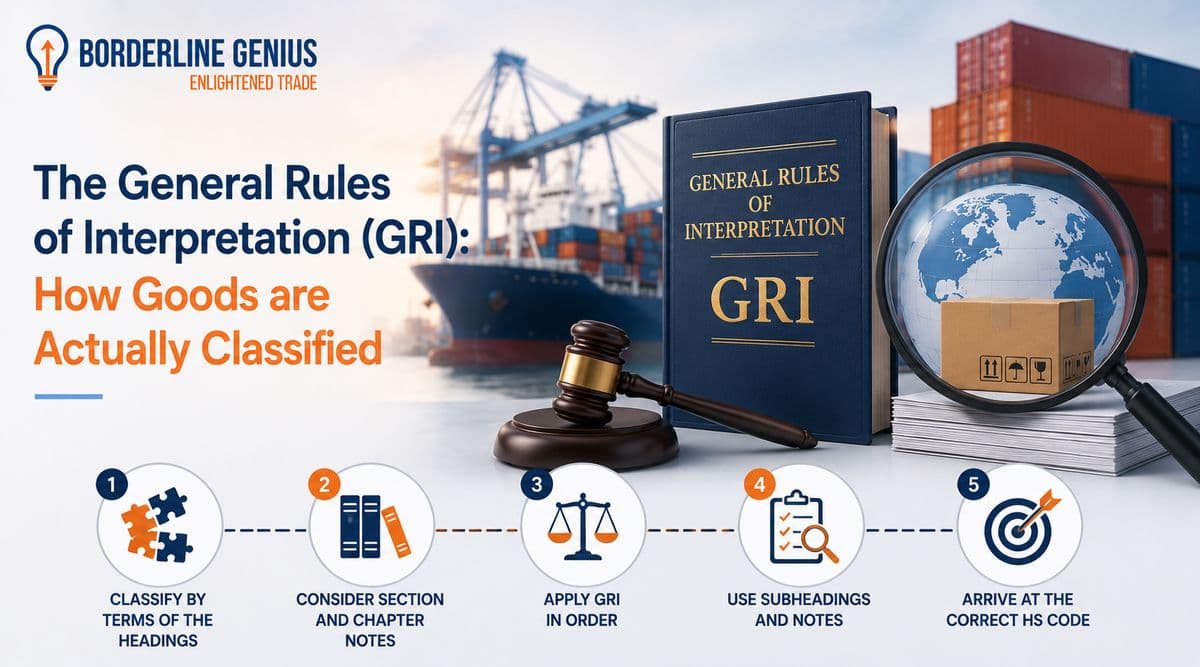 17 min read
The General Rules of Interpretation (GRIs): How Goods are Actually Classified
The six General Rules of Interpretation govern every HS classification decision. Get a full walk-through of GRI 1 to 6, with worked examples and the errors that cost importers money.
Read article