
How to Calculate Landed Cost for Cross-Border eCcommerce?
Learn how to calculate landed cost for cross-border ecommerce, including product costs, shipping, duties, taxes and checkout considerations.
Selling internationally can make a product available to a much larger market. It can also make the economics of selling that product considerably harder to understand.
A product that costs $25 to source and sells for $60 in the domestic market may appear to have a healthy margin. But when the same product is sold internationally, additional costs can enter the equation: international freight, customs duties, import taxes, brokerage, currency conversion, handling, and other destination-specific charges.
For an ecommerce business, these costs create two related problems.
The first is profitability.
If the business does not know its true landed cost, it may overestimate the margin on international orders.
The second is customer experience.
If duties and taxes are not properly accounted for, customers may discover additional charges when their package arrives. That can create unexpected costs, delivery friction, abandoned purchases, or dissatisfaction.
This is why landed cost ecommerce is becoming an important consideration for brands selling across borders.
The goal is not simply to calculate what a product costs.
It is to understand what an international order is likely to cost the business and, where applicable, what the customer is likely to pay before the transaction is completed.
What Is Landed Cost in E-commerce?
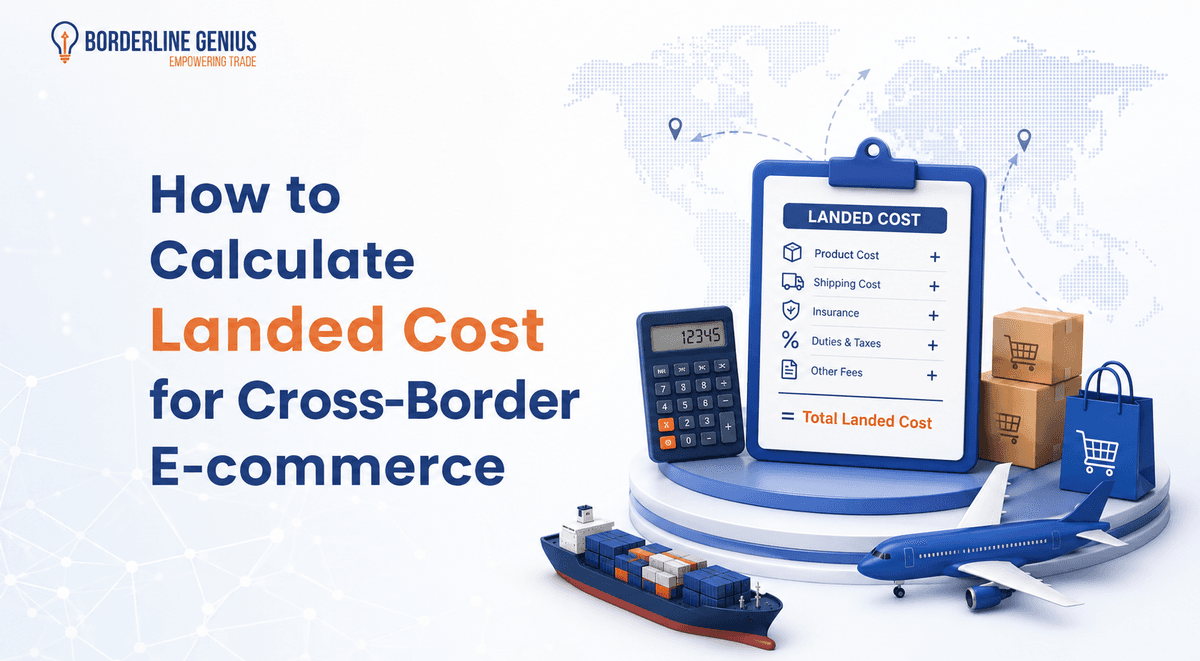
For an ecommerce business, landed cost is the total cost associated with getting a product from its source to its intended destination, including the product cost and applicable shipping, import, tax, customs, and handling costs.
A simplified formula is:
E-commerce Landed Cost = Product Cost + International Shipping + Insurance + Duties + Taxes + Brokerage + Handling + Other Applicable Costs
The exact components depend on the transaction.
For example, an ecommerce brand shipping a $50 product from the United States to Germany may need to consider international transportation, applicable customs duties, import VAT, and carrier or customs-clearance charges.
A brand shipping from China to the United Kingdom may face a different combination of costs.
A business selling under DDP may also have a different cost structure from one selling under DAP.
This means there is no single universal cross-border ecommerce landed cost.
The calculation needs to account for the product, origin, destination, shipment characteristics, trade terms, and applicable customs and tax rules.
Why Landed Cost Matters for Cross-Border E-commerce
Domestic ecommerce makes product economics relatively straightforward.
A business might calculate:
Selling price − product cost − fulfillment cost − payment fees = margin
International ecommerce introduces another layer.
The business may need to account for:
-
International shipping
-
Customs duties
-
Import taxes
-
Brokerage
-
Destination handling
-
Currency-related costs
-
Returns across borders
-
Other market-specific costs
These costs can materially change the economics of an order.
Consider a product that sells for:
$100
Suppose the product and fulfillment costs are:
$55
The apparent gross contribution is:
$45
Now add:
International shipping: $12
Duties: $6
Import taxes: $10
Other import-related costs: $3
The relevant cost becomes:
$86
The remaining amount is:
$14
The product did not suddenly become less attractive.
The original calculation simply failed to account for the costs of selling internationally.
That is why landed cost needs to be considered before expanding into a new market, setting international prices, or evaluating cross-border product profitability.
What Costs Should Be Included in Ecommerce Landed Cost?
There is no single list that applies to every ecommerce transaction, but several cost categories commonly need to be considered.
1. Product Cost
Start with the cost of the product itself.
For a retailer or DTC brand, this may include the supplier price or manufacturing cost.
If the product costs $25:
Product Cost = $25
This is the starting point, not the final landed cost.
2. International Shipping
International shipping can include the cost of moving the product from its origin to the destination country.
Depending on the fulfillment model, this may include:
-
Air freight
-
Ocean freight
-
Courier transportation
-
Postal shipping
-
Cross-border parcel delivery
-
Other transportation charges
Shipping costs can vary substantially based on destination, weight, dimensions, shipping service, carrier, and delivery speed.
For ecommerce businesses, this makes shipping one of the most important variables in the landed-cost calculation.
3. Customs Duties
Imported products may be subject to customs duties based on factors such as:
-
Product classification
-
Country of origin
-
Destination country
-
Customs valuation
-
Trade agreements
-
Preferential tariff programs
-
Applicable trade measures
The product's HS code can therefore have a direct effect on the calculation.
A product cannot reliably be assigned a duty rate simply because it belongs to a broad category such as apparel, electronics, furniture, or cosmetics.
The specific classification and destination rules matter.
4. Import Taxes
Cross-border ecommerce orders can also be subject to VAT, GST, sales taxes, or other destination-specific taxes.
The applicable tax and calculation method depend on the destination market and the structure of the transaction.
This is important because businesses should not treat:
Duty rate + tax rate = total import rate
as a universal calculation.
Duties and taxes can have different taxable bases and different rules.
Some taxes may also be recoverable by the business depending on its registration status and local tax treatment.
Therefore, ecommerce landed cost calculations need to distinguish between cash costs incurred at import and costs that represent a permanent economic cost to the business.
How to Calculate Landed Cost for an International Ecommerce Order
A practical landed cost calculation can be approached in several steps.
Step 1: Determine the Product Cost
Start with the product's acquisition or manufacturing cost.
For example:
Product cost = $30
Step 2: Determine the Destination
The destination matters because duties, taxes, de minimis thresholds, customs procedures, and other requirements can vary by country.
A $30 product shipped to one market may have a very different landed cost from the same product shipped to another.
Step 3: Identify the Product Classification
Determine the appropriate HS code or other applicable tariff classification.
The classification helps establish the relevant duty treatment.
This is one reason accurate product data is essential for cross-border ecommerce.
Step 4: Determine the Shipping Cost
Calculate the expected cost of moving the product from its origin to the destination.
For example:
International shipping = $10
Step 5: Determine Applicable Duties
Calculate the relevant customs duty using the applicable customs valuation and tariff rules.
Suppose the estimated duty is:
$4
Step 6: Determine Applicable Taxes
Calculate applicable import taxes based on the destination's rules.
Suppose the relevant tax amount is:
$6
Step 7: Add Brokerage and Other Costs
If applicable:
Brokerage and handling = $2
Step 8: Calculate the Total
Using the example:
|
Component |
Cost |
|
Product |
$30 |
|
International shipping |
$10 |
|
Duty |
$4 |
|
Import tax |
$6 |
|
Brokerage and handling |
$2 |
|
Estimated landed cost |
$52 |
The product costs $30 to acquire.
But the estimated cross-border landed cost is:
$52
That is the number the ecommerce business needs when evaluating the economics of the international order.
Ecommerce Landed Cost Calculator: What Should It Calculate?
An ecommerce landed cost calculator should do more than add the product price and shipping cost.
At minimum, a useful calculator should be able to consider variables such as:
Product information
-
SKU
-
Product price
-
Quantity
-
Product category
-
Country of origin
Shipment information
-
Origin
-
Destination
-
Weight
-
Dimensions
-
Shipping method
-
Freight or carrier cost
Trade information
-
HS code
-
Incoterm
-
Customs value
-
Applicable duty
-
Trade agreement or preferential treatment
Tax information
-
Import tax
-
VAT/GST
-
Tax base
-
Applicable exemptions or thresholds
Additional costs
-
Brokerage
-
Handling
-
Clearance
-
Other applicable fees
The calculator then needs to translate those inputs into a meaningful output.
For example:
Product Cost: $30
Shipping: $10
Duty: $4
Tax: $6
Other costs: $2
Estimated Landed Cost: $52
For ecommerce, however, there is another important question:
Is that $52 a cost to the business, a cost to the customer, or a combination of both?
That depends on how the transaction is structured.
Landed Cost at Checkout: Why It Matters
One of the biggest challenges in cross-border ecommerce is the possibility of unexpected duties and taxes.
A customer may see:
Product: $100
Shipping: $15
and assume:
Total = $115
But if the customer later receives an additional customs or tax charge, the actual cost of the purchase is higher than what appeared during checkout.
That creates an unpleasant experience.
For some businesses, the better approach may be to provide greater visibility into applicable duties and taxes during checkout or incorporate those costs into the commercial price and delivery model.
This is where landed cost at checkout becomes relevant.
The objective is to give the customer a clearer understanding of what they are likely to pay for the transaction, where the business model and applicable regulations allow that information to be determined and presented.
But businesses should be careful with the terminology.
Landed cost is not automatically the same thing as the customer's checkout total.
A customer's final price may also include:
-
Product price
-
Domestic or international shipping
-
Marketplace fees
-
Discounts
-
Payment fees
-
Duties
-
Taxes
-
Other charges
Landed cost is primarily a measure of the cost of acquiring and delivering goods.
Checkout pricing is a commercial decision that uses some of that cost information.
DDP vs. DAP for Cross-Border E-commerce
The Incoterm used for international ecommerce fulfillment can materially affect how duties, taxes, and delivery costs are handled.
Two particularly relevant terms are DDP and DAP.
Under DAP (Delivered at Place), the seller delivers the goods to the named destination, while the buyer generally handles import clearance and pays applicable duties and taxes.
Under DDP (Delivered Duty Paid), the seller assumes substantially more responsibility, including import clearance and applicable duties and taxes, subject to destination-country requirements.
This creates different customer experiences.
DAP-style experience
The ecommerce business ships the product internationally.
The customer may be responsible for duties and taxes when the shipment enters the destination country.
The initial checkout price may therefore not represent the customer's complete out-of-pocket cost.
DDP-style experience
The ecommerce business or its logistics partner arranges the shipment so that applicable import duties and taxes are handled as part of the delivery arrangement.
The customer can potentially receive a more predictable delivered cost.
But DDP may increase the seller's cost and operational complexity.
Neither model is automatically better.
The right choice depends on:
-
Destination market
-
Product value
-
Customer expectations
-
Tax obligations
-
Logistics capabilities
-
Carrier arrangements
-
Duty rates
-
Margin
-
Regulatory requirements
This is why ecommerce businesses should evaluate the landed cost impact of the delivery model, rather than choosing an Incoterm solely based on shipping convenience.
How Landed Cost Affects Ecommerce Margins
Consider an ecommerce brand selling a product for $100.
The business has:
Product cost: $35
Fulfillment: $8
Payment and platform costs: $7
The apparent contribution before international costs is:
$50
Now consider an international order.
International shipping: $12
Duty: $5
Import tax: $8
Other costs: $3
The contribution becomes:
$22
That is a significant difference.
If the business applies its domestic pricing strategy to international markets without understanding landed cost, it can unknowingly accept orders that produce much lower margins.
This becomes particularly dangerous when international sales represent a growing percentage of revenue.
A product that is profitable domestically is not necessarily profitable internationally.
International expansion requires international cost visibility.
Landed Cost and Product Pricing
Landed cost can also influence how an ecommerce business sets prices across markets.
Suppose a product has a domestic landed cost of:
$35
The business sells it for:
$70
That creates a $35 difference before other operating costs.
Now suppose the landed cost in another market becomes:
$48
Selling at the same $70 price leaves only:
$22
The business has several options:
-
Increase the international selling price
-
Absorb some of the additional cost
-
Change the shipping model
-
Use a different fulfillment location
-
Change the supplier
-
Adjust the product assortment
-
Negotiate better logistics terms
-
Decide not to enter the market
The important point is that these decisions require visibility into landed cost.
Without that number, international pricing becomes guesswork.
Landed Cost and Cross-Border Market Expansion
Landed cost should ideally be considered before an ecommerce business enters a new country.
Imagine a brand wants to expand into five markets.
The products are identical.
But the landed cost can vary because each market may have different:
-
Duty rates
-
Tax structures
-
Customs rules
-
Shipping costs
-
De minimis thresholds
-
Import requirements
-
Delivery costs
The business may therefore discover that a product with a healthy margin in Market A becomes marginal in Market B.
This creates an opportunity for market-level profitability analysis.
Instead of asking:
"How large is this market?"
the business can ask:
"Can we serve this market profitably at our expected selling price?"
That is a much stronger expansion decision.
Why Manual Ecommerce Landed Cost Calculation Breaks Down
A spreadsheet can calculate landed cost for one product.
The challenge is calculating it consistently across thousands of products and destinations.
Consider an ecommerce catalog with:
5,000 SKUs × 20 countries
That creates potentially 100,000 product-market combinations.
Now add:
-
Different HS codes
-
Different duty rates
-
Different tax rules
-
Different product values
-
Different shipping costs
-
Different currencies
-
Different Incoterms
-
Changing regulations
-
Different fulfillment locations
The problem is no longer arithmetic.
It is data management and calculation at scale.
Manual spreadsheets can also create problems such as:
Outdated rates
A calculation may continue using an old tariff or tax assumption.
Incorrect classifications
An incorrect HS code can produce the wrong duty estimate.
Inconsistent calculations
Different teams may use different assumptions.
Double counting
A cost already included in a supplier or logistics quote may be added again.
Missing costs
Brokerage, handling, or destination charges may be overlooked.
Slow checkout calculations
If landed cost needs to be calculated dynamically for an ecommerce transaction, manually looking up costs is not practical.
This is where automation becomes valuable.
How Automation Changes Ecommerce Landed Cost Calculation
For a growing ecommerce business, the ideal landed cost workflow is not:
Order → Spreadsheet → Manual lookup → Calculation
It is closer to:
Product + Origin + Destination + Shipment + Trade Data → Automated Calculation → Landed Cost
The system can then use the resulting calculation for different business processes.
For example:
Internal profitability
What will this order cost us?
Pricing
What price should we charge in this market?
Checkout
What duties and taxes should the customer see, where applicable?
Market expansion
Can we serve this country profitably?
Supplier comparison
Which sourcing option produces the lowest total cost?
Operations
What should we expect to pay when the shipment arrives?
This is where an ecommerce landed cost calculator becomes more than a simple calculator.
It becomes part of the commerce infrastructure.
Using a Landed Cost API for E-commerce
For ecommerce businesses with an established technology stack, landed cost calculation may need to happen inside existing systems rather than in a standalone tool.
A brand may need landed-cost information to flow between:
-
Ecommerce platform
-
Product catalog
-
ERP
-
Order management system
-
Shipping platform
-
Tax engine
-
Customs system
-
Checkout
-
Analytics platform
This is where an API-based landed cost approach can become useful.
Instead of manually exporting order data and calculating landed cost separately, an ecommerce system can pass relevant transaction information to a landed-cost service and receive the calculated result.
A simplified workflow could look like:
Customer selects destination
↓
Ecommerce platform identifies product and order
↓
Product, origin, destination and shipment data are sent for calculation
↓
Applicable trade and cost variables are evaluated
↓
Estimated landed cost is returned
↓
Business uses the result for pricing, margin analysis, checkout, or fulfillment
The exact implementation depends on the ecommerce architecture and the business's requirements.
But the principle is straightforward:
Landed cost becomes more useful when it can be calculated where the business actually makes decisions.
How Landed Cost Genius Helps E-commerce Businesses
Landed Cost Genius is designed to help businesses move beyond a simple product-price calculation and understand the broader cost of importing products into a destination market.
For ecommerce businesses, that means landed cost can become part of the digital workflow rather than a calculation performed manually after an order or shipment has already been processed.
The relevant variables can include:
-
Product information
-
Origin
-
Destination
-
HS classification
-
Incoterm
-
Freight
-
Duties
-
Taxes
-
Other applicable import costs
The goal is to provide businesses with a clearer view of the economics of cross-border transactions.
Calculate before you expand
Before entering a new market, businesses can use landed-cost analysis to evaluate whether the expected economics make sense.
A market may have strong customer demand but still be unattractive if duties, taxes, freight, and other costs make the product uncompetitive.
Understand international order profitability
Instead of treating every international order as though it has the same economics as a domestic order, businesses can incorporate destination-specific costs into their analysis.
Support checkout experiences
Where the business model and regulatory requirements allow it, landed-cost information can help support more transparent international pricing and duties-and-taxes experiences.
Integrate through APIs
For ecommerce businesses with existing technology infrastructure, an API-based approach can allow landed-cost calculations to become part of existing workflows rather than requiring teams to work in a separate spreadsheet.
The advantage is not simply automation.
It is making landed cost available at the point where the business needs the information.
Example: Using Landed Cost to Decide Whether to Enter a Market
Consider a DTC brand selling a product for $90.
The product has:
Product cost: $30
Domestic fulfillment: $7
Marketing and payment costs: $13
The business has:
$40 remaining before international costs.
Now evaluate two international markets.
Market A
International shipping: $8
Duties: $4
Taxes and other costs: $5
Estimated additional cost:
$17
Remaining contribution:
$23
Market B
International shipping: $12
Duties: $10
Taxes and other costs: $8
Estimated additional cost:
$30
Remaining contribution:
$10
Both markets may have similar customer demand.
But their economics are very different.
Without landed-cost analysis, Market B may look attractive based on revenue potential.
With landed-cost analysis, the business can see that Market A offers substantially better unit economics.
This is the kind of decision that makes landed cost strategically valuable for ecommerce.
Learn More about Landed Cost Genius
How to Build a Cross-Border Ecommerce Landed Cost Strategy
A strong process generally has five stages.
1. Establish accurate product data
Maintain accurate:
-
Product descriptions
-
SKU information
-
Country of origin
-
Product value
-
Weight and dimensions
-
HS classification
Poor product data produces poor landed-cost calculations.
2. Understand the commercial terms
Know which Incoterm applies and which costs are included in the supplier's quotation or logistics arrangement.
3. Determine market-specific costs
For each destination, establish applicable:
-
Duties
-
Taxes
-
Shipping costs
-
Brokerage
-
Handling
-
Other import charges
4. Calculate before the transaction
Use estimated landed cost to inform:
-
Pricing
-
Market expansion
-
Product selection
-
Supplier selection
-
Shipping strategy
5. Connect the calculation to your ecommerce stack
Where scale requires it, integrate landed cost with the systems where decisions actually happen.
That could include the ecommerce platform, checkout, ERP, order management, analytics, or other systems.
This is where an API-enabled approach can become significantly more valuable than a static spreadsheet.
Common Cross-Border Ecommerce Landed Cost Mistakes
Assuming product cost equals cost of sale
The supplier invoice does not represent the full cost of selling internationally.
Ignoring destination differences
The same product can have very different landed costs in different countries.
Treating duties and taxes as one percentage
Duties and taxes may have different bases and rules.
Ignoring Incoterms
The supplier's quoted price cannot be evaluated properly without understanding what the Incoterm includes.
Calculating only after the sale
If landed cost is known only after the order ships, it is too late to use that information for pricing or checkout decisions.
Using outdated trade data
Duty rates, tax rules, thresholds, and other requirements can change.
Treating every international customer the same
Different destinations can produce very different cost structures.
Building everything into a spreadsheet
Spreadsheets are useful for analysis, but they become difficult to maintain when products, markets, and transactions scale.
The Bottom Line
Cross-border ecommerce creates a simple commercial problem with a surprisingly complex answer:
What does it really cost to sell this product in another country?
The product price is only the starting point.
International shipping, customs duties, import taxes, brokerage, handling, Incoterms, and destination-specific costs can all affect the final economics of an order.
That is why landed cost ecommerce analysis should happen before the business commits to a price, enters a market, selects a supplier, or scales international sales.
A basic formula can get you started:
Landed Cost = Product Cost + Shipping + Duties + Taxes + Other Applicable Import Costs
But at ecommerce scale, the challenge is no longer the formula.
It is having the right information, applying the right rules, and making the calculation available at the right point in the customer and operational journey.
Landed Cost Genius helps ecommerce businesses bring landed-cost intelligence into that process.
From evaluating international market opportunities to understanding order-level economics and supporting API-driven workflows, it gives businesses a way to move beyond domestic product economics and account for the real cost of selling across borders.
Because international growth should not be based on:
"Customers in this market will pay $100."
It should be based on:
"Customers in this market will pay $100 and we understand what it will actually cost us to serve them."
Frequently asked questions
Navigate Global Trade With Greater Confidence
Access expert guidance to help your organization address complex trade, classification, tariff, and compliance challenges.
Talk to a Trade ExpertRelated articles
Keep reading with more guidance on trade compliance and classification.
 19 min read
How Incoterms Affect Landed Cost: Guide for Importers and E-commerce
Learn how Incoterms affect landed cost, import duties, taxes, freight and customs costs. Compare EXW, FOB, CIF, DAP and DDP for better sourcing decisions.
Read article 17 min read
AD/CVD: How Anti-Dumping & Countervailing Duties Work
Learn how importers can check AD/CVD duties, understand AD/CVD scope, find applicable rates and case numbers, and reduce compliance risks.
Read article 8 min read
What is Trade Compliance Software & Why Do Modern Businesses Need it in 2026?
Learn what trade compliance software is, how it works, its key features, benefits, and why businesses need AI-powered trade compliance solutions in 2026.
Read article