
Scalable Trade Compliance: Classification to Monitoring
Learn how to build a scalable trade compliance workflow connecting classification, tariffs, landed cost, and regulatory monitoring.
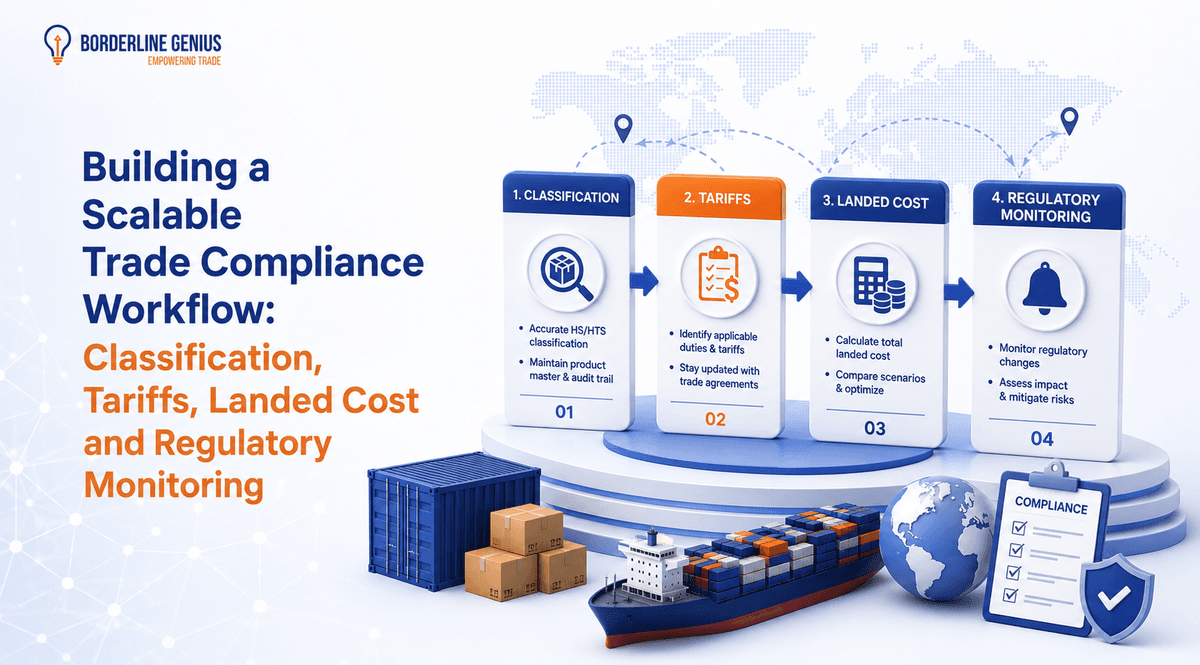
Trade compliance rarely breaks because a company cannot perform one individual task. The bigger problem is what happens between the tasks.
A product needs to be classified. That classification helps determine its tariff treatment. The applicable duties and other import costs contribute to landed cost. Regulatory requirements can affect whether the product can be imported and what documentation is required. Then, when regulations or tariff measures change, the entire analysis may need to be revisited.
These activities are connected.
Yet many businesses manage them as separate processes, often using different spreadsheets, systems, teams, and manual workflows.
That creates a fundamental challenge for modern trade compliance management:
How do you build a trade compliance workflow that connects the entire process instead of managing each compliance activity in isolation?
For a small importer with a limited product catalog, manual processes may be manageable.
For an organization with thousands of products, multiple suppliers, several countries of origin, and global markets, they become increasingly difficult to scale.
A more effective approach is to build a connected global trade compliance workflow that links:
Product data → Classification → Tariffs → Landed Cost → Regulatory Requirements → Monitoring → Action
This is where automation and centralized compliance technology can make a significant difference.
Genius Workspace is designed to help bring these connected compliance activities into a more unified workflow, helping businesses centralize product and compliance information, monitor regulatory changes, and surface potentially relevant issues.
What Is a Trade Compliance Workflow?
A trade compliance workflow is the sequence of activities a business follows to ensure that products can be imported or exported in accordance with applicable customs, tariff, regulatory, and trade requirements.
A typical workflow may include:
-
Collecting product information
-
Classifying products
-
Determining country of origin
-
Identifying applicable tariffs and duties
-
Calculating landed cost
-
Identifying regulatory requirements
-
Preparing documentation
-
Monitoring regulatory changes
-
Reviewing compliance impacts
-
Taking corrective or preventive action
The exact process differs by company, product, and market.
But the important point is that these activities are interdependent.
A change in one part of the workflow can affect another.
For example:
Classification changes
→ tariff treatment may change
→ landed cost may change
→ product margin may change
→ pricing or sourcing may need to change
Similarly:
Regulatory requirement changes
→ documentation may change
→ import process may change
→ shipment readiness may change
→ operational costs may change
A scalable trade compliance process therefore needs to account for these relationships.
Why Traditional Trade Compliance Processes Become Difficult to Scale
Many organizations start with a relatively simple model.
A compliance professional maintains a spreadsheet.
Another person handles customs documentation.
Finance maintains duty assumptions.
Procurement manages supplier information.
Someone else monitors regulatory changes.
Each activity may work reasonably well on its own.
The problem is that the information does not always move smoothly between them.
You may end up with:
-
Product data in one system
-
HS classifications in a spreadsheet
-
Tariff information somewhere else
-
Landed-cost calculations in finance files
-
Regulatory updates arriving by email
-
Compliance documentation stored in shared folders
Now imagine a regulation changes.
Someone has to determine:
Which products are affected?
Then:
Which classifications are affected?
Then:
Does the tariff treatment change?
Then:
Does landed cost change?
Then:
Does pricing or sourcing need to change?
That is where a disconnected process becomes expensive.
The Four Core Components of a Scalable Trade Compliance Workflow
A strong trade compliance process can be organized around four connected areas:
1. Classification
What is the product?
How should it be classified?
2. Tariffs
What duties or tariff measures apply?
3. Landed Cost
What does it actually cost to import the product?
4. Regulatory Monitoring
What rules or requirements have changed that could affect the product?
These should not be treated as four separate compliance projects.
They are parts of the same decision chain.
1. Product Classification: The Foundation of the Workflow
Everything starts with understanding the product.
For customs purposes, that often means determining the appropriate HS classification.
Classification can affect:
-
Duty rates
-
Tariff treatment
-
Import restrictions
-
Documentation
-
Government agency requirements
-
Trade program eligibility
-
Reporting requirements
That makes classification one of the most important inputs in a trade compliance workflow.
The challenge at scale
A business may have:
-
Thousands of SKUs
-
Similar products
-
Multiple product variations
-
Frequent new-product introductions
-
Different suppliers
-
Multiple markets
Maintaining accurate classifications across that product catalog can become difficult.
And classification is not necessarily a "set it and forget it" activity.
Products change.
Regulations change.
Classification guidance can change.
Trade measures can change.
That means classification needs to be treated as a maintained data point within the broader compliance workflow.
2. Tariff Management: Turning Classification Into Cost
Once a product is classified, the business can determine the tariff treatment that may apply to the import.
This can involve factors such as:
-
HS code
-
Country of origin
-
Destination
-
Trade agreements
-
Additional tariff measures
-
Product-specific trade actions
-
Applicable exemptions or programs
This is where classification and tariffs become directly connected.
For example:
Product → HS Code → Country of Origin → Applicable Tariff
A change to the classification or origin information can therefore change the tariff analysis.
This is one reason why maintaining tariff information separately from product compliance data can create problems.
3. Landed Cost: Understanding the Real Cost of Importing
The tariff rate is only one part of the financial picture.
Landed cost represents the total cost of getting a product to its intended destination.
Depending on the transaction, it can include:
-
Product purchase price
-
Freight
-
Insurance
-
Duties
-
Taxes
-
Brokerage
-
Handling
-
Other import-related costs
A simplified formula is:
Landed Cost = Product Cost + Freight + Insurance + Duties + Taxes + Other Applicable Costs
Consider a product with:
-
Product cost: $100
-
Freight: $15
-
Insurance: $2
-
Duty: $10
-
Other costs: $5
The estimated landed cost is:
$132
That number is much more useful for financial planning than the product's purchase price alone.
Why Landed Cost Belongs in the Compliance Workflow
Landed cost is often treated as a finance or procurement calculation.
But many of its inputs come directly from trade compliance.
For example:
HS classification
→ determines tariff treatment
Country of origin
→ can affect applicable duties or trade measures
Import requirements
→ can create additional costs
Regulatory changes
→ can change the cost assumptions
This means landed cost should not exist completely separately from trade compliance.
A change in the compliance environment can become a change in the economics of the product.
This is an important connection for importers, manufacturers, and e-commerce businesses.
4. Regulatory Monitoring: Keeping the Workflow Current
Even an accurate compliance workflow can become outdated.
Why?
Because regulations change.
Governments can introduce or modify:
-
Tariffs
-
Duties
-
Import restrictions
-
Licensing requirements
-
Product requirements
-
Documentation requirements
-
Trade measures
-
Country-specific rules
-
Agency requirements
This makes regulatory monitoring an ongoing part of trade compliance management.
The challenge is not simply finding regulatory updates.
It is determining:
Which changes actually affect our products?
A business may receive hundreds of regulatory notifications.
Only a fraction may be relevant.
A scalable workflow therefore needs a way to connect regulatory updates with the company's product and trade data.
The Connected Trade Compliance Workflow
Now bring the four components together.
A scalable process looks like:
Product Data
↓
Classification
↓
Tariff Determination
↓
Landed Cost
↓
Regulatory Requirements
↓
Regulatory Monitoring
↓
Impact Assessment
↓
Action
This creates a continuous loop rather than a collection of disconnected tasks.
And that distinction is critical.
Why the Workflow Needs to Be Connected
Consider a manufacturer importing a component.
The product is currently classified under a particular HS code.
That classification determines the applicable tariff.
The tariff contributes to landed cost.
Finance uses that landed cost to calculate product margin.
Now a regulatory or tariff change occurs.
The change affects the classification or tariff treatment.
Suddenly:
Compliance changes
→ Tariff changes
→ Landed cost changes
→ Margin changes
→ Business decision changes
If those systems are disconnected, the business may discover the financial impact only after someone manually connects the dots.
A connected workflow can make those relationships much easier to identify.
From Reactive Compliance to Proactive Compliance
Traditional compliance processes often operate reactively.
Reactive model
Regulation changes
↓
Someone notices
↓
Compliance investigates
↓
Affected products are identified
↓
Finance is informed
↓
Business reacts
The problem is that every step depends on someone remembering to take the next step.
A more proactive trade compliance workflow looks like:
Proactive model
Regulatory change detected
↓
Potentially affected products identified
↓
Classification and tariff impact reviewed
↓
Landed-cost implications assessed
↓
Relevant stakeholders alerted
↓
Action taken
This reduces the distance between regulatory intelligence and business action.
Where Trade Compliance Automation Fits
Automation should not mean automating every compliance decision.
That would create unnecessary risk.
The better objective is to automate the repetitive parts of the workflow while keeping expert review where judgment is required.
For example, automation can help with:
-
Data collection
-
Product record updates
-
Regulatory monitoring
-
Change detection
-
Information matching
-
Alerts
-
Workflow routing
-
Review reminders
-
Reporting
Human expertise remains important for:
-
Complex classification decisions
-
Regulatory interpretation
-
Compliance approval
-
Exception handling
-
High-impact business decisions
This creates a useful model:
Automation handles the volume. Experts handle the judgment.
How AI Can Improve Trade Compliance Management
AI adds another layer to traditional automation.
Traditional automation generally follows predefined rules.
For example:
If HS code = X, apply workflow Y.
AI can help with more complex information.
For example:
A regulatory notice has been published. Determine which products, classifications, or trade activities may be relevant.
AI can help:
-
Read regulatory information
-
Extract important changes
-
Summarize complex language
-
Identify relevant entities
-
Match updates against product information
-
Surface potentially affected products
-
Prioritize alerts
This can be particularly valuable when regulatory information is published in large volumes of text.
But AI should not be treated as the final authority on legal or compliance interpretation.
The strongest approach combines:
AI detection + structured data + human validation.
How Genius Workspace Fits Into the Trade Compliance Workflow
This is where Genius Workspace becomes important.
Genius Workspace is designed to help bring product compliance data and regulatory monitoring into a more connected environment.
Rather than treating:
-
Product information
-
Classification
-
Compliance requirements
-
Regulatory changes
as completely separate activities, Genius Workspace can provide a centralized foundation for managing the information and identifying changes that may require attention.
The workflow becomes:
Centralize → Monitor → Match → Alert → Review → Act
Centralize Product Compliance Data
The first step is creating a structured view of the products being managed.
This can include information such as:
-
Product details
-
HS classifications
-
Country of origin
-
Compliance requirements
-
Supporting information
This gives regulatory monitoring the context it needs.
Monitor Regulatory Changes
Genius Workspace can help monitor relevant regulatory information rather than requiring teams to manually search across multiple sources.
The objective is continuous awareness.
Match Changes to Products
A regulatory change becomes more useful when the system can help answer:
Which products may be affected?
This can involve comparing regulatory information against relevant product and trade data.
Surface Relevant Alerts
Instead of giving teams another stream of generic notifications, the objective is to surface potentially relevant changes with enough context for review.
For example:
Potential tariff change affecting monitored products
rather than:
New trade regulation published
The difference is relevance.
Review the Impact
Once a potentially relevant change is identified, the compliance team can assess:
-
Classification
-
Tariff treatment
-
Regulatory requirements
-
Documentation
-
Landed-cost implications
This is where the broader trade compliance workflow comes together.
Act
The organization can then decide whether to:
-
Update product data
-
Review classification
-
Recalculate landed cost
-
Contact suppliers
-
Change sourcing
-
Update documentation
-
Review upcoming shipments
-
Escalate the issue
The system supports the workflow.
Compliance experts make the decision.
A Practical Example
Consider an e-commerce company importing a consumer product from Asia into the United States.
The company has:
-
1,500 SKUs
-
Multiple suppliers
-
Several countries of origin
-
Products sold across multiple markets
The current process is largely spreadsheet-based.
Step 1: Classification
The product is assigned an HS code.
Step 2: Tariff
The applicable tariff treatment is determined using classification and origin.
Step 3: Landed Cost
Finance calculates the product's expected landed cost.
Step 4: Regulatory Monitoring
A new trade measure is announced affecting products within a particular classification and origin.
Traditional workflow
Someone receives the announcement.
They read it.
They search the compliance spreadsheet.
They identify potentially affected products.
They contact finance.
Finance updates the landed-cost model.
Procurement is informed.
Someone reviews upcoming shipments.
This could take days.
Connected workflow
A regulatory change is detected.
The potentially relevant products are surfaced.
The compliance team reviews the classification and tariff implications.
The landed-cost impact is assessed.
Relevant stakeholders receive the information.
The business decides whether to adjust pricing, sourcing, or shipment planning.
The difference is not simply speed.
It is workflow visibility.
Learn More abour Genius Workspace
What a Scalable Global Trade Compliance Workflow Should Include
A mature global trade compliance workflow should ideally cover several layers.
Product Layer
-
SKU
-
Product description
-
Product attributes
-
Product category
Classification Layer
-
HS code
-
Classification rationale
-
Classification status
-
Review history
Trade Layer
-
Country of origin
-
Destination
-
Supplier
-
Trade agreements
-
Applicable tariff measures
Cost Layer
-
Product cost
-
Freight
-
Duties
-
Taxes
-
Other import costs
-
Landed cost
Regulatory Layer
-
Import requirements
-
Restrictions
-
Licensing
-
Documentation
-
Government agency requirements
Monitoring Layer
-
Regulatory changes
-
Tariff changes
-
Product-specific updates
-
Alerts
-
Impact assessment
Action Layer
-
Review
-
Approval
-
Documentation
-
Corrective action
-
Stakeholder notification
This creates a connected compliance architecture rather than a collection of isolated processes.
Common Trade Compliance Workflow Problems
1. Classification Is Managed Separately
If classification information is not connected to the rest of the compliance process, tariff and landed-cost analysis can become disconnected from the source data.
2. Tariff Information Is Updated Manually
Manual tariff updates can become difficult when businesses operate across many products and markets.
3. Landed Cost Is Treated as a Finance-Only Problem
Landed cost depends on several trade inputs.
Keeping finance disconnected from compliance can result in outdated assumptions.
4. Regulatory Monitoring Is Generic
Receiving a regulatory update is not the same as knowing whether it affects your business.
5. Compliance Data Lives in Multiple Spreadsheets
Multiple versions create uncertainty about which information is current.
6. There Is No Impact Assessment Workflow
A regulatory alert arrives, but nobody knows who should review it or what should happen next.
7. Compliance Is Reactive
The organization discovers changes only after they affect shipments, costs, or operations.
How to Build a Scalable Trade Compliance Process
A practical implementation does not require automating everything immediately.
Start with the highest-impact connections.
Step 1: Map the Current Workflow
Document how information moves today.
Ask:
-
Where does product data originate?
-
Who assigns classifications?
-
Where are HS codes stored?
-
Who maintains tariff information?
-
How is landed cost calculated?
-
Where are regulatory updates monitored?
-
Who receives alerts?
-
Who decides what action is required?
This often reveals more problems than expected.
Step 2: Identify the Critical Data
Determine which information needs to move between processes.
Typical examples include:
-
SKU
-
HS code
-
Country of origin
-
Supplier
-
Destination
-
Product category
-
Regulatory requirement
Step 3: Create a Source of Truth
Avoid maintaining the same information independently in multiple spreadsheets.
Establish where the authoritative record lives.
Step 4: Connect Classification to Tariffs
Make sure classification and origin information can support tariff analysis.
Step 5: Connect Tariffs to Landed Cost
Ensure that changes in tariff assumptions can flow into cost calculations.
Step 6: Connect Regulatory Monitoring to Product Data
This is one of the highest-value steps.
A regulatory change should be evaluated in the context of the products and trade activity it may affect.
Step 7: Create an Alert and Review Workflow
Define:
Who gets the alert?
Who reviews it?
What information do they need?
What happens after review?
Without this, monitoring can create information without action.
Step 8: Automate Repetitive Work
Once the workflow is defined, automate the activities that consume the most manual time.
This can include:
-
Regulatory monitoring
-
Change detection
-
Product matching
-
Alerts
-
Data synchronization
-
Review reminders
-
Reporting
How to Measure Trade Compliance Workflow Performance
A scalable process should be measurable.
Useful metrics include:
Classification
-
Classification turnaround time
-
Percentage of products with reviewed classifications
-
Classification exceptions
Data Quality
-
Missing compliance records
-
Duplicate records
-
Outdated product information
-
Data correction rate
Regulatory Monitoring
-
Number of relevant regulatory changes identified
-
Time from publication to detection
-
Time from detection to review
Workflow
-
Time from alert to action
-
Number of unresolved compliance issues
-
Number of manual steps per workflow
Financial Impact
-
Duty savings
-
Avoided compliance costs
-
Landed-cost variance
-
Cost impact from regulatory changes
The objective is not to maximize the number of alerts or automate the largest number of tasks.
It is to make the compliance process faster, more accurate, and more predictable.
When Should You Invest in Trade Compliance Automation?
Automation becomes particularly valuable when:
-
Product volume is growing
-
The company operates across multiple countries
-
Regulatory changes are frequent
-
Compliance teams spend significant time on repetitive research
-
Product information is fragmented
-
Multiple departments depend on compliance data
-
Manual workflows create delays
-
Errors have significant financial consequences
-
The organization is expanding internationally
The more interconnected the business becomes, the greater the value of a connected workflow.
Our Broader Approach to Trade Compliance
Trade compliance is not one problem.
It is a chain of connected decisions.
A business needs to know:
What is this product?
→ Classification
What tariff applies?
→ Tariff analysis
What will it actually cost us?
→ Landed cost
What other requirements apply?
→ Regulatory compliance
What has changed?
→ Regulatory monitoring
What should we do?
→ Compliance workflow and action
This is why solving only one part of the process often leaves significant manual work elsewhere.
The broader BLG ecosystem is designed around addressing different parts of this trade compliance challenge.
Within that ecosystem, Genius Workspace provides the compliance-focused layer for centralizing product and compliance information and helping businesses monitor regulatory changes and identify potentially relevant impacts.
The important distinction is that these capabilities should work together rather than exist as isolated tools.
The Future of Trade Compliance Management
The future of trade compliance is unlikely to be completely manual.
But it also should not be completely automated.
The more practical direction is a human-in-the-loop compliance model.
In that model:
Systems collect and organize data.
AI identifies patterns and potential changes.
Automation moves information through workflows.
Compliance experts validate important decisions.
Business teams act on the resulting intelligence.
This model combines scale with judgment.
It also changes the role of the compliance team.
Instead of spending most of its time searching for information and reconciling spreadsheets, the team can spend more time on:
-
Risk assessment
-
Classification judgment
-
Strategic sourcing
-
Regulatory interpretation
-
Exception management
-
Business advisory
That is where technology can create genuine leverage.
The Bottom Line
A scalable trade compliance workflow is not about creating more checklists.
It is about connecting the information and decisions that already exist.
Classification determines how a product is treated.
Tariffs influence the cost of importing it.
Landed cost shows the broader economics of the transaction.
Regulatory requirements determine what else may be required to import or sell the product.
Regulatory monitoring keeps that information current.
And trade compliance management brings all of these activities together into an ongoing process.
The organizations that scale effectively are not necessarily the ones with the largest compliance teams.
They are the ones that build workflows where data moves efficiently between the right people and systems.
The evolution looks like this:
Manual tasks
→ Connected data
→ Automated workflows
→ AI-assisted monitoring
→ Human-reviewed compliance decisions
That is the direction modern trade compliance is moving.
Genius Workspace helps support that transition by bringing product and compliance information together with AI-powered regulatory monitoring and alerts—giving businesses a more connected foundation for managing trade compliance at scale.
Build compliance as a connected workflow, not a collection of disconnected tasks.
Frequently asked questions
Navigate Global Trade With Greater Confidence
Access expert guidance to help your organization address complex trade, classification, tariff, and compliance challenges.
Talk to a Trade ExpertRelated articles
Keep reading with more guidance on trade compliance and classification.
 13 min read
Import Compliance: Duties, Taxes & OGA/PGA Rules
Understand import compliance requirements beyond tariffs, including duties, taxes, restrictions, licenses and OGA/PGA requirements.
Read article 8 min read
What is Trade Compliance Software & Why Do Modern Businesses Need it in 2026?
Learn what trade compliance software is, how it works, its key features, benefits, and why businesses need AI-powered trade compliance solutions in 2026.
Read article 7 min read
Parts, Accessories or Complete Articles? How to Classify Components Under the HS
Parts, accessories or complete articles? The decision sequence for classifying components under the HS: Section XVI notes, parts of general use, GRI 2(a).
Read article