
Manual vs. Automated HS Classification: Comparing Cost and Accuracy
Compare manual vs. automated HS classification on cost, accuracy, consistency, auditability, maintenance, and human review in trade compliance.
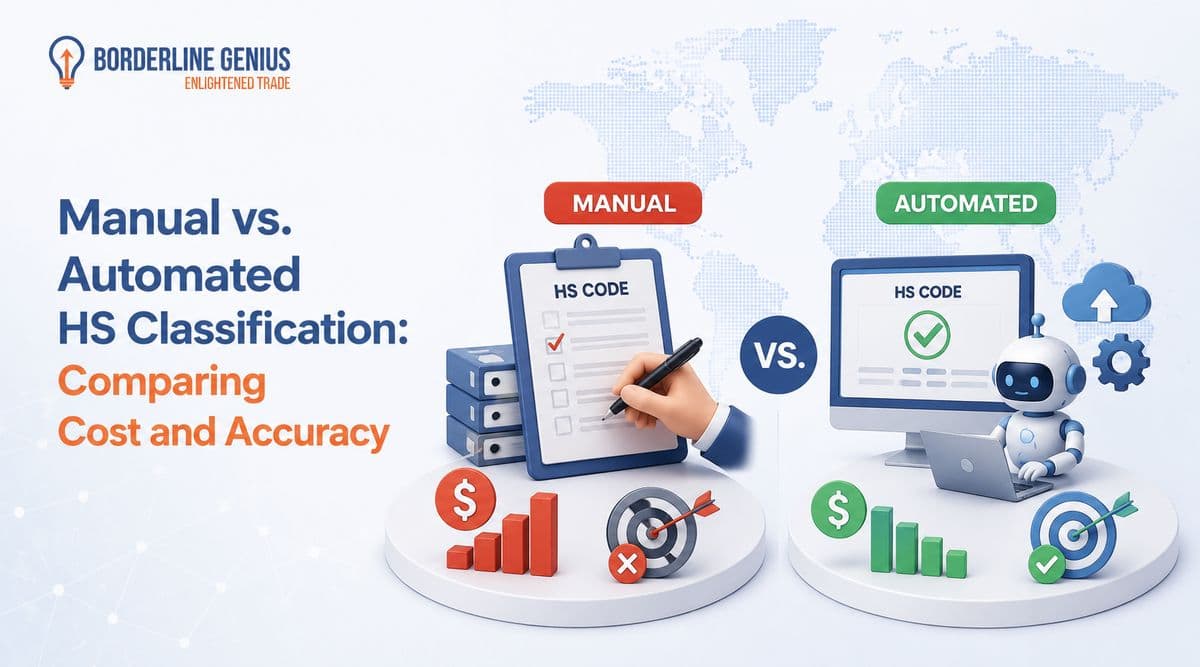
Automated HS classification is often compared with manual classification as though the choice is between human judgement and machine speed. In practice, the comparison is more nuanced. Effective automation still depends on human expertise, while manual classification at scale often relies on shortcuts rather than a fresh legal analysis for every product.
Every importer has a process for classifying, whether formal or informal. For some, it involves trained specialists applying the Harmonized System (HS) and documenting their reasoning. For others, it consists of spreadsheets, supplier codes, or classifications copied from similar products over time. The approach chosen can influence consistency, efficiency, and long-term trade compliance outcomes.
Understanding the differences between the manual and automated approach to classify is essential for businesses. It is equally important to know where each method performs well, where its limitations begin, and why many importers combine both to strengthen trade compliance.
What Does Manual HS Classification Involve?
Manual HS classification is a legal and analytical process that requires a classifier to evaluate a product against the Harmonized System before assigning a tariff classification. This forms one side of the manual vs automated classification debate.
-
A trained classifier reviews the relevant heading text and Section and Chapter Notes.
-
One applies the General Rules of Interpretation (GRIs) in sequence.
-
The Explanatory Notes and applicable rulings are examined.
-
Next, the reasoning supporting the final decision is recorded.
The outcome is not simply an HS code, but a documented classification that can withstand future review.
This process may not be meaningfully compressed without sacrificing quality. As time pressure increases, manual programmes often shift from legal analysis to product-name searches or reusing codes assigned to similar products. While this may appear efficient, it can reduce HS classification accuracy and increase the likelihood of inconsistent decisions over time.
What Does Automated HS Classification Include?
Automated classification works by evaluating structured product attributes instead of matching product names against tariff descriptions. It uses information such as material composition, percentages, function, form, degree of processing, retail packaging, and any other attributes relevant to the applicable tariff provisions.
The legal requirements remain the same as those used for classifying manually. The difference is that the required product information is captured explicitly and evaluated systematically. An item described only as "bracket, steel, black" still cannot be classified accurately because the quality of its description determines the outcome.
-
A well-designed automated HS classification system generates a code together with a confidence score and the reasoning behind the decision.
-
Low-confidence or high-risk products are routed for human review rather than classified automatically.
-
Systems that assign a code without confidence scoring or review workflows simply automate guessing.
What are the Key Differences between Manual and Automated HS Classification?
The differences between manual and automated classification are most apparent in throughput, consistency, auditability, maintenance, and cost. The comparison is not simply about speed. It is about how each approach performs as product volumes, complexity, and compliance demands increase.
|
Dimension |
Unaided Manual at Volume |
Automated with Human Review |
What Drives the Difference |
|
Throughput |
Linear in analyst hours |
Largely decoupled from catalogue size |
Time per product is the binding constraint |
|
Consistency |
Varies between people and over time |
Identical inputs give similar outputs |
Whether the rule applied is recorded and reused |
|
Hard cases |
Stronger, where expertise exists |
Only as good as its flagging behavior |
Novel goods and essential-character judgements |
|
Auditability |
Depends on documentation habit |
Depends on reasoning capture |
Whether reasoning is stored, not who produced it |
|
Maintenance |
Decays silently |
Only as current as its version control |
Nomenclature edition, rulings, catalogue churn |
|
Cost |
Variable, distributed, largely invisible |
Substantially fixed and visible |
Where the labor sits on the books |
Throughput
A dimension like throughput is where automated HS classification delivers the greatest advantage, although its value increases only beyond a certain catalogue size. For businesses managing a few hundred stable articles that change infrequently, processing speed is rarely the main constraint.
-
As catalogues expand and new goods are introduced continuously, classifying manually becomes difficult to sustain at scale.
-
Instead of carrying out a fresh legal analysis for every product, teams often begin reusing existing classifications for similar items.
-
This makes code reuse the practical outcome rather than true classification.
Consistency
Importantly, consistency is where manual and automated approaches differ most in day-to-day operation. Two experienced classifiers may assign different codes to the same item. Even the same person may reach a different conclusion months later if the original reasoning was not documented. This makes HS classification accuracy dependent not only on expertise but also on consistent decision-making.
-
From an auditor's perspective, materially identical products classified differently often indicate weak internal controls rather than isolated judgement calls.
-
CBP's Focused Assessment begins with a Pre-Assessment Survey of classification controls because it is designed to identify these patterns.
Consistency also has limits. A system will apply the same rule every time, including an incorrect one if that is flawed. For that reason, review processes and documented reasoning remain more important than this dimension alone.
Accuracy on Hard Cases
Human expertise remains the strongest approach for complex decisions related to classifying. Novel products, GRI 3(b) essential-character determinations, and disputed chapter boundaries require legal interpretation rather than attribute matching. This is where AI tariff classification reaches its practical limits.
In Cyber Power Systems (USA) Inc. v. United States (U.S. Court of International Trade, 23 April 2026), power cables were found not to be "of a kind used for telecommunications". This was because their principal use was transmitting power rather than conveying messages. That conclusion depended on legal analysis of the product's principal use rather than information contained in a specification sheet.
The most valuable capability is therefore not claiming perfect accuracy. It is identifying uncertain cases and routing them for expert review. A system that flags goods requiring further assessment is more valuable than one that confidently classifies every item without recognizing its own limitations.
Auditability
Dimensions, such as auditability, depend on whether the process to classify preserves the reasoning behind each decision. Import records must generally be retained for five years in the United States under 19 U.S.C. §1508 and for a three-year baseline in the European Union under the Union Customs Code. By the time a review takes place, the person who made the original decision may no longer be available.
The advantage therefore lies with whichever approach captures and retains its reasoning. A classification stored in a spreadsheet without supporting notes is less defensible than a documented process. Likewise, even the best HS classification software offers little value if it produces decisions without explaining how each conclusion was reached.
Maintenance
As tariff classification changes over time, maintenance is an ongoing requirement. HS 2028 enters into force on 1 January 2028, adding 428 subheadings and deleting 172. Where codes are split, businesses must reclassify affected products rather than simply remap them. Between nomenclature updates, the HS Committee continues to issue Classification Opinions, rulings are revoked, and products are reformulated without notice.
Classifying manually can become outdated gradually because there is no automatic indication that a previously assigned code is no longer correct. Automated HS classification addresses this only when the system actively manages nomenclature versions, monitors regulatory changes, and supports systematic reclassification rather than relying on existing codes indefinitely.
What is the Cost of Manual vs. Automated Classification?
The cost of classifying manually and automatically is determined by more than labour or software expenses. The manual approach often appears inexpensive because the work is distributed across product management, logistics, customs brokerage, and compliance teams instead of being recorded as a dedicated operational cost.
Classification errors account for the larger financial exposure. Under 19 U.S.C. §1592, negligent violations may expose importers to penalties of up to twice the loss of duties or the domestic value of the merchandise, depending on the circumstances. The False Claims Act has also become an important enforcement mechanism, illustrated by the Perfectus Aluminum settlement announced on 12 May 2026 involving aluminium extrusions declared as finished merchandise.
No verified industry benchmark exists for the classifying time per product, error rates, or cost per SKU. Figures presented in vendor sales material should, therefore, be treated as the vendor's own modelling rather than independently verified evidence. These hidden operational and compliance costs are often where manual vs. automated classification becomes a measurable business decision rather than a technology choice.
Where Does Manual or Automated Classification Work Best?
The most effective approach to classify depends on the size, complexity, and risk profile of the product catalogue. Rather than choosing one method for every item, businesses achieve better results by matching the approach to the level of classification risk.
Best Suited for Classifying Manually
Expert manual classification remains the stronger approach for high-value or technically complex items. A catalogue containing a limited number of goods with significant duty differences often justifies detailed legal analysis and, where appropriate, binding tariff rulings.
Auto-Classifying for Large Catalogues
Automation supported by human review performs better at scale. The advantage is not that systems do it better than specialists, but that automated HS classification reduces the need to rely on code reuse as article volumes and new product introductions increase.
A Hybrid Approach Works Best
Most businesses benefit from combining both approaches, i.e. manual and automated. Low-risk, low-ambiguity items can be processed through the system, while specialists focus on goods where duty rates, import volumes, or trade remedy exposure make errors more costly.
Who is Responsible for Automated Classification?
Using AI tariff classification does not change who is legally responsible for the ultimate decision. Under 19 U.S.C. §1484, as amended by the Customs Modernization Act 1993, the importer of record remains responsible for exercising reasonable care. The same principle applies to customs brokers under 19 CFR 141.32, where a power of attorney delegates the work but not the legal liability.
-
A classification generated by an automated system is still by the importer.
-
Responsibility does not transfer to the software provider, and contractual accuracy commitments do not alter who answers to the customs authority.
-
As of July 2026, no regulator has issued guidance specifically governing AI in trade compliance programmes.
-
What matters is that every decision can be reviewed, documented, and approved by a clearly identified individual.
What should You Ask When Evaluating a Classification Approach?
The quality of a classification programme is determined less by whether it is manual or automated than by the controls supporting it. A reliable process should produce decisions that can be explained, reviewed, updated, and defended over time. These are the questions that reveal whether an HS classification software solution, or a manual programme, is designed for long-term compliance rather than short-term speed.
Use the following questions to evaluate either approach:
Can the Reasoning be Reconstructed?
Every classification should be traceable to the relevant heading text, applicable Section or Chapter Notes, and the General Rules of Interpretation or GRIs that determined the final tariff code.
What Happens to Low-Confidence Classifications?
Uncertain classifications should be identified, routed for expert review, and documented rather than being assigned a code automatically without further assessment.
Which Nomenclature Version was Applied?
Each classification should identify the HS edition used and support efficient reassessment of the product catalogue when a new nomenclature version takes effect.
What Does the Audit Trail Capture?
The classification audit trail should record who or what generated the code, the product information relied upon, the reasoning applied, the approval history, and any subsequent changes.
How Does the Process Handle Incomplete Product Data?
Additionally, the process should identify when product information is insufficient for classification, request the missing details, and avoid assigning a tariff code until adequate information is available.
How can Borderline Genius Inc. Support Classification?
Borderline Genius Inc. supports this process with tools for automated HS classification, tariff information, landed-cost analysis, and centralized trade compliance. Businesses can use these capabilities to manage growing product catalogs while maintaining appropriate oversight for complex or uncertain decisions.
Explore its product suite to find the capabilities that fit various trade compliance needs.
Genius Workspace
For managing trade compliance activities, Genius Workspace provides a central environment. It is a centralized trade compliance hub that combines capabilities that enable teams to work with classification, tariff, and landed-cost information within a connected workflow. This can support organizations managing trade compliance across product catalogs and cross-border operations as they expand while keeping key activities organized in one place.
Classification Genius
The AI-powered HS code classification software, Classification Genius, uses artificial intelligence to classify products at scale. It evaluates product information and uses expert-trained models informed by BTIs, WCO notes, cross rulings, and official tariff references. Confidence scoring can identify high-risk or uncertain classifications for expert human review, supporting a process that combines automation with appropriate oversight.
Landed Cost Genius
Before goods are shipped, the intelligent landed cost API, Landed Cost Genius, supports a business in understanding import expenses. The platform provides access to VAT, duty, as well as special tariff data and works with classification information to determine applicable duty rates across jurisdictions. This gives businesses a way to assess landed costs alongside classification and tariff considerations when planning cross-border transactions.
Tariff Genius
Designed to provide tariff and duty information for cross-border trade decisions, Tariff Genius gives businesses access to relevant tariff data across markets. It provides information on applicable duties and tariffs that can support product evaluation and import planning. By making current information accessible, the trade tariff intelligence and management software enables assessing duty requirements and incorporating them into broader trade and cost decisions.
Summarizing
Neither manual nor automated classification is universally superior. Each performs best under different conditions, and the strongest outcomes come from applying the right approach to the right goods. The real measure of a programme for classifying is not how quickly it assigns a code, but how reliably it identifies decisions that require expert review.
Frequently asked questions
Navigate Global Trade With Greater Confidence
Access expert guidance to help your organization address complex trade, classification, tariff, and compliance challenges.
Talk to a Trade ExpertRelated articles
Keep reading with more guidance on trade compliance and classification.
 10 min read
What Happens When You Get an HS Code Wrong: Penalties, Delays, and Retroactive Duties
Learn the risks of incorrect HS codes, from delayed shipments and additional duties to licensing issues, failed origin claims, and customs penalties.
Read article 18 min read
How to Monitor Regulatory Changes that Affect Your Products?
Learn how to monitor regulatory changes, identify trade regulations that affect your products, and build a proactive compliance monitoring process.
Read article 8 min read
What is Trade Compliance Software & Why Do Modern Businesses Need it in 2026?
Learn what trade compliance software is, how it works, its key features, benefits, and why businesses need AI-powered trade compliance solutions in 2026.
Read article