
Landed Cost Formula Explained with Examples
Learn the landed cost formula with step-by-step examples and understand how to calculate the overall import expense and expenditure per unit for imported goods.
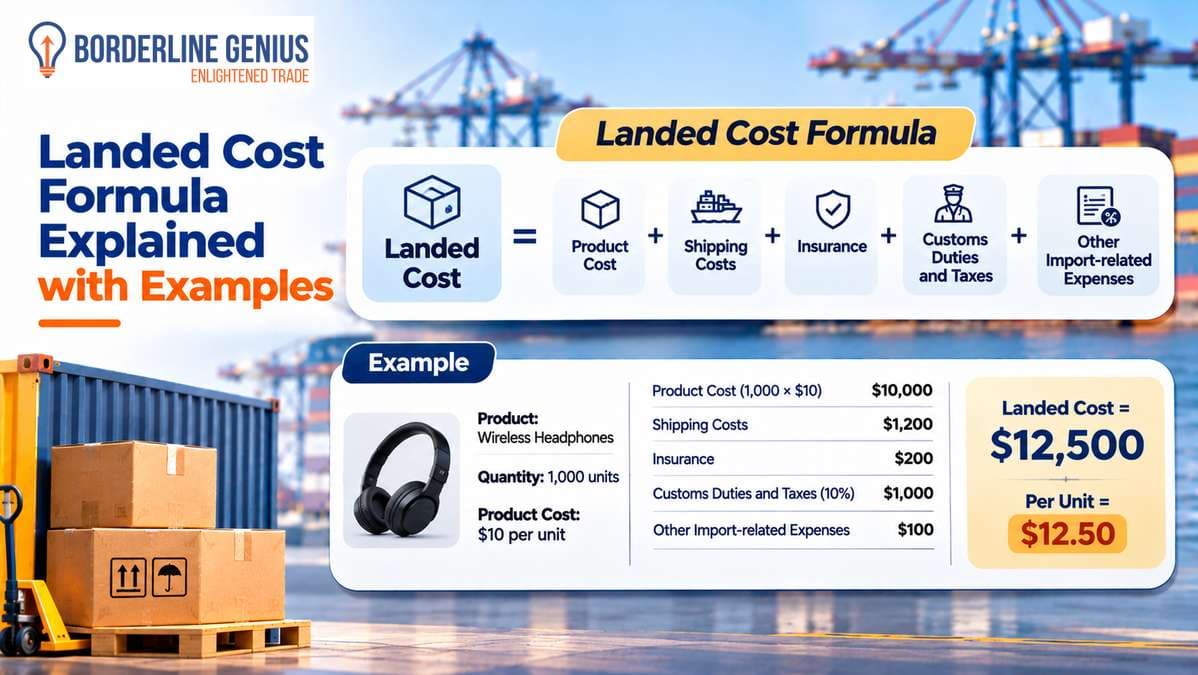
Landed cost is calculated by adding the product price to the expenses incurred to transport and import goods. The landed cost formula helps businesses determine the total expenditure of a shipment and the amount spent on each unit. This calculation is particularly important for importers, manufacturers, retailers, and businesses that source products internationally. Knowing the total cost of goods delivered can enable them to understand the actual sum of acquiring them before setting prices or evaluating suppliers. To calculate this cost accurately, businesses need to identify the expenses included in bringing products to their final destination. The values may vary as per the shipment, product, and destination country.
For a better understanding of how this expense is calculated, this guide explains the respective formula step by step and demonstrates how to apply it through practical examples.
What is the Formula for Landed Cost?
The landed cost formula is a method to calculate the total expense of acquiring goods and delivering them to a specified destination. It includes a product’s purchase price and the additional expenses incurred during transportation and importation.
Note that the exact costs of importing a product depend on the shipment and the applicable trade requirements. For example, an importer may need to account for freight charges, insurance, customs duties, and destination handling fees. Some shipments may also involve inspection charges or other import-related expenses.
Understanding Landed Cost Formula Components
Landed cost formula components represent the expenses included in purchasing a product and bringing it to its final destination. These include the item’s transportation charges, purchase price, customs duties, insurance, and other import expenses. Adding these components can help calculate the total expense of a shipment.
The general landed cost formula is given below:
Landed cost = Product cost + Shipping costs + Insurance + Customs duties and taxes + Other import-related expenses
-
Note that this formula calculates the total landed cost of a shipment.
-
For finding out the landed cost per unit, one should divide the total landed cost by the number of units in the shipment.
-
The landed cost per unit is calculated by dividing the total landed cost of a shipment by the total number of units included in that shipment.
Calculating Landed Cost Using the Formula with Step-by-Step Examples
Trade professionals can calculate landed cost by first determining the purchase price of goods and then identifying the additional expenses included in bringing them to their destination. To apply the formula for landed cost, find the value of each cost component. Then add the amounts to estimate the total shipment expenditure. Divide this amount by the number of units to get the final cost per unit.
The following steps further explain how to apply this formula using relevant examples:
Step 1: Determine the Product Cost
To apply the formula to calculate goods' landed cost, their purchase price is required. This is the amount paid to the supplier for the products. It is usually calculated by multiplying the price per unit by the quantity bought.
Let us understand this through a landed cost example. An importer purchases 500 units of a product at $10 per unit. Considering this,
Product Cost = 500 × $10 = $5,000
This amount represents the value of the goods before accounting for shipping and other import-related expenses.
Step 2: Calculate the Shipping Costs
While calculating the landed cost for cross-border eCommerce, shipping expenditures are needed. They cover the transportation of products from the supplier to the destination. They may include international freight and other transportation charges.
Assume that the shipment has the following freight expenses:
-
International freight costs $800.
-
Inland transportation accounts for $200.
Then the total shipping amount is:
Shipping costs = $800 + $200 = $1,000
Note: The sum of shipping may differ as per the transport mode and shipment route.
Step 3: Add Insurance and Other Expenses
During the landed cost calculation, adding insurance and other expenditures is vital. Insurance protects the shipment against specified risks during transit. Its value should be included when it is part of the expense incurred to bring the goods to their intended destination.
Let us suppose the importer pays $100 for shipment insurance. $150 is additionally incurred in handling fees. The combined amount is:
Insurance and handling = $100 + $150 = $250
Other expenses may apply based on the shipment. These can comprise inspection fees or documentation charges.
Step 4: Calculate Customs Duties and Taxes
Customs duties and taxes depend on the goods being imported and the regulations of the destination country. When incorporating them for the estimated landed cost, keep in mind that duty rates may undergo variations on the basis of the product’s tariff classification and country of origin.
For this example, one can consider that the shipment incurs $600 in customs duties and import taxes. This amount is illustrative. Actual duties and taxes should be determined using the applicable customs rules as well as shipment details.
Step 5: Calculate the Total Landed Cost
After every relevant expense has been identified, estimate the total through the formula for goods' landed cost.
Remember that the shipment details are:
Product price = $5,000
Shipping expenses = $1,000
Insurance and handling amount = $250
Customs duties and taxes = $600
Total landed cost = $6,850
Step 6: Calculate the Landed Cost Per Unit
The landed cost per unit shows the average price of acquiring and importing each item. It is useful for pricing products and evaluating profit margins. To calculate it, divide the sum of the landed cost by the number of units.
Landed cost per unit = $6,850 ÷ 500 = $13.70
Although the supplier price is $10 per unit, the actual landed cost is $13.70 per unit. The difference reflects the additional expenses included in importing the goods.
For example, consider two suppliers offering 500 units of the same product. Supplier A may quote a lower purchase price, while Supplier B may offer cheaper shipping charges. By estimating the landed cost per unit for both suppliers, an importer can identify which option has the overall less expensive expense.
|
Cost Component |
Supplier A |
Supplier B |
|---|---|---|
|
Product cost |
$4,500 |
$4,800 |
|
Shipping value |
$1,200 |
$700 |
|
Insurance and other expenses |
$200 |
$150 |
|
Customs duties and taxes |
$600 |
$650 |
|
Total landed cost |
$6,500 |
$6,300 |
|
Landed cost per unit |
$13.00 |
$12.60 |
Supplier A provides a cheaper product price. However, Supplier B has decreased shipping costs and a lower total landed cost.
Such examples of landed cost calculation show why businesses should compare the full cost of importing goods rather than relying only on the supplier’s quoted price.
How to Simplify Landed Cost Calculation?
To simplify landed cost calculation, trade professionals should organize shipment details and estimate import-related expenses in one place. However, gathering accurate information can take time, especially when importing multiple products or managing shipments from different suppliers.
A landed cost calculation tool can reduce manual work. It can additionally make it easier to review cost components and estimate the total expense before a shipment is finalized.
Simplify Calculations with Landed Cost Genius
Landed Cost Genius is a reliable tool for calculating landed costs. It helps businesses and professionals determine these by using shipment information and relevant expenditure details. It can support importers who need to estimate the sum of bringing goods into a destination market.
Using this landed cost calculation software by Borderline Genius Inc., they can:
-
Simply organize their calculations.
-
Assess how additional expenses affect the final cost.
Take into account that accurate results still depend on the quality of the information entered. Importers should verify product details and applicable customs requirements when estimating duties as well as taxes.
All in All,
The landed cost formula enables a business to understand the full expense of importing goods. By adding product pricing to shipping, insurance, customs duties, and other relevant expenses, importers can estimate the total landed cost and value per unit. These figures can eventually support better pricing, supplier comparisons, and purchasing decisions.
Frequently asked questions
Navigate Global Trade With Greater Confidence
Access expert guidance to help your organization address complex trade, classification, tariff, and compliance challenges.
Talk to a Trade ExpertRelated articles
Keep reading with more guidance on trade compliance and classification.
 Importers & ExportersLanded Cost GeniusLanded Cost6 min read
What is Landed Cost for Importers? Definition, Importance, and Calculation
Understand the meaning of landed cost for importers and its importance, what it includes, key components, factors that influence it, and how to calculate it.
Read article 20 min read
How to Calculate Landed Cost for Cross-Border eCommerce?
Learn how to calculate landed cost for cross-border ecommerce, including product costs, shipping, duties, taxes and checkout considerations.
Read article 19 min read
What is Landed Cost? Formula, Components, and How to Calculate it
What is landed cost? Learn the landed cost formula, key components, calculation methods, examples, and how Landed Cost Genius helps simplify import cost analysis.
Read article