
How is AI Transforming Customs Brokerage in 2026?
Learn how AI for customs brokers is bringing change in 2026, from HS code classification to customs compliance, and how customs brokerage can adopt its use.
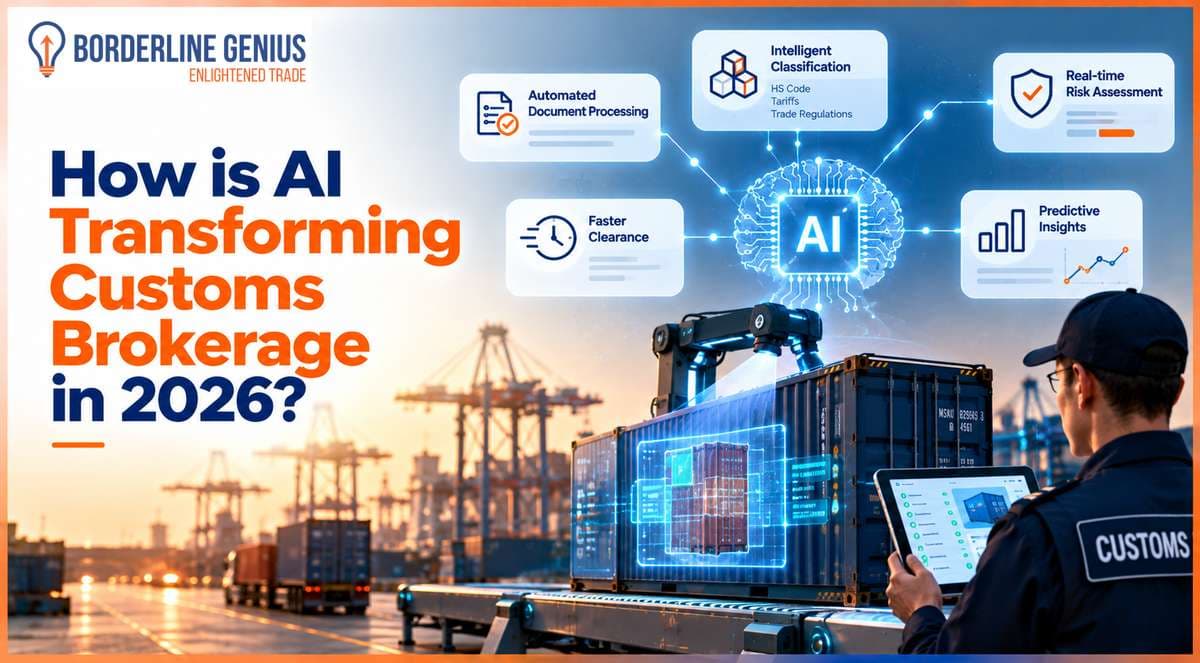
In 2026, AI is changing how customs brokers process shipment documents, prepare customs declarations, classify goods, and manage compliance requirements. By automating repetitive tasks, AI for customs brokers can reduce manual work and identify data discrepancies before submission. However, classification decisions and regulatory requirements still need appropriate verification. As customs processes become more data-driven, brokers need to understand where AI can improve efficiency and where human expertise remains essential. Customs brokers should understand these developments to evaluate suitable technology, manage compliance risks, and remain prepared for changing industry requirements.
What is AI in customs brokerage?
AI in customs brokerage refers to the use of artificial intelligence to assist brokers with documentation, goods classification, declaration preparation, compliance checks, and shipment monitoring. It uses technologies such as machine learning and natural language processing to analyse data and support routine brokerage tasks.
Is AI transforming customs brokerage?
Indeed, AI is changing customs brokerage by automating repetitive administrative tasks and supporting data-driven decisions. Its impact depends on data quality, software capabilities, regulatory coverage, and human oversight. Artificial intelligence can assist brokers with routine processing, while complex classification and compliance decisions may still require expert review.
How is AI changing customs brokerage in 2026?
In 2026, AI for customs brokers is helping to automate documentation, validate shipment data, and identify potential compliance issues. Its applications extend across classification, declarations, duty calculations, and shipment monitoring. This allows brokers to focus more on exceptions and complex cases.
Automating Customs Documentation and Data Entry
AI-powered document processing extracts relevant information from commercial invoices, packing lists, and bills of lading. Bringing a transformation to the customs brokerage industry, it transfers extracted data into brokerage systems and flags missing or inconsistent details. This reduces repetitive manual entry and supports more efficient document preparation.
Improving HS Code Classification and Tariff Determination
Customs brokerage automation can analyse product descriptions and technical specifications to suggest suitable HS codes. These suggestions can speed up classification research. But brokers must verify them against the applicable tariff schedule, classification rules, and product-specific requirements before using them in declarations.
Automating Customs Declarations and Filing
Artificial intelligence can help prepare customs declarations by extracting shipment information, populating relevant fields, and checking for missing data. When integrated with compatible customs filing systems, AI for customs brokerage can support electronic submission. Brokers must still verify declaration details and meet applicable filing requirements.
Strengthening Customs Compliance and Risk Detection
AI can analyse shipment records and declaration data to identify inconsistencies, missing information, and potential compliance concerns. These alerts help customs brokers prioritize reviews before submission. Reliable results depend on accurate source data and current regulatory information.
Supporting Customs Duty and Tax Calculations
Customs automation can support duty and tax calculations in 2026 by processing product classification, customs value, origin, and applicable tariff information. Brokers should verify the underlying data and current rules because incorrect inputs or outdated tariff information can produce inaccurate estimates.
Improving Shipment Tracking and Predictive Risk Analysis
AI can analyse shipment events and available logistics data to identify potential delays or processing disruptions. Customs brokers can use these insights to monitor consignments, update clients, and prepare for exceptions. Predictive results depend on data availability and quality.
Improving Client Communication and Service Availability
Customs broker AI systems can transform the industry by enabling brokers to answer routine client questions about shipment status, documentation requirements, and processing updates. When connected to reliable brokerage records, these tools can reduce repetitive enquiries and help teams respond more consistently without replacing expert advice.
Connecting Customs Systems and Business Applications
AI-driven customs broker software can connect with compatible ERP, transport management, and documentation systems through integrations. This connectivity through AI for customs brokers can transfer shipment data between applications, reduce duplicate entry, and maintain more consistent records throughout the customs clearance workflow.
AI-Powered Customs Brokerage vs. Traditional Customs Brokerage
Traditional customs brokerage often relies on manual document review, data entry, and repeated verification. AI in customs brokerage uses software to automate selected tasks and flag potential errors. Both approaches require accurate information, regulatory knowledge, and appropriate human oversight, especially for complex declarations and classification decisions.
What are the Benefits of AI in Customs Brokerage?
One key benefit of AI for the customs brokerage sector is reduced manual processing. By extracting shipment data and automating repetitive checks, artificial intelligence-powered software can assist brokers in preparing declarations more efficiently. This allows staff to spend more time reviewing exceptions, resolving discrepancies, and managing complex compliance requirements.
Other benefits of automated customs brokerage include:
-
AI can help identify missing information and inconsistencies before customs declarations are submitted.
-
Automated document processing can reduce repetitive data entry across shipment records.
-
AI-assisted classification can speed up HS code research when supported by reliable product information.
-
Automated alerts can assist brokers in detecting potential compliance risks earlier.
-
Connected systems can improve shipment visibility and client communication.
-
Workflow automation can support brokerage teams in managing growing shipment volumes.
Are there Any Limitations of AI for Customs Brokers?
A key limitation of AI for customs brokers is its dependence on accurate data and reliable regulatory information. Incomplete product descriptions, inconsistent documents, or outdated tariff references can lead to incorrect recommendations. Human verification, therefore, remains important.
Other limitations of this technology are:
-
Integrating AI with existing brokerage and customs systems may require technical resources.
-
Businesses may need to evaluate accuracy with suitable testing and performance metrics.
How can Customs Brokers Implement AI Effectively in 2026?
Customs brokers can implement AI effectively by selecting customs broker software that addresses specific operational needs. To choose AI customs broker software, start by assessing document processing, HS code classification support, declaration validation, compliance monitoring, and integration capabilities.
-
Also, test the software against real workflows and verify its outputs.
-
Measure processing time, error rates, and manual intervention as well before expanding automation.
Conclusion
Indeed, AI is reshaping customs brokerage in 2026 by automating documentation, supporting HS code classification, and improving compliance checks. However, accuracy depends on reliable data, updated regulations, and human oversight. Brokers should evaluate customs broker software based on their operational needs, integration capabilities, and compliance requirements prior to adopting AI for their operations.
Frequently asked questions
Navigate Global Trade With Greater Confidence
Access expert guidance to help your organization address complex trade, classification, tariff, and compliance challenges.
Talk to a Trade ExpertRelated articles
Keep reading with more guidance on trade compliance and classification.
 AITrade ComplianceHS Classification4 min read
How is AI Transforming Global Trade Compliance?
Discover how AI is transforming global trade compliance through smarter classification, regulatory research, risk detection, and automated compliance workflows.
Read article Genius WorkspaceAITrade Compliance5 min read
Manual vs AI-Powered Trade Compliance: What is the Difference?
Compare manual and automated trade compliance based on scalability, accuracy, and human review to understand which approach suits different compliance needs.
Read article Customs BrokersTrade ComplianceGenius Workspace7 min read
What is Customs Broker Software?
Learn about customs broker software, its features, benefits, and role in managing customs transactions, documentation, duties, and shipment information.
Read article