
Manual vs AI-Powered Trade Compliance: What is the Difference?
Compare manual and automated trade compliance based on scalability, accuracy, and human review to understand which approach suits different compliance needs.
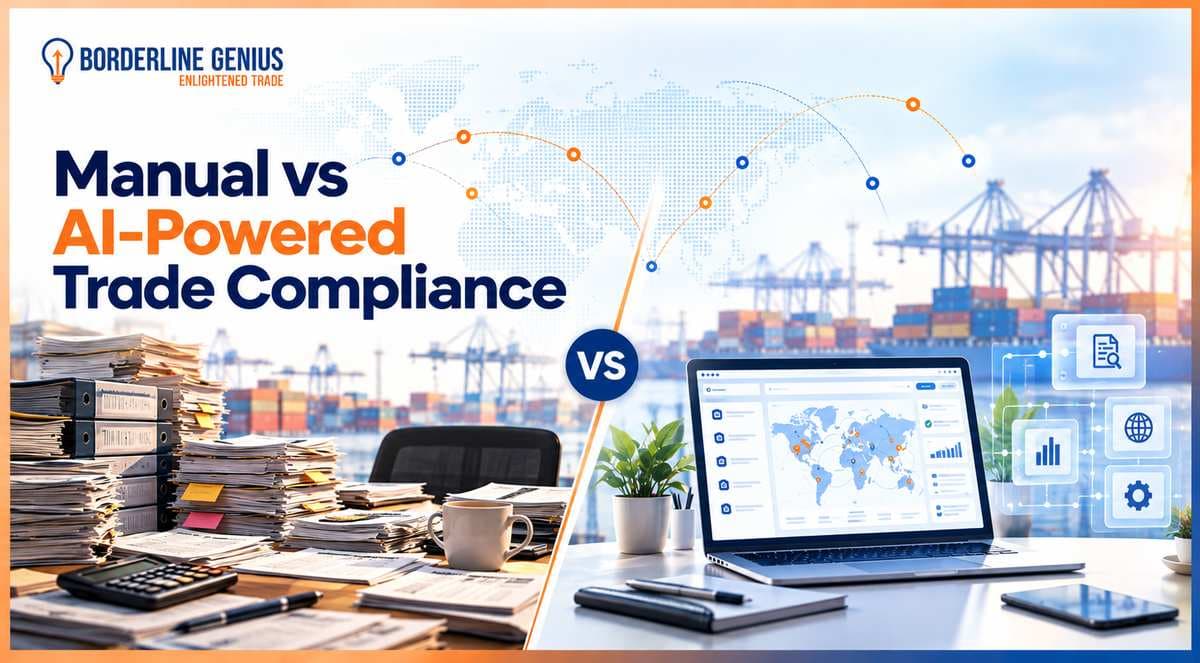
Manual and AI-powered trade compliance differ mainly in how businesses collect, review, validate, and manage trade-related information. Manual compliance relies heavily on human research, along with judgment and repetitive checks. However, automated trade compliance uses technology to assist with data analysis and routine compliance activities. Several factors distinguish these approaches, such as the speed of processing, the impact on scalability, and human involvement. Understanding the comparison is important for determining where automation can improve compliance workflows and where human expertise remains necessary. This differentiation becomes particularly essential as transaction volumes increase and trade regulations become more complex.
What is Manual Trade Compliance?
Briefly, manual trade compliance is an approach in which compliance professionals perform related checks and decisions. For this, they use human research, documents, spreadsheets, databases, and other resources. They may manually review classification, origin, documentation, restrictions, and other requirements before approving or processing a transaction.
What is AI-Powered Trade Compliance?
AI trade compliance uses artificial intelligence to assist with the respective activities by analyzing data, identifying patterns, and supporting routine checks. On the basis of the system, artificial intelligence can help review product information, detect potential compliance issues, prioritize exceptions, and support decisions while keeping human professionals involved in appropriate review processes.
Manual vs Automated Trade Compliance: 7 Main Differences
The main difference between manual and AI-driven trade compliance is how the core process is performed and supported. Manual processes place more responsibility on human research and repetitive review. On the flip side, automated processes use technology to handle or assist with data-intensive tasks.
Here is a comparison that highlights the key differences between these approaches:
|
Manual Trade Compliance |
AI-Powered Trade Compliance |
|---|---|
|
When compliance is manual, it requires professionals to research and review trade information using available documents, databases, and other resources. |
The use of AI for compliance involves analyzing relevant information and assisting professionals with routine research and review activities. |
|
As part of this, processing large numbers of transactions can rely on additional human effort because each transaction may need individual attention. |
AI-powered systems can process large amounts of information more efficiently, making them highly suitable for increasing transaction volumes. |
|
In human-led compliance, the consistency of manual reviews can depend on the experience, workload, and procedures of individual compliance professionals. |
Artificial intelligence-driven systems can apply configured processes consistently across similar transactions while still allowing human review when needed. |
|
During manual compliance, teams may spend significant time performing repetitive checks and gathering information before making decisions. |
In contrast, AI can reduce repetitive work by identifying relevant information and highlighting transactions that may need further attention. |
|
Detecting potential issues manually can take more time when compliance teams must review large amounts of data. |
AI systems can help spot patterns, anomalies, or potential compliance issues that warrant additional review. |
|
Human judgment plays a central role throughout the process of complying manually. |
This approach supports compliance professionals, but human judgment remains important for complex decisions and exceptions. |
|
Scaling manual compliance operations may demand further personnel as transaction volumes increase. |
AI-powered workflows can enable businesses to handle growing volumes without increasing manual effort at the same rate. |
Which is Better: Manual or Automated Trade Compliance?
Automated trade compliance is generally more suitable for a business that handles large transaction volumes, repetitive compliance checks, and substantial amounts of trade data. This is because automation can help improve processing speed, consistency, and scalability. The benefits can extend depending on the specific trade compliance software used by a business.
However, manual review remains necessary for complex classifications. It serves a vital role for unusual transactions, regulatory interpretation, exceptions, and decisions that require professional judgment. For this reason, the most effective approach is often a combination of AI-powered assistance and human oversight.
Key Takeaway
Trade compliance automation can reduce repetitive work and help manage growing compliance workloads more efficiently. But AI does not remove the need for professional judgment. Organizations can gain the most value when technology handles suitable routine activities while experienced compliance professionals review complex cases as well as final decisions.
Frequently asked questions
Navigate Global Trade With Greater Confidence
Access expert guidance to help your organization address complex trade, classification, tariff, and compliance challenges.
Talk to a Trade ExpertRelated articles
Keep reading with more guidance on trade compliance and classification.
 Trade Compliance5 min read
Common Trade Compliance Challenges and How to Resolve them
Find out 4 common trade compliance challenges and practical solutions that a business can use to reduce these, avoid risks, and improve compliance.
Read article Genius WorkspaceTrade ComplianceAI12 min read
Choosing the Right Trade Compliance Software in 2026
Choose the right trade compliance software in 2026. Compare key features, integrations, evaluation criteria, and best practices to find the right fit.
Read article 8 min read
What is Trade Compliance Software & Why Do Modern Businesses Need it in 2026?
Learn what trade compliance software is, how it works, its key features, benefits, and why businesses need AI-powered trade compliance solutions in 2026.
Read article