How is AI Transforming Global Trade Compliance?
Discover how AI is transforming global trade compliance through smarter classification, regulatory research, risk detection, and automated compliance workflows.
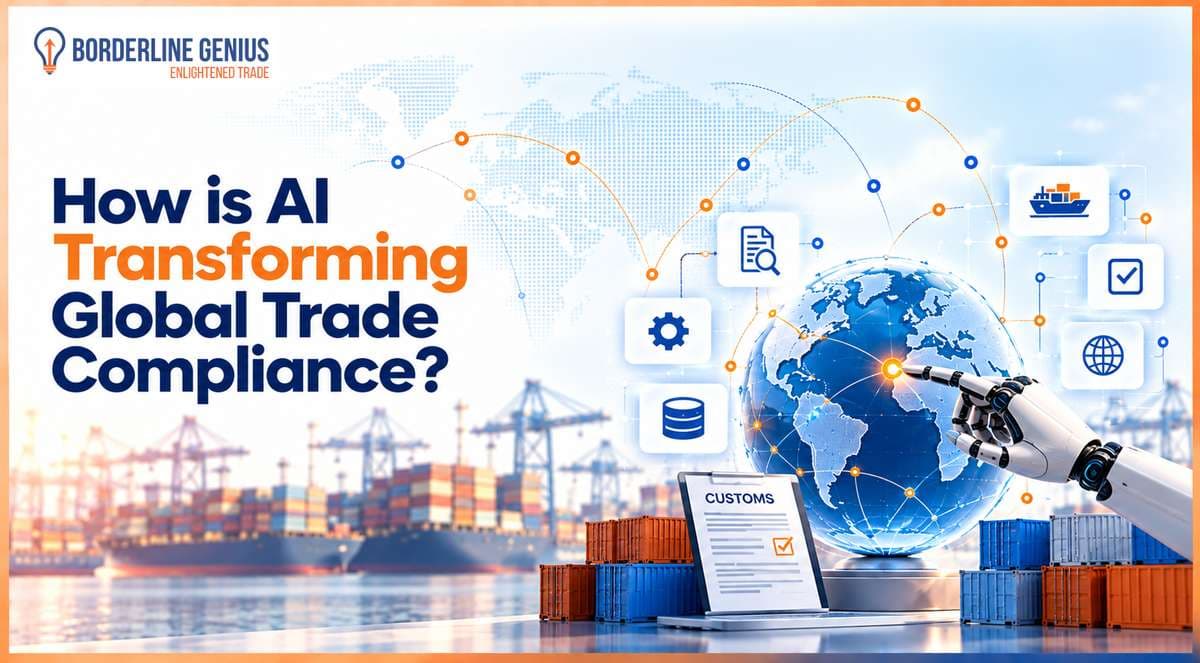
Global trade compliance can become increasingly complex when businesses navigate changing tariffs, customs regulations, sanctions, export controls, and documentation requirements across multiple markets. Traditional manual processes can be slow and difficult to scale. Artificial intelligence or AI in trade compliance is changing this landscape by helping organizations analyze trade data, classify products, identify regulatory requirements, and do more. It has automated repetitive compliance tasks. By combining AI with expert oversight, organizations can improve accuracy across their processes. Besides, it can help respond faster to regulatory changes as well as reduce compliance risks.
What is AI-Powered Trade Compliance?
AI-powered trade compliance is the use of artificial intelligence to assist a business in managing and meeting international trade regulations. It combines AI with trade data, product information, tariffs, and regulatory requirements to support faster, more accurate compliance decisions across importing and exporting activities.
In What Ways is AI Transforming Global Trade Compliance?
Notably, AI in trade compliance is bringing a transformation by reducing manual work and helping organizations make faster, data-driven decisions. From product classification to regulatory monitoring, this component can process large amounts of information and identify relevant compliance requirements more efficiently than traditional manual approaches.
Automating HS Code Classification
AI can analyze product descriptions, specifications, attributes, and historical classification information to recommend relevant HS codes. This can significantly reduce the time required for classification while improving consistency across large product catalogs. Human experts can then review complex or high-risk classifications before final decisions are made.
2. Improving Tariff and Duty Intelligence
With AI, businesses in global trade can identify applicable tariffs, duties, taxes, and trade measures across different countries and products. By processing changing regulatory information, AI-powered systems can provide more timely intelligence. Thus, importers can understand potential cost impacts and respond faster when tariff policies change.
3. Streamlining Regulatory Research
Trade professionals often spend considerable time searching regulations, customs rulings, government notices, and other sources. AI can analyze large volumes of regulatory information and surface relevant content based on products, countries, transactions, or compliance questions, making research faster and more focused.
4. Identifying Compliance Risks
AI in trade compliance can analyze trade data to identify unusual patterns, inconsistencies, or potential compliance issues. It can flag transactions or product classifications that may require additional review. This allows compliance teams to prioritize higher-risk activities instead of manually examining every transaction with the same level of attention.
Benefits of AI for Global Trade Compliance Teams
Artificial intelligence can help trade compliance teams improve operational efficiency while managing increasingly complex regulations. By automating repetitive tasks and making relevant information easier to access, it assists professionals in spending more time on strategic decisions, risk management, and complex compliance matters.
-
AI automates repetitive classification, research, and data-processing activities.
-
It can reduce errors associated with manual data entry and repetitive compliance processes.
-
For better scalability, it can help organizations manage growing product catalogs and transaction volumes.
-
AI can make it easier to identify and respond to changes in trade regulations.
-
For reduced compliance risk, it can flag potentially problematic transactions and classifications for review.
-
It can centralize important trade intelligence and compliance information.
-
For better decision-making, it provides data-driven insights.
-
AI helps maintain consistent records and decision trails for compliance activities.
Conclusion
AI in trade compliance is becoming an important tool for present-day organizations. Businesses should begin by identifying repetitive, high-volume compliance processes where AI can deliver measurable value. Combining AI automation with reliable data, expert validation, and appropriate human oversight can help them create faster, more accurate, scalable, and resilient compliance operations.
Frequently asked questions
Navigate Global Trade With Greater Confidence
Access expert guidance to help your organization address complex trade, classification, tariff, and compliance challenges.
Talk to a Trade ExpertRelated articles
Keep reading with more guidance on trade compliance and classification.
 Genius WorkspaceAITrade Compliance5 min read
Manual vs AI-Powered Trade Compliance: What is the Difference?
Compare manual and automated trade compliance based on scalability, accuracy, and human review to understand which approach suits different compliance needs.
Read article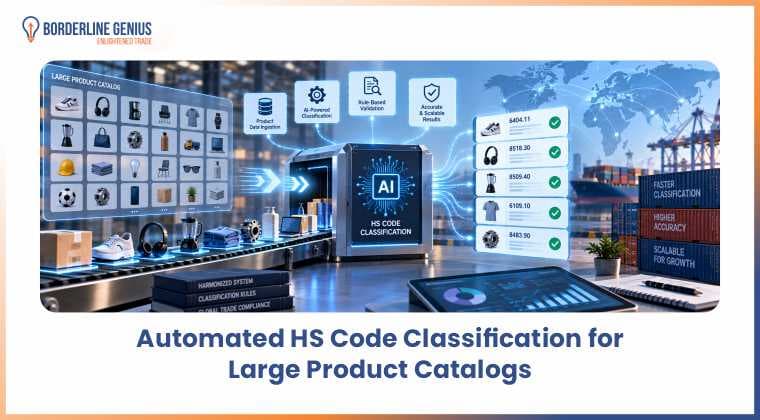 Classification GeniusHS ClassificationTrade Compliance6 min read
Automated HS Code Classification for Large Product Catalogs
Learn how automated HS code classification works for large product catalogs and how AI, bulk processing, APIs, and review workflows can improve classification.
Read article 13 min read
Manual vs. Automated HS Classification: Comparing Cost and Accuracy
Compare manual vs. automated HS classification on cost, accuracy, consistency, auditability, maintenance, and human review in trade compliance.
Read article