AI Trade Compliance: Where AI can Automate Global Trade Decisions
Find out how AI trade compliance can automate global trade decisions, from HS classification to regulatory research, and make processes easier to manage.
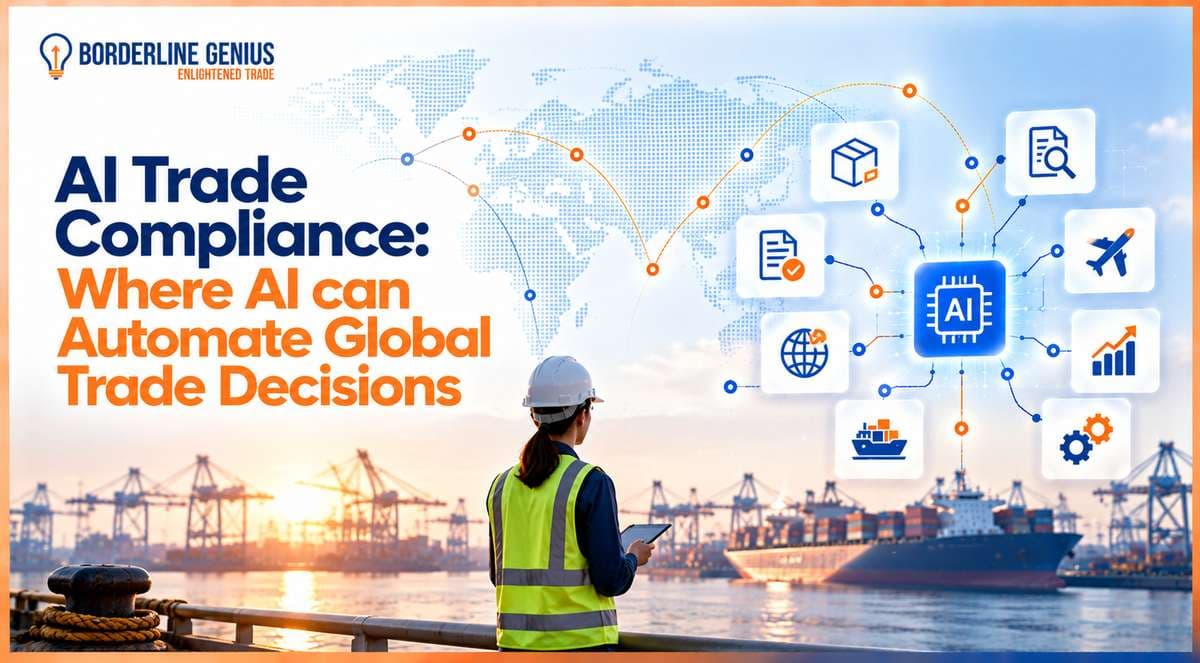
AI trade compliance is changing how businesses manage the growing complexity of cross-border exchange globally. Companies must continuously deal with product classifications, tariffs, duties, regulations, documentation, and compliance risks across multiple markets. Manual processes can make these activities time-consuming and difficult to scale. Artificial intelligence can help automate repetitive trade decisions by analyzing large volumes of product data, identifying relevant requirements, and supporting faster decision-making. However, effective automation does not mean removing human expertise. The most practical approach combines AI-driven automation with expert oversight, allowing organizations to streamline routine decisions while keeping complex or high-risk compliance matters under human control.
In Brief: AI Trade Compliance
Simply said, AI trade compliance refers to the utilization of artificial intelligence to automate and support decisions that are involved in managing the requirements for international trade. AI can analyze products along with tariff, regulatory, and transaction data to improve classification. Moreover, it can facilitate compliance research, risk detection, documentation, and other trade processes.
Where can AI Automate Global Trade Decisions?
AI can automate many repetitive and data-intensive trade compliance decisions. By processing large amounts of information quickly, it can help organizations identify relevant requirements and flag potential issues. It can also recommend appropriate actions while allowing compliance professionals to oversee complex decisions.
HS Code Classification
Through the use of AI in global trade, one can analyze product descriptions, specifications, attributes, and supporting information. It can be utilized to recommend relevant HS codes. This helps businesses accelerate classification across large product catalogs, improve consistency, and detect products requiring additional information or expert review.
Tariff and Duty Determination
Artificial intelligence can identify applicable tariffs and duties as well as taxes and additional trade measures based on product and country information. This is vital for businesses to understand potential import costs faster and respond more efficiently when tariff requirements change.
Landed Cost Analysis
AI can enable trade compliance automation to combine duties, tariffs, taxes, and other relevant costs to support landed cost calculations. Organizations can use these insights to compare sourcing options, evaluate market opportunities, and make more informed purchasing and pricing decisions.
Regulatory Research
A business can rely on AI to analyze large volumes of regulations, customs rulings, government notices, and trade information to surface relevant requirements. This reduces the time compliance professionals spend searching multiple sources. It can enable them to focus on regulations applicable to specific products or transactions.
Compliance Risk Detection
AI can analyze trade data to identify inconsistencies. The component further comes into use for finding out unusual patterns and potentially risky transactions. By flagging issues automatically, AI in trade compliance can enable prioritizing higher-risk cases instead of manually reviewing every transaction with equal attention.
Benefits of AI in Trade Compliance
One major benefit of AI in global trade compliance is greater operational efficiency. By automating repetitive research, classification, data analysis, and review activities, it can reduce the time compliance teams spend on routine work. Thus, professionals can focus on complex decisions and higher-value strategic activities.
-
Besides, for compliance, AI can process large volumes of trade information quickly.
-
For improved consistency, it can apply standardized approaches across repetitive compliance processes.
-
To drive scalable trade compliance, growing product catalogs and transaction volumes can be managed more efficiently.
-
For reducing manual effort, AI can automate repetitive research and data-processing activities.
-
Its utilization results in better risk visibility after identifying potentially problematic transactions and classifications.
-
AI can support faster response to regulatory changes as relevant updates surface more efficiently.
-
To improve data quality, artificial intelligence can detect missing, inconsistent, or incomplete product information.
-
For better audit readiness, it can maintain more consistent compliance records and decision trails.
Start Automating Trade Compliance with Borderline Genius Inc.
Borderline Genius Inc. combines AI-powered technology and trade compliance intelligence to help businesses simplify complex global trade processes. Its connected solutions can support product classification, tariff and duty intelligence, landed cost calculations, and centralized compliance workflows. Thus, teams can make faster and more informed trade decisions through its AI trade compliance software.
-
Through Classification Genius, it offers AI-powered HS and ECCN classification support.
-
Facilitating intelligence for tariffs, duties, taxes, and trade measures, Tariff Genius is a reliable solution.
-
Using Landed Cost Genius, understanding and calculating the total cost of importing goods becomes easier.
-
Genius Workspace is a centralized hub for managing trade compliance activities.
Coming to a Close
Businesses should begin the use of AI in trade compliance by identifying repetitive, high-volume decisions where automation can deliver measurable value. Start with reliable data and establish appropriate human-review checkpoints. Then expand gradually based on results. The goal should not be to automate everything, but to combine AI efficiency with human expertise for smarter and scalable trade compliance.
Frequently asked questions
Navigate Global Trade With Greater Confidence
Access expert guidance to help your organization address complex trade, classification, tariff, and compliance challenges.
Talk to a Trade ExpertRelated articles
Keep reading with more guidance on trade compliance and classification.
 AITrade ComplianceHS Classification4 min read
How is AI Transforming Global Trade Compliance?
Discover how AI is transforming global trade compliance through smarter classification, regulatory research, risk detection, and automated compliance workflows.
Read article Genius WorkspaceAITrade Compliance5 min read
Manual vs AI-Powered Trade Compliance: What is the Difference?
Compare manual and automated trade compliance based on scalability, accuracy, and human review to understand which approach suits different compliance needs.
Read article Classification GeniusHS ClassificationTrade Compliance6 min read
Automated HS Code Classification for Large Product Catalogs
Learn how automated HS code classification works for large product catalogs and how AI, bulk processing, APIs, and review workflows can improve classification.
Read article