
Customs Classification: How to Classify Products for Accurate Duty Assessment?
Understand customs classification and how to classify products, determine the correct duty treatment using the appropriate tariff code, and apply tariff rules.
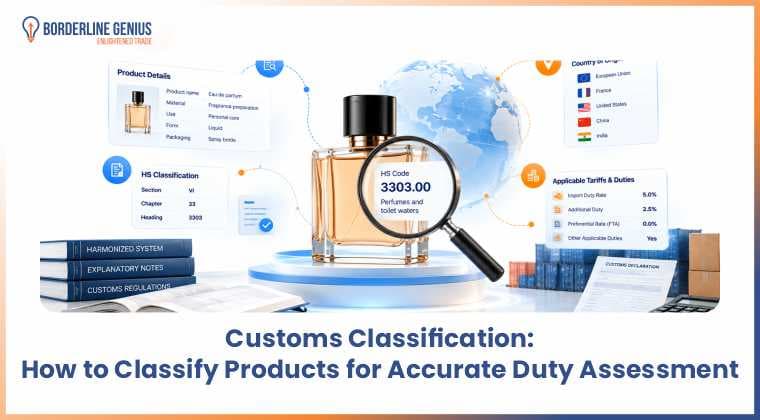
To classify products for accurate duty assessment, a business should identify the correct customs classification by applying the relevant tariff rules to their characteristics. Customs classification is the process of assigning an item to the appropriate tariff code under the applicable nomenclature. The link between the two is direct: the assigned tariff code determines the applicable duty treatment for the item. The Harmonized System provides the international foundation for this process. Accurate classification matters because an incorrect code can result in incorrect duty assessment and other customs compliance issues.
This guide explains how to classify a product step by step and why accurate classification matters for determining the correct duty treatment as well as maintaining customs compliance.
What is Customs Classification?
Customs classification is the process of assigning a traded product to the appropriate tariff code on the basis of its characteristics. Besides, for this, the applicable classification rules are taken into consideration. Most countries use the Harmonized System as the foundation, with national tariff schedules extending the international six-digit HS structure where required.
What is the Role of Customs Classification in Accurate Duty Assessment?
The practice of customs classification helps determine the tariff treatment that applies to imported goods. The assigned classification connects the item to the relevant tariff provision. It can establish the applicable duty rate and other requirements under the destination country’s tariff schedule.
This customs classification process also serves a role in affecting:
-
The tariff rate and duty calculation that applies
-
Quantity units used where a duty is specific or compound
-
The implementation of additional trade measures or restrictions
-
Customs information required for the import declaration
-
The need for further classification research or an official ruling
How to Classify a Product for Accurate Duty Assessment?
For classifying a product for accurate duty assessment, start by collecting the complete information about an item. Then apply the relevant tariff rules in sequence. The analysis generally moves from the product’s characteristics to the appropriate heading and subheading before confirming the applicable national tariff code.
Here is a step-by-step breakdown of the customs product classification for the correct assessment of duties:
Step 1: Gather Complete Product Information
To classify an article and determine the proper duty, the initial step is to collect enough technical information to describe it with accuracy. Product composition, function, specifications, form, intended use, and condition can affect classification. Incomplete descriptions can make it difficult to distinguish between competing tariff provisions.
In this regard, useful information may include:
-
The product’s primary function and intended use
-
Materials or substances that make up the item
-
Technical specifications and operating characteristics
-
Whether the item is complete, unfinished, unassembled, or presented as a set
-
Product literature, drawings, photographs, and manufacturer specifications
Step 2: Identify the Relevant HS Heading
The next step to carry out product classification for customs is inclusive of identifying potential headings by examining the description against the terms of the tariff schedule. Under GRI 1, classification begins with the heading terms and the relevant HS Section and Chapter Notes.
So, the initial review should focus on the legal wording of the tariff rather than relying only on a commercial item’s name. It may be described differently in trade documents than in the tariff nomenclature.
Step 3: Apply the General Rules of Interpretation
To classify goods for accurate duty assessment, apply the General Rules of Interpretation (GRIs). They should be implemented in the prescribed order when the classification cannot be resolved by the initial heading analysis. GRI 1 is considered first, while subsequent rules address situations such as incomplete goods, mixtures, composite products, and items that could fall under multiple headings.
Particular attention may be required when:
-
A product contains multiple materials
-
Several components are presented together
-
The item is imported unfinished or unassembled
-
More than one heading appears to be relevant
Step 4: Determine the Correct Subheading
Once the appropriate heading is established, for the customs classification of an item, determine the correct subheading by comparing provisions at the same level. GRI 6 governs classification at the subheading level. It applies the essential principles for classifying to the subheadings under consideration.
This step is important because the six-digit HS subheading provides the international classification foundation. However, individual countries may add further digits for national tariff requirements.
Step 5: Review Explanatory Notes and Classification Decisions
In order to classify products to correctly assess duties, review authoritative classification resources when the tariff language does not resolve the issue clearly. The WCO, or World Customs Organization, identifies Explanatory Notes, Classification Opinions, and classification decisions as tools that assist with assigning HS codes.
Additional research may include:
-
Relevant customs classification rulings from the destination country
-
Previous decisions to classify goods involving similar merchandise
-
Applicable tariff or national customs guidance
-
Official interpretations of relevant headings and subheadings
Step 6: Confirm the National Tariff Code
Going forward with customs classification, confirm the assigned code against the tariff schedule of the country where the goods are being imported. The international HS provides the first six digits. But national authorities may extend the code to provide additional tariff and statistical detail.
The final product classification for customs should, therefore, reflect the tariff structure and legal requirements that apply to the specific import transaction.
Step 7: Document the Classification Decision
Document the reasoning behind the classification of the item so the decision can be reviewed and maintained. Supporting product information, tariff references, applicable rules, rulings, and approval records can be used to demonstrate how the classification was determined.
Good records can help teams:
-
Reuse established classifications for comparable products
-
Review classifications when product specifications change
-
Support internal approvals and customs inquiries
-
Maintain a history of decisions for classifying articles
Classify Products with Borderline Genius Inc. for More Accurate Duty Assessment
For customs classification with highly accurate assessment of duties, Borderline Genius Inc. provides Classification Genius. This platform for classifying products combines AI-powered classification with expert review. Thus, it assists businesses in managing HS and HTS classifications. Its workflow allows users to upload items' information, receive code-related recommendations, and obtain expert-reviewed results.
This platform supports classification workflows through capabilities such as the following:
-
Businesses can upload multiple products using an Excel template.
-
Classification recommendations can be reviewed by trade professionals.
-
Teams can maintain the respective history and audit trails.
-
Classification data can be managed through applications, APIs, or Genius Workspace.
Conclusion
Accurate customs classification begins with complete product information and a structured review of the applicable tariff rules. Following the process step by step can help a business establish the appropriate code for customs, support accurate duty assessment, and maintain better classification records across international trade operations.
Frequently asked questions
Navigate Global Trade With Greater Confidence
Access expert guidance to help your organization address complex trade, classification, tariff, and compliance challenges.
Talk to a Trade ExpertRelated articles
Keep reading with more guidance on trade compliance and classification.
 Classification GeniusHS ClassificationTrade Compliance6 min read
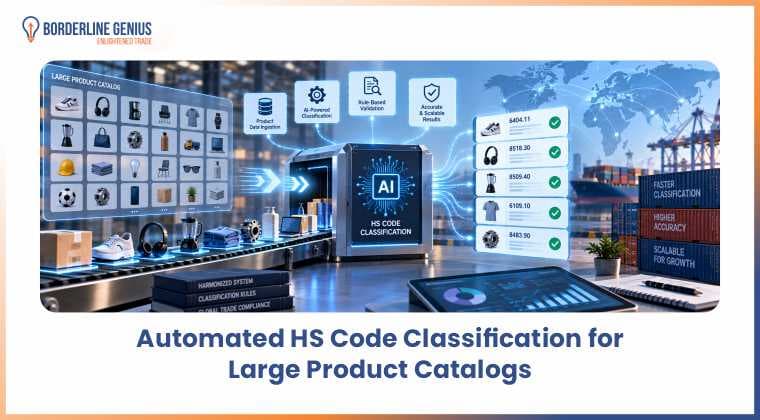
Automated HS Code Classification for Large Product Catalogs
Learn how automated HS code classification works for large product catalogs and how AI, bulk processing, APIs, and review workflows can improve classification.
Read article Classification GeniusHS ClassificationTrade Compliance5 min read
HS Code Classification Software: What to Look For
Find out how to choose HS code classification software by assessing key features that can improve classification accuracy, research, and review.
Read article 13 min read
Manual vs. Automated HS Classification: Comparing Cost and Accuracy
Compare manual vs. automated HS classification on cost, accuracy, consistency, auditability, maintenance, and human review in trade compliance.
Read article