
HS 2028: What is Changing, When, and How to Prepare?
As HS 2028 will take effect on 1 January 2028, learn about the key changes, implementation timeline, business impact, and steps to prepare classifications.
HS 2028 is the eighth edition of the Harmonized System. It will replace HS 2022 on 1 January 2028. The revision updates the classification of selected traded products within the international HS structure. Some businesses will face limited changes, while others may need to reassess classifications across their product catalogues. These changes can affect customs duties, origin treatment, licensing, rulings, and internal trade data. Importers, exporters, customs teams, and compliance professionals should assess their exposure before implementation. Early preparation gives businesses more time to resolve complex classifications and update affected processes.
Understanding the scope and timing of HS 2028 can help businesses reduce customs delays, incorrect duty payments, and compliance risks during the transition.
What is HS 2028?
In simple terms, HS 2028 is the eighth edition of the Harmonized Commodity Description and Coding System maintained by the World Customs Organization (WCO). It will replace HS 2022, the seventh edition of the Harmonized System.
The Harmonized System provides the international six-digit structure used to classify traded products. HS 2028 does not create a new classification system. Instead, it revises the existing structure by adding, removing, or modifying product classifications to reflect changes in trade and technology.
-
National tariff schedules build on the international HS structure.
-
Countries, therefore, need to update their national tariff codes and related customs systems.
-
These updates must be completed when the HS 2028 amendments take effect.
When Does HS 2028 Take Effect?
The Harmonized System, or HS 2028, enters into force on 1 January 2028. The key milestones leading to its implementation are as follows:
|
Milestone |
Date |
|
Seventh HS Review Cycle runs |
July 2019 to June 2025 |
|
HS Committee provisionally adopts the amendment recommendation |
March 2025 |
|
WCO Council formally adopts the Article 16 Recommendation |
December 2025 |
|
The World Customs Organization publishes the amendments |
January 2026 |
|
WCO publishes HS 2022, HS 2028 correlation tables |
2026 |
|
National tariff schedules published (varied by country) |
2026 to 2027 |
|
HS 2028 enters into force |
1 January 2028 |
The tacit acceptance process is the formal mechanism through which HS amendments become accepted under Article 16 of the HS Convention. After the WCO Council recommends the amendments, contracting parties have a defined period to object. If no objection is made, the amendments are accepted.
-
For HS 2028, the acceptance period has closed.
-
The amendments are established for implementation on 1 January 2028.
How Many HS 2028 Changes are there?
HS 2028 changes include 299 sets of amendments across the international nomenclature. There are key changes to note compared with HS 2022.
-
Six new headings have been created.
-
Five headings have been deleted.
-
428 new subheadings have been formed.
-
172 subheadings have been removed.
-
The revised nomenclature contains 1,229 headings.
-
There are 5,852 subheadings in the revised nomenclature.
The impact varies by product and industry because the changes are concentrated in specific areas rather than evenly distributed. A deleted subheading can no longer be used for customs declarations. Merged or split subheadings may require businesses to reassess their product classifications and duty treatment.
What are the Main Changes in Harmonized System 2028?
The Harmonized System 2028 amendments focus on several policy priorities identified during the WCO review cycle.
-
Public health changes improve classification for ambulances, PPE, ventilators, and diagnostic devices.
-
Vaccine classifications create separate headings for human and other vaccines.
-
A new heading provides a dedicated classification for dietary supplements.
-
Plastic waste classifications are revised to better align with Basel Convention categories.
-
New provisions improve classification of single-use plastic articles.
-
Additional detail covers narcotics precursors and dual-use goods.
-
Technology classifications are updated for newer products and changing trade patterns.
How Did HS 2028 Come About?
Following the WCO’s established review process, HS 2028 was developed as an update to the Harmonized System. Running from July 2019 to June 2025, the seventh review cycle involved proposals from national administrations, industry bodies, and international organizations.
Several stages make up the review process:
-
Proposals are submitted and reviewed during the cycle.
-
The HS Review Sub-Committee evaluates and refines proposals.
-
Then the Harmonized System Committee considers the surviving proposals.
-
The WCO Council adopts the amendments under Article 16.
Proposals generally address changes in trade, policy requirements, or persistent classification issues. Industry and other stakeholders can influence proposals through national customs administrations or recognized international bodies.
What are HS 2028 Correlation Tables and How Do They Work?
HS 2028 correlation tables provide the WCO’s official mapping between HS 2028 and HS 2022 codes.
-
There are two available tables.
-
Table I maps HS 2028 codes back to HS 2022 codes.
-
Table II maps HS 2022 codes forward to HS 2028 codes.
For classification migration, Table II is the more relevant starting point because it begins with the codes currently in use. Table I is useful for analyzing historical trade data under the newer classification.
Types of HS Code Relationships
HS 2022 and HS 2028 codes can correspond in different ways, which determines whether further classification review is needed.
-
One-to-one relationships link one HS 2022 code to one HS 2028 code.
-
Partial relationships apply when only part of an old code’s scope moves to a new code.
-
Changed-scope relationships occur when the code number remains the same but its product coverage changes.
Correlation tables provide a mapping, not a final classification decision. Products affected by partial or changed-scope relationships may require review against the HS 2028 legal texts.
Why Won’t Harmonized System 2028 Arrive Everywhere at the Same Time?
Harmonized System 2028 is less likely to arrive everywhere at the same time because each country must separately update its national tariff schedule and complete its own legislative or administrative process.
-
The international HS structure uses six-digit codes, while countries add national extensions.
-
National extensions may use eight, ten, or more digits for duties, statistics, and regulatory requirements.
-
Each country must rebuild its national extensions on the revised HS structure.
-
Different national processes create different implementation timelines.
-
National tariff schedules may be published at different times.
-
Some countries may implement HS 2028 later.
-
Individual duty rates may change during the transition.
-
Trade agreements may require tariff lines to be updated.
-
Businesses must manage classification changes market by market.
What Does HS 2028 Affect Beyond the Tariff Code?
HS 2028 affects several areas beyond the tariff code because classification data is also used in customs rulings, origin rules, licensing, trade remedies, business systems, and historical trade reporting.
-
Besides, binding and advance rulings may need review when classifications change.
-
Preferential origin rules may change when tariff headings move.
-
Import and export licences may depend on revised tariff codes.
-
Trade remedies may use tariff lines to define covered goods.
-
ERP and master data may require updated classifications.
-
Historical reporting may require correlation tables for comparisons.
How should Businesses Prepare for HS Code Changes 2028?
Preparing for HS code changes 2028 requires a risk-based approach. This is because not every classification change has the same operational or financial impact. Businesses should first focus on products where a code change could affect duties, origin, licensing, or customs treatment.
Afterward, organizations can work through reclassification, related compliance requirements, system updates, and implementation controls in sequence.
1. Identify and Prioritize Affected HS Codes
To prepare for Harmonized System 2028, start by building a complete list of the HS codes currently in use. Use the correlation tables to identify unchanged codes, simple remaps, and splits.
-
Rank affected codes by duty exposure.
-
Prioritize split codes for detailed review.
-
Build the work queue by volume and duty value.
2. Reclassify Affected Products
Products affected by split or complex codes should be classified against the new legal texts rather than assigned a code through simple remapping, while preparing for HS 2028.
Review the relevant Heading terms, Section and Chapter Notes, and General Rules of Interpretation. Document the classification reasoning for future audit support.
3. Review Related Compliance Requirements
Affected classifications may require businesses to review related rulings, origin requirements, licences, and control lists as they get ready for the Harmonized System 2028. They should review binding tariff rulings for affected codes. Reassess preferential origin qualification. Check licensing and control-list requirements.
4. Update Systems and Partners
A business should update classification data and communicate changes to customs brokers and other service providers before implementation to be equipped for HS 2028 changes.
-
Maintain HS 2022 and HS 2028 codes with effective dates.
-
Update broker instructions and customs software.
-
Confirm service providers are ready for the transition.
5. Monitor the Transition
After implementation of HS 2028, companies should monitor customs entries and duty outcomes closely to identify classification issues early. They should monitor entry rejections during the initial transition and track unexpected duty variances. Additionally, they should review anomalies as potential classification issues.
What are the Risks of not Preparing for Harmonized System 2028?
Failing to prepare for Harmonized System 2028 can cause customs declarations to be rejected when businesses continue using codes that no longer exist. Such rejections can delay shipments at the border and require the importer to correct the classification before the goods can clear customs.
-
Also, incorrect codes can result in duty underpayments or overpayments.
-
Obsolete tariff lines can cause preferential origin claims to be denied.
-
Rulings tied to obsolete codes may no longer provide protection.
-
Unresolved classification errors can affect repeated shipments.
The financial impact can extend beyond individual customs entries. A single classification error may recur across multiple shipments, increasing potential duties, penalties, recovery issues, and audit exposure over time.
Can Trade Compliance Software Help with HS 2028?
Trade compliance software can help businesses prepare for HS 2028 because it can manage large volumes of classification data, apply updates consistently, and maintain records across products and markets. Such functionalities are dependent on the specific software. Accordingly, it can reduce the manual effort involved in managing classification changes.
Using Trade Compliance Software for HS 2028 Preparation
Businesses can use trade compliance software to manage HS 2028 classification workflows at scale. It can assign tasks and track review status. Further, it can give teams visibility into unresolved classifications across products and jurisdictions.
-
Such a software system can maintain an audit trail of classification decisions and supporting documents.
-
Teams can set effective dates for classifying under HS 2022 and HS 2028.
-
Users can monitor outstanding classification reviews and approval workflows.
-
They can generate reports on classification changes and implementation progress.
How can Borderline Genius Inc. Help You Prepare for HS 2028?
Preparing for HS 2028 requires businesses to manage classification changes alongside broader trade compliance requirements as well as risks.
Borderline Genius Inc. can help companies and professionals manage trade compliance processes to strengthen their preparation for the transition. Its support can improve existing practices in this regard and assist them in handling classification and other trade-related requirements in a systematic manner.
By and Large,
HS 2028 introduces targeted changes to product classification and related compliance requirements. Now that businesses understand the transition, they can assess the work required and prepare before implementation. The immediate priority is to identify exposure and address high-risk classifications early.
Frequently asked questions
Navigate Global Trade With Greater Confidence
Access expert guidance to help your organization address complex trade, classification, tariff, and compliance challenges.
Talk to a Trade ExpertRelated articles
Keep reading with more guidance on trade compliance and classification.
 Trade ComplianceTrade Compliance TeamsGenius Workspace9 min read
What is Trade Compliance? A Complete Guide
Learn what trade compliance is, how it works, key compliance areas, risks of non-compliance, and how software can support global trade operations.
Read article 13 min read
Manual vs. Automated HS Classification: Comparing Cost and Accuracy
Compare manual vs. automated HS classification on cost, accuracy, consistency, auditability, maintenance, and human review in trade compliance.
Read article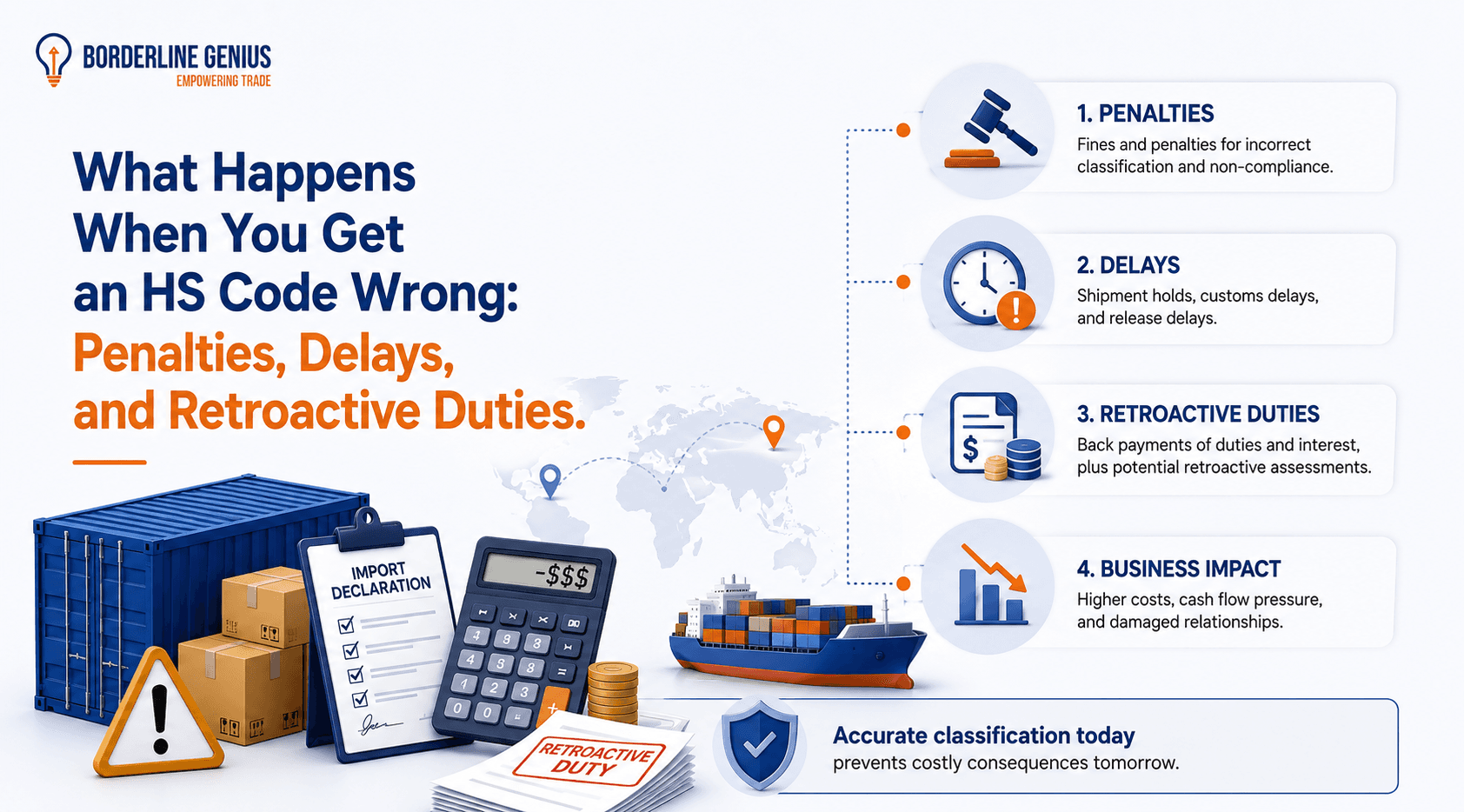 10 min read
What Happens When You Get an HS Code Wrong: Penalties, Delays, and Retroactive Duties
Learn the risks of incorrect HS codes, from delayed shipments and additional duties to licensing issues, failed origin claims, and customs penalties.
Read article