
Tariff vs Duty in Global Trade: What's the Difference?
Understand the difference between tariff vs duty in global trade to know the key purpose they serve, how both are applied, and the impact they create.
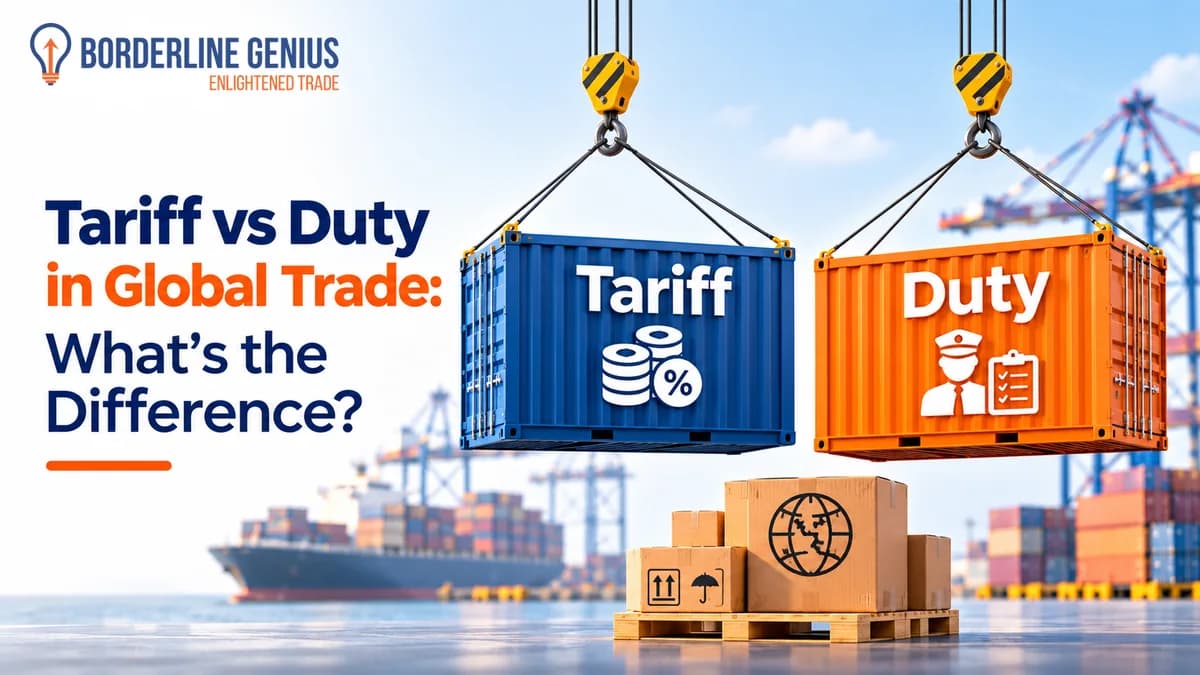
Tariffs and duties are important components of international trade. They influence the cost of moving goods across borders and affect how businesses plan their imports and exports. However, these terms are often used interchangeably. Trade professionals should know the difference between tariff vs duty to use them appropriately, understand their scope, determine their application, and find their impact. Understanding their definitions and differences can also help them identify applicable charges. Thus, it can support accurate import cost calculations and better trade compliance decisions.
What are Tariffs in Global Trade?
A tariff is a tax applied by a government on items traded across international borders, most commonly on imports. It can protect domestic industries from foreign competition and generate government revenue. Tariffs may be calculated as the percentage of a product's value or as a fixed or definite amount/unit.
What is a Duty in International Trade?
In international trade, a duty is a tax on specific goods that a government imposes. Customs duties are primarily collected on imported or exported items. The applicable amount is dependent on factors like product classification, customs value, origin country, and trade regulations. Different duties may apply to the same shipment.
Tariff vs Duty in Trade: Key Differences to Know
Duty vs tariff differ in terms of their scope in the realm of global trade. Besides, their application and purpose lead to the key differences between them. Understanding these differences also requires looking at other important factors like their types and how to calculate them.
Meaning and Scope
A tariff generally refers to a tax or rate imposed on goods entering a country. It is commonly associated with import taxation and trade policy.
On the other hand, duty is a broader term for a government-applied tax or charge. In international trade, customs duty applies to goods that cross borders. The term can further refer to other taxes, such as excise duty, depending on the context.
Application
Tariffs and duties differ on the basis of how they are applied. Tariffs are primarily associated with imported goods. Governments use them to regulate imports and influence the competitiveness of foreign products in domestic markets.
Duties, on the flip side, can apply to both imports and exports. For example, import duty is collected on goods entering a country, while export duty may apply to particular items leaving it. Other duties may apply under particular trade measures.
Purpose
Considering the difference between tariffs vs duties, it is important to look at the purpose of both. Tariffs are often used to protect domestic industries from international competition. They can additionally generate revenue and influence the flow of imported goods.
In contrast, duties serve different purposes based on their type. Customs duties generate government revenue, while anti-dumping as well as countervailing duties address specific unfair trade practices and subsidies.
Types
While differentiating between a tariff vs duty, the types of both should be essentially looked at. Tariffs can be classified according to how they are calculated or their intended purpose. Their common examples include:
-
Ad Valorem tariff, calculated as the percentage of the product's customs value
-
Compound tariff, which combines an ad valorem rate with a specific charge
-
Specific tariff, charged as a fixed value per unit/imported goods
-
Protective tariff, intended to protect domestic industries from foreign competition
On the contrary, duties include several categories based on their application:
-
Basic customs duty, a standard customs duty imposed on imported goods
-
Anti-dumping duty, which is imposed on certain imports sold at unfairly low prices
-
Countervailing duty, applied to offset the effects of some foreign government subsidies
-
Safeguard duty, used to protect domestic industries from a sudden increase in imports
-
Export duty, collected on specified items leaving a country
Calculation
In global trade, tariffs are calculated using the applicable tariff rate and the relevant customs value or quantity of products. For example, an ad valorem tariff of 10% on goods valued at $1,000 results in a tariff of $100.
Considering tariffs vs duties, the latter is calculated according to the specific duty type and applicable regulations. Some are based on customs value, while others use quantity, weight, or other prescribed measures. Additional duties calculated may also apply depending on the product and country.
Tariffs vs Duties: How Do They Impact Trade?
Duties and tariffs differ in terms of their influence on international trade costs. However, their impact depends on the type of charge and the goods involved.
Tariffs impact trade in the following ways:
-
They can increase the cost of bringing foreign goods into a country.
-
Tariffs can affect import costs in global trade, making locally manufactured alternatives more competitive.
-
Businesses may reconsider sourcing countries or suppliers to manage tariff expenses.
-
Importers may pass additional tariff costs on to customers or absorb them through lower profit margins.
Let us now go through the impact of duties:
-
Applicable customs duties add to the expenses associated with importing or exporting goods.
-
Anti-dumping and countervailing duties can create extra costs for specific products.
-
Export duties may influence the volume and pricing of goods sold internationally.
-
Different duty rates can affect the total cost of receiving goods at their destination.
Conclusion
A tariff and duty are closely related but differ in their scope and application. Understanding these distinctions helps identify applicable charges and calculate import costs accurately. Accurate HS code classification and updated trade information are equally important for managing customs obligations and maintaining compliance in global trade.
Frequently asked questions
Navigate Global Trade With Greater Confidence
Access expert guidance to help your organization address complex trade, classification, tariff, and compliance challenges.
Talk to a Trade ExpertRelated articles
Keep reading with more guidance on trade compliance and classification.
 Tariff GeniusTariffsTariff Management4 min read
How Do Tariffs Affect Import Costs in Global Trade?
Learn how tariffs affect import costs, landed costs, and profit margins and find out how businesses can intelligently check tariff rates in global trade.
Read article Tariff GeniusTariff Management7 min read
What is a Tariff and How Does it Work in Global Trade?
Learn what a tariff is, how tariffs work in global trade, its different types, as well as how to calculate it accurately with real-world examples.
Read article Tariff GeniusTariff Management6 min read
What is Tariff Management in Global Trade?
Understand what tariff management in global trade is, along with its key components, how it works, as well as how to improve it effectively.
Read article