
AI for HS Code Classification: How it Works
Learn how AI HS code classification works, from analyzing product information to identifying potential HS codes and validating classification results.
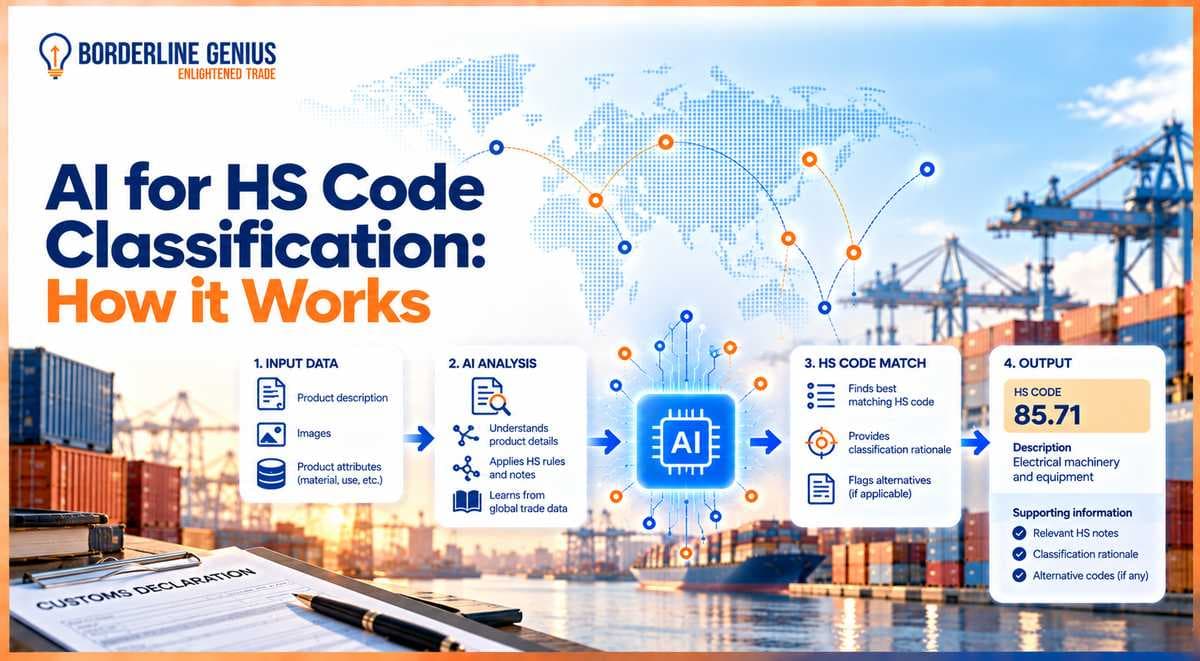
As global trade becomes more complex, businesses need faster and more reliable ways to classify products for customs purposes. Traditional classification often requires extensive research and manual review, particularly when organizations manage extensive product portfolios. AI HS code classification makes use of artificial intelligence to analyze product information and determine potential HS codes based on relevant characteristics and tariff data. It can help reduce repetitive research, improve consistency, and process goods' information with better efficiency. However, AI works best when combined with reliable product data, applicable classification rules, and appropriate human validation. It can then support more accurate and compliant classification decisions.
Is AI Useful for HS Code Classification?
AI is indeed useful for HS classification as it makes the process faster and more consistent. It does so by thoroughly analyzing products' information and identifying relevant tariff categories. Then it supports classification research. Also, it can reduce repetitive manual work while helping trade teams review large product catalogs efficiently.
An Overview of Automated HS Code Classification
Automated HS code classification is a technology-driven process that uses software and AI to analyze product information. Then, it determines potential codes. It can evaluate descriptions, materials, functions, and technical attributes against tariff data and classification rules. Thus, it helps streamline classification, reduce manual research, and manage extensive product catalogs.
How Does AI-Powered HS Code Classification Work?
AI-powered HS code classification works through a structured process that begins with collecting relevant product information. Eventually, it identifies a suitable code for an article. This involves the analysis of product characteristics, comparison with tariff data, application of classification rules, and reviewing results through human validation.
Step 1: Collect and Analyze Product Information
The process of AI HS code classification starts by gathering the information needed to understand a product. Artificial intelligence can analyze product descriptions, technical specifications, materials, functions, intended use, and other relevant attributes. The quality and completeness of this information can directly affect the classification results.
Step 2: Identify Relevant Product Characteristics
AI-based classification evaluates the information to determine which characteristics are important for assigning codes. It can recognize factors such as the product’s primary function, composition, technical features, and intended application. This enables narrowing the HS code classification possibilities and detecting the tariff categories most relevant to the item.
Step 3: Match the Product With HS Classifications
When classifying products through the use of artificial intelligence, the practice compares the identified characteristics with available tariff data as well as potential HS classifications. Multiple possible matches are evaluated through AI HS code classification rather than relying only on an exact keyword match. This helps detect relevant headings and subheadings for further evaluation.
Step 4: Apply Classification Rules
After identifying potential classifications, the system can assess applicable classification rules and tariff notes. This may include the General Rules of Interpretation (GRIs). In addition to these, it can involve going through HS Section Notes and Chapter Notes. These rules help determine which classification is appropriate when more than one option appears relevant.
Step 5: Review and Validate the Result
The final stage of the functioning of automated HS code classification includes reviewing the suggested classification. This is essential for confirming that it is appropriate for the product and relevant tariff requirements.
Note that trade compliance professionals can validate the result, particularly when the item is complex or the classification involves significant regulatory or financial implications.
Automate HS Code Classification with Borderline Genius Inc.
Borderline Genius Inc. assists businesses in streamlining HS code classification with AI-powered technology built for trade compliance. Its HS code classification software, Classification Genius, brings product information, tariff references, and review capabilities into one workflow.
Thus, trade teams can reduce manual effort and improve consistency. Moreover, they can manage classification across large product portfolios with higher efficiency.
Classification Genius for Streamlined Workflows
The artificial intelligence-driven solution, Classification Genius, streamlines product classification workflows by combining AI models, official references, and confidence scores. It also utilizes expert validation to support the process.
Through these capabilities, the HS code classification software helps trade teams:
-
Organize classification research.
-
Review potential HS codes.
-
Manage the respective activities effectively.
In Summary
AI HS code classification works by analyzing product information, finding relevant characteristics, comparing them with tariff data, and assessing applicable classification rules. It then presents potential HS codes for review and validation. This structured process helps trade teams handle classification research efficiently while retaining appropriate human oversight.
Frequently asked questions
Navigate Global Trade With Greater Confidence
Access expert guidance to help your organization address complex trade, classification, tariff, and compliance challenges.
Talk to a Trade ExpertRelated articles
Keep reading with more guidance on trade compliance and classification.
 Classification GeniusHS ClassificationTrade Compliance6 min read
What is HS Code Classification?
Understand HS code classification, how it works, the role of GRIs, Section Notes, Chapter Notes, and Explanatory Notes, as well as common mistakes.
Read article Classification GeniusHS ClassificationTrade Compliance5 min read
HS Code Classification Software: What to Look For
Find out how to choose HS code classification software by assessing key features that can improve classification accuracy, research, and review.
Read article 13 min read
Manual vs. Automated HS Classification: Comparing Cost and Accuracy
Compare manual vs. automated HS classification on cost, accuracy, consistency, auditability, maintenance, and human review in trade compliance.
Read article